Types of Artificial Intelligence
| Institution | Jomo Kenyatta University of Science and Technology |
| Course | Information Technolo... |
| Year | 3rd Year |
| Semester | Unknown |
| Posted By | Jeff Odhiambo |
| File Type | |
| Pages | 3 Pages |
| File Size | 94.78 KB |
| Views | 4240 |
| Downloads | 0 |
| Price: |
Buy Now
 Buy via
whatsapp Buy via
whatsapp
|


Description
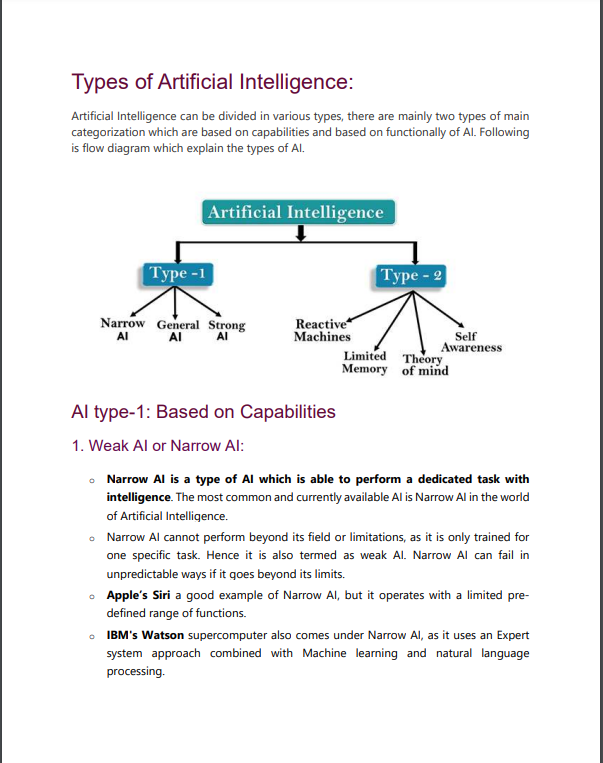
Buy "Types of Artificial Intelligence" now and learn about the diverse and dynamic categorization of AI based on capabilities and functionalities. This comprehensive book delves into the distinctions between Narrow AI, General AI, and Super AI, highlighting how these types of AI perform tasks with varying degrees of intelligence and autonomy. With detailed examples and engaging narratives, you'll explore real-world applications of Narrow AI, such as Apple's Siri and IBM's Watson, and understand the potential and challenges of developing General AI and Super AI.
Discover the fascinating functionalities of AI, including Reactive Machines, Limited Memory, Theory of Mind, and Self-Awareness. The book explains how each type operates, from reactive machines like IBM's Deep Blue to the hypothetical concept of self-awareness AI. With insights into the current state and future possibilities of AI, "Types of Artificial Intelligence" is an essential read for anyone looking to deepen their understanding of AI's diverse landscape and its impact on our world.
Below is the document preview.

Marketing Mix: Price
Trending!
"Price" component of the Marketing Mix refers to the strategy used by businesses to determine the cost of their products or services, ensuring it aligns with their target market, competition, and value proposition. IT companies need to consider factors such as production costs, software licensing, maintenance, and support services when setting prices. The price must reflect the perceived value of the technology, offering a competitive advantage while also considering customer willingness to pay. Pricing models in IT can vary, ranging from subscription-based pricing, pay-per-use, and freemium models, to one-time purchases. The right pricing strategy not only impacts profitability but also customer adoption and retention.
12 Pages
3415 Views
0 Downloads
802.48 KB
Marketing mix: Place
Trending!
"Place" element of the marketing mix refers to the distribution channels through which IT products and services reach consumers. This involves selecting the right platforms for delivering IT solutions, such as online stores, physical retail locations, direct sales teams, or digital marketplaces. IT companies often leverage e-commerce websites, cloud-based services, and partnerships with resellers or distributors to make their products accessible to a global audience. The strategic placement of these products ensures they are readily available to the target market, meeting customer demand through convenient and efficient access points.
12 Pages
3114 Views
0 Downloads
565.87 KB
Marketing Mix: Promotion
Trending!
"Promotion" element of the Marketing Mix refers to the strategies and tactics used to communicate the value and benefits of IT products or services to potential customers. This includes advertising, public relations, digital marketing, and direct selling, all tailored to highlight the technological advantages, features, and innovations of IT solutions. Effective promotion in IT often leverages online platforms, social media, and search engine optimization (SEO) to reach tech-savvy consumers. Additionally, demonstrations, webinars, and trial offers are commonly used to allow potential customers to experience the product's functionality before making a purchase decision.
26 Pages
3794 Views
0 Downloads
999.05 KB
Introduction to Knowledge Based Systems
Knowledge-Based Systems (KBS) are computer programs designed to simulate human expertise and decision-making processes by using a knowledge base and inference engine. The knowledge base consists of facts, rules, and heuristics that represent domain-specific knowledge, while the inference engine applies logical reasoning to derive conclusions or make decisions based on that knowledge. KBS are widely used in fields like medicine, engineering, and finance to assist with complex problem-solving tasks. These systems aim to provide solutions in situations where human expertise is limited or unavailable, enhancing efficiency, consistency, and decision-making accuracy.
441 Views
0 Downloads
1.11 MB
Knowledge Engineering
Knowledge Engineering is the process of designing, building, and managing systems that enable computers to mimic human expertise in specific domains. It involves gathering, organizing, and structuring knowledge from human experts or existing sources, transforming it into a form that can be used by computer systems. This includes creating knowledge bases, designing inference mechanisms, and ensuring that the system can solve real-world problems effectively. Knowledge engineers work closely with domain experts to ensure that the knowledge captured is accurate and relevant. The field plays a crucial role in developing knowledge-based systems (KBS), artificial intelligence applications, and decision support tools that can replicate or augment human decision-making.
736 Views
0 Downloads
815.5 KB
Knowledge Representation
Knowledge representation (KR) is a field of artificial intelligence that focuses on how to formally model information about the world in a way that a computer system can understand, reason, and use to make decisions. It involves the creation of structures, such as graphs, rules, or ontologies, that capture relationships, concepts, and properties of objects in a domain. KR allows machines to simulate human-like reasoning and problem-solving by encoding knowledge in a structured form, facilitating tasks like natural language understanding, expert systems, and machine learning. The goal is to enable intelligent systems to process, infer, and act upon knowledge efficiently and accurately.
451 Views
0 Downloads
1.98 MB
Inference and Knowledge Processing
Inference and knowledge processing involve the use of logical reasoning and computational techniques to derive conclusions or insights from available data and information. Inference refers to the ability to make conclusions based on known facts, rules, or observations, often using deductive or inductive reasoning. Knowledge processing, on the other hand, encompasses the methods of collecting, organizing, analyzing, and interpreting knowledge to solve problems, make decisions, or enhance understanding. Together, these processes are fundamental in fields like artificial intelligence, cognitive science, and data analytics, enabling systems to simulate human-like reasoning and decision-making.
762 Views
0 Downloads
365.27 KB
Logic programming
Logic programming is a paradigm of programming based on formal logic, where programs are written as a set of logical statements or rules. These statements express relationships between objects and conditions, and the program operates by applying logical inference to derive conclusions from these facts and rules. The primary language used in logic programming is Prolog, which allows for declarative problem-solving by focusing on what the problem is, rather than how to solve it. The system automatically searches for solutions through backtracking, making it particularly useful in fields like artificial intelligence, natural language processing, and expert systems.
750 Views
0 Downloads
192.29 KB
Reasoning and Uncertainty
Trending!
Reasoning refers to the mental process of drawing conclusions, making decisions, or solving problems based on available information. It involves evaluating evidence, considering alternatives, and forming judgments. Uncertainty, on the other hand, arises when there is a lack of complete knowledge or clarity, making it difficult to predict outcomes or make definitive decisions. In reasoning, uncertainty can influence the confidence and reliability of conclusions, often requiring individuals to incorporate probabilistic thinking, assumptions, or estimation in the absence of perfect information. Balancing reasoning with an understanding of uncertainty is crucial for effective decision-making in complex or ambiguous situations.
3148 Views
0 Downloads
371 KB
Automated Reasoning
Automated reasoning is a field of artificial intelligence and mathematical logic focused on developing systems and algorithms that can automatically perform logical deductions and proofs. It involves using computational methods to determine the validity of statements, derive conclusions from premises, and solve problems that traditionally require human reasoning. Automated reasoning techniques are applied in various domains, such as formal verification of software and hardware systems, proving mathematical theorems, and optimizing decision-making processes in fields like robotics and artificial intelligence. The goal is to enhance efficiency, accuracy, and scalability in reasoning tasks.
811 Views
0 Downloads
521.5 KB