Means-Ends Analysis in AI
| Institution | Jomo Kenyatta University of Science and Technology |
| Course | Information Technolo... |
| Year | 3rd Year |
| Semester | Unknown |
| Posted By | Jeff Odhiambo |
| File Type | |
| Pages | 4 Pages |
| File Size | 111.9 KB |
| Views | 4803 |
| Downloads | 0 |
| Price: |
Buy Now
 Buy via
whatsapp Buy via
whatsapp
|


Description
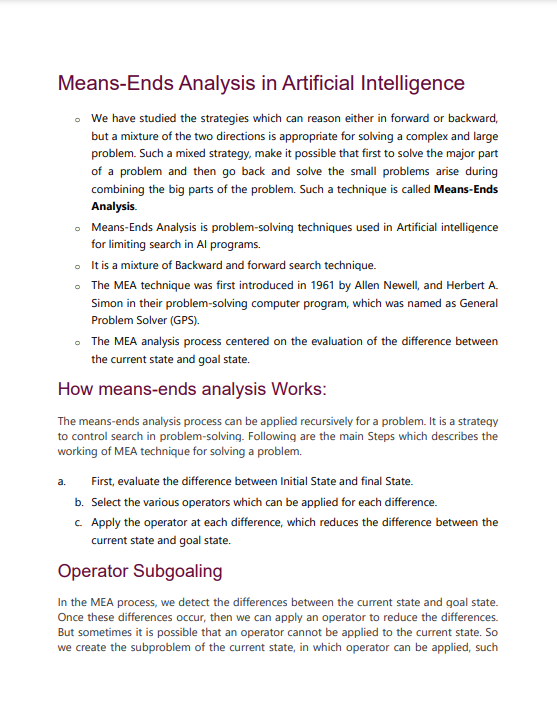
Buy "Means-Ends Analysis in AI" now and learn how to solve complex and large problems with a mixture of forward and backward reasoning techniques. This comprehensive book introduces the concept of Means-Ends Analysis (MEA), a problem-solving strategy that limits search in AI programs by first solving major parts of a problem and then addressing smaller subproblems as they arise. With practical examples and detailed explanations, you'll explore how MEA works by evaluating differences between the current state and goal state, and applying operators to reduce these differences, making it accessible to both beginners and seasoned professionals.
Dive into the fascinating world of Operator Subgoaling, where operators are selected, and subgoals are set up to establish the preconditions for solving a problem. The book covers the essential algorithm for MEA and provides real-world examples to illustrate its application in various AI-driven tasks. "Means-Ends Analysis in AI" is an essential read for anyone looking to deepen their understanding of AI's problem-solving techniques and apply these methods to tackle real-world challenges effectively.
Below is the document preview.

BIT 2319: Artificial Intelligence
Institution: Jomo Kenyatta University of Science and Technology
Year: 2021/2022
Semester: 3rd Year, 1st Semester (3.1)
BIT 2319: Artificial Intelligence
Institution: Jomo Kenyatta University of Science and Technology
Year: 2021/2022
Semester: 3rd Year, 1st Semester (3.1)
BIT 2319: Artificial Intelligence
Institution: Jomo Kenyatta University of Science and Technology
Year: 2021/2022
Semester: 3rd Year, 1st Semester (3.1)
BIT 2319: Artificial Intelligence
Institution: Jomo Kenyatta University of Science and Technology
Year: 2021/2022
Semester: 3rd Year, 1st Semester (3.1)
BIT 2319: Artificial Intelligence
Institution: Jomo Kenyatta University of Science and Technology
Year: 2022/2023
Semester: 3rd Year, 1st Semester (3.1)
BIT 2319: Artificial Intelligence
Institution: Jomo Kenyatta University of Science and Technology
Year: 2022/2023
Semester: 3rd Year, 1st Semester (3.1)
BIT 2319: Artificial Intelligence
Institution: Jomo Kenyatta University of Science and Technology
Year: 2022/2023
Semester: 3rd Year, 1st Semester (3.1)
Review of Data Structures
Trending!
A review of data structures involves examining various ways to organize, store, and manage data efficiently for different computational tasks. It covers fundamental structures like arrays, linked lists, stacks, and queues, as well as more complex ones like trees, graphs, and hash tables. Each data structure has unique characteristics, advantages, and use cases, influencing factors such as time complexity, memory usage, and ease of implementation. The review typically includes analyzing operations like insertion, deletion, searching, and sorting, as well as their efficiency in different scenarios. Understanding data structures is crucial for optimizing algorithms and improving software performance.
76 Pages
3306 Views
0 Downloads
2.02 MB
Introduction to Artificial Intelligence
Introduction to Artificial Intelligence (AI) explores the development of computer systems that can perform tasks requiring human-like intelligence, such as problem-solving, learning, reasoning, and decision-making. AI encompasses various subfields, including machine learning, natural language processing, computer vision, and robotics. It relies on algorithms and models that enable computers to analyze data, recognize patterns, and make predictions or decisions with minimal human intervention. AI is widely used in industries such as healthcare, finance, and automation, transforming how technology interacts with the world. Understanding AI principles is essential for leveraging its potential and addressing ethical and societal challenges.
493 Views
0 Downloads
3.61 MB
AI and the Design of Agents
Trending!
"I and the Design of Agents" explores the relationship between human intelligence and the creation of artificial agents capable of autonomous decision-making. It examines how human cognition, reasoning, and problem-solving inspire the development of AI-driven agents that can perceive their environment, process information, and take actions to achieve specific goals. This topic delves into agent architectures, decision-making models, and learning mechanisms that enable adaptability and interaction with dynamic environments. Understanding this connection helps in designing intelligent systems that can collaborate with humans, solve complex tasks, and function effectively in real-world applications.
3411 Views
0 Downloads
4.34 MB