Artificial Intelligence
| Institution | Jomo Kenyatta University of Science and Technology |
| Course | Information Technol... |
| Year | 3rd Year |
| Semester | Unknown |
| Posted By | Jeff Odhiambo |
| File Type | |
| Pages | 10 Pages |
| File Size | 175.16 KB |
| Views | 772 |
| Downloads | 2 |
| Price: |
Buy Now
 Buy via
whatsapp Buy via
whatsapp
|


Description
Artificial Intelligence (AI) refers to the simulation of human intelligence in machines designed to perform tasks that typically require human cognition, such as learning, problem-solving, perception, and decision-making. It encompasses various subfields, including machine learning, natural language processing, computer vision, and robotics, allowing systems to analyze data, recognize patterns, and adapt to new inputs. AI can range from narrow AI, which excels in specific tasks, to general AI, which aims to replicate the full breadth of human cognitive abilities. The growing influence of AI has the potential to transform industries, enhance efficiency, and open new possibilities in diverse fields like healthcare, finance, and automation.
Below is the document preview.
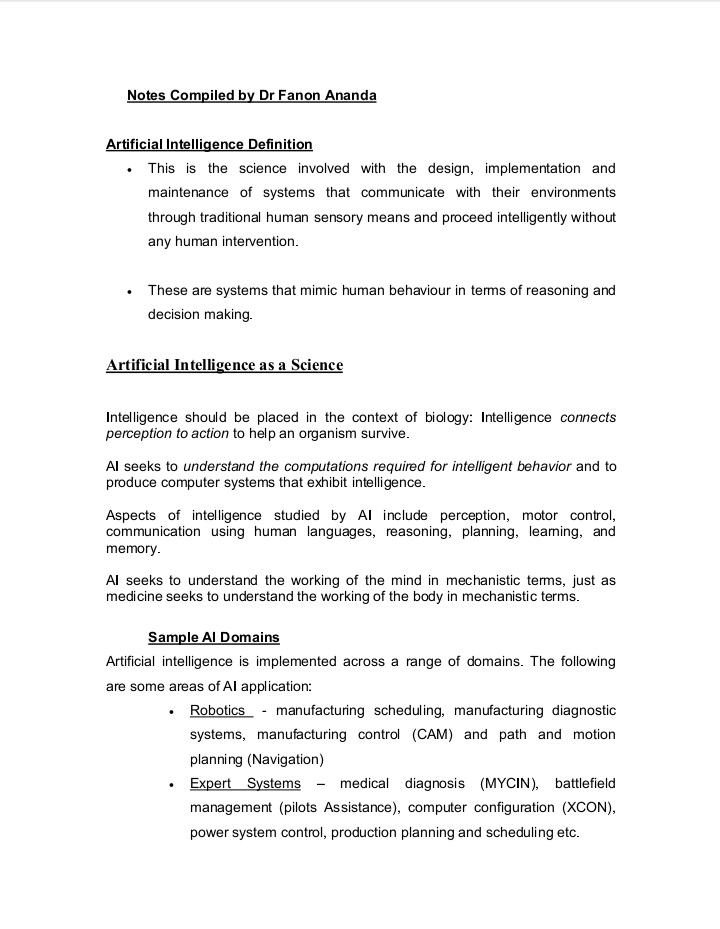

Introduction to Artificial Intelligence
Introduction to Artificial Intelligence (AI) explores the development of computer systems that can perform tasks requiring human-like intelligence, such as problem-solving, learning, reasoning, and decision-making. AI encompasses various subfields, including machine learning, natural language processing, computer vision, and robotics. It relies on algorithms and models that enable computers to analyze data, recognize patterns, and make predictions or decisions with minimal human intervention. AI is widely used in industries such as healthcare, finance, and automation, transforming how technology interacts with the world. Understanding AI principles is essential for leveraging its potential and addressing ethical and societal challenges.
491 Views
0 Downloads
3.61 MB
Agents in Artificial Intelligence
Trending!
In artificial intelligence (AI), an agent refers to an entity that perceives its environment through sensors and acts upon that environment using actuators, often with the goal of achieving specific objectives. Agents can range from simple programs designed for tasks like web searching or data analysis to more complex systems, such as autonomous robots or intelligent virtual assistants, that adapt and learn from their interactions. They can operate based on predefined rules or learn from experience, employing techniques like machine learning and reinforcement learning to improve their performance over time. AI agents are central to many applications, from decision-making in dynamic environments to human-computer interaction.
5 Pages
3501 Views
1 Downloads
157.6 KB
Baye's theorem in Artificial Intelligence
Trending!
Bayes' Theorem in Artificial Intelligence (AI) is a fundamental principle used for probabilistic reasoning and decision-making under uncertainty. It describes how to update the probability of a hypothesis based on new evidence, using prior knowledge. Mathematically, it is expressed as P(H|E) = [P(E|H) * P(H)] / P(E), where P(H|E) is the probability of hypothesis H given evidence E, P(E|H) is the likelihood of observing E given H, P(H) is the prior probability of H, and P(E) is the overall probability of E. In AI, Bayes' Theorem is widely applied in areas like spam filtering, medical diagnosis, machine learning, and natural language processing to make data-driven predictions and improve decision-making.
5 Pages
4221 Views
0 Downloads
305.54 KB
Artificial Intelligence course outline
An Artificial Intelligence (AI) course typically covers fundamental concepts, techniques, and applications of AI. It begins with an introduction to AI, its history, and its impact on various industries. Core topics include machine learning, deep learning, natural language processing, computer vision, robotics, and expert systems. Students learn about algorithms such as neural networks, decision trees, and reinforcement learning, along with ethical considerations and AI's societal impact. Practical components may involve programming with Python, using AI frameworks like TensorFlow or PyTorch, and developing real-world AI applications. The course concludes with projects or case studies to apply learned concepts.
2 Pages
410 Views
0 Downloads
85.83 KB
Introduction to Artificial Intelligence
Introduction to Artificial Intelligence (AI) explores the principles, techniques, and applications of intelligent systems that mimic human cognition. It covers fundamental topics such as machine learning, neural networks, natural language processing, and computer vision. AI aims to enable machines to solve complex problems, make decisions, and adapt to new information. The field has diverse applications, including healthcare, finance, robotics, and autonomous systems. As AI continues to evolve, ethical considerations, bias mitigation, and responsible AI development remain crucial challenges. This introduction provides a foundation for understanding how AI is transforming industries and shaping the future of technology.
491 Views
0 Downloads
309.5 KB
What is Artificial Intelligence
Trending!
Artificial Intelligence (AI) is a branch of computer science that focuses on creating machines capable of performing tasks that typically require human intelligence. These tasks include problem-solving, learning, reasoning, perception, and language understanding. AI can be categorized into narrow AI, which is designed for specific tasks like speech recognition, and general AI, which aims to replicate human cognitive abilities. It incorporates techniques such as machine learning, neural networks, and natural language processing to enhance automation and decision-making. AI is transforming industries like healthcare, finance, and robotics, driving innovation and efficiency in various domains.
5 Pages
3544 Views
0 Downloads
150.94 KB
Applications of Artificial intelligence
Trending!
Artificial Intelligence (AI) is widely applied across various industries, revolutionizing how tasks are performed. In healthcare, AI aids in disease diagnosis, drug discovery, and personalized treatment plans. In finance, it enhances fraud detection, risk assessment, and algorithmic trading. AI-driven automation boosts efficiency in manufacturing and supply chains. In customer service, AI chatbots provide instant support, while in marketing, AI optimizes ad targeting and consumer insights. Autonomous vehicles, smart assistants, and robotics showcase AI's impact on daily life. Additionally, AI is crucial in cybersecurity, climate modeling, and scientific research, making it an essential tool for innovation and problem-solving.
4 Pages
3979 Views
0 Downloads
244.68 KB
History of Artificial Intelligence
Trending!
The history of Artificial Intelligence (AI) dates back to ancient times, with myths of mechanical beings. However, modern AI began in the 1950s when Alan Turing proposed the concept of machine intelligence and developed the Turing Test. In 1956, the Dartmouth Conference marked AI's formal birth. Early AI research focused on symbolic reasoning and problem-solving but faced challenges due to limited computing power. The 1980s saw the rise of expert systems, and in the 1990s, machine learning gained traction. The 21st century brought deep learning, big data, and powerful neural networks, leading to breakthroughs in natural language processing, computer vision, and autonomous systems. Today, AI continues to evolve, transforming industries and daily life.
4 Pages
4346 Views
0 Downloads
211.64 KB
Knowledge-based Agent in Artificial Intelligence
Trending!
A knowledge-based agent in Artificial Intelligence (AI) is a system that uses a structured knowledge base to make decisions, solve problems, and interact with its environment intelligently. It consists of a knowledge base, which stores facts and rules, and an inference engine that applies logical reasoning to derive conclusions. These agents can learn from past experiences, update their knowledge, and make informed decisions. They are widely used in expert systems, medical diagnosis, robotics, and automated decision-making. By combining symbolic reasoning with machine learning, knowledge-based agents enhance AI's ability to handle complex tasks requiring logic, inference, and domain expertise.
5 Pages
3678 Views
1 Downloads
128.98 KB
Propositional Logic in Artificial Intelligence
Trending!
Propositional Logic in Artificial Intelligence (AI) is a formal system used to represent and reason about facts and relationships in a structured and unambiguous way. It consists of propositions, which are statements that can be either true or false, and logical connectives such as AND, OR, NOT, IMPLICATION, and BICONDITIONAL. In AI, propositional logic is used for knowledge representation, automated reasoning, and decision-making. It enables inference through rules of deduction, such as Modus Ponens and Resolution, allowing AI systems to derive new knowledge from existing facts. However, while propositional logic is useful for simple reasoning tasks, it lacks expressiveness for handling complex domains involving variables, quantifiers, or uncertainty, which are addressed by more advanced logical systems like First-Order Logic and Probabilistic Logic.
7 Pages
4009 Views
1 Downloads
214.07 KB