 Join Our WhatsApp Channel for Updates!
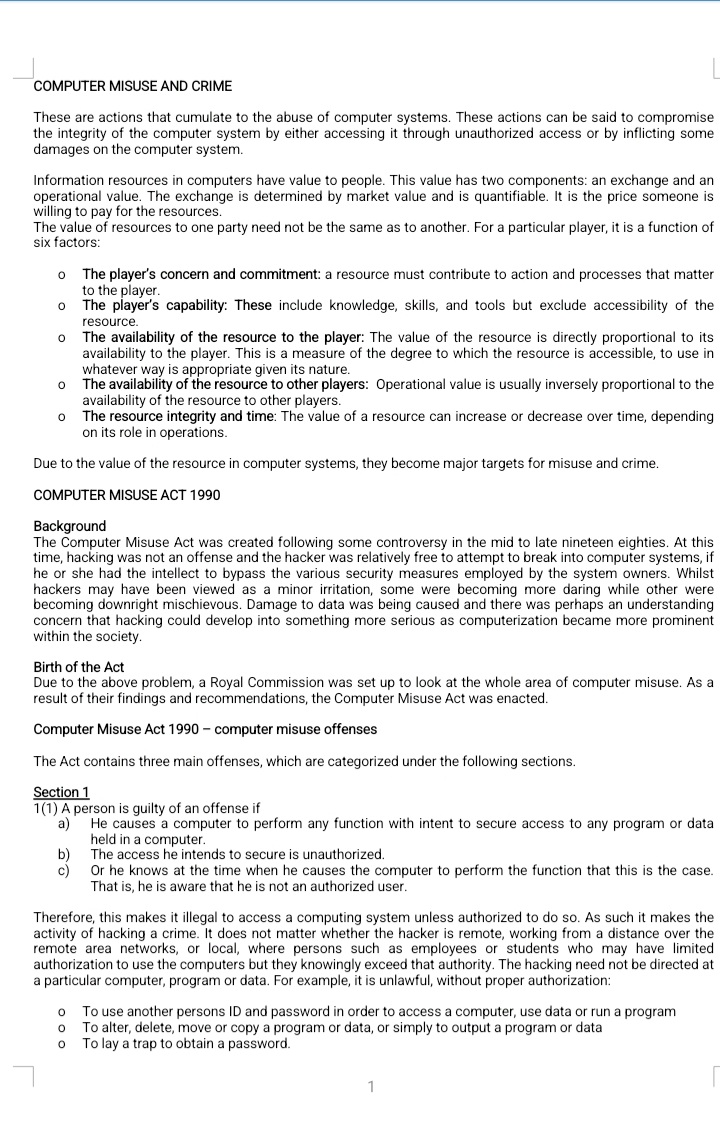
Computer Misuse and crime
| Institution | Jomo Kenyatta University of Science and Technology |
| Course | Information Technol... |
| Year | 4th Year |
| Semester | Unknown |
| Posted By | Jeff Odhiambo |
| File Type | doc |
| Pages | |
| File Size | 62.5 KB |
| Views | 3015 |
| Downloads | 0 |
| Price: |
Buy Now
 Buy via
whatsapp Buy via
whatsapp
|


Description
Computer misuse and crime refer to illegal activities involving computers, networks, or digital systems to commit offenses such as hacking, fraud, identity theft, and malware distribution. These crimes exploit vulnerabilities in technology for unauthorized access, data breaches, financial theft, or disruption of services. Common examples include phishing attacks, ransomware, and cyberstalking. Governments and organizations implement cybersecurity measures and legal frameworks, such as the Computer Misuse Act, to prevent and penalize these offenses, ensuring digital safety and integrity.
Below is the document preview.

Computer system security
Computer system security refers to the protection of computer systems and networks from unauthorized access, data breaches, cyberattacks, and other threats that could compromise confidentiality, integrity, and availability. It involves implementing measures such as encryption, firewalls, antivirus software, multi-factor authentication, and intrusion detection systems to safeguard sensitive information. Security practices also include regular updates, vulnerability assessments, and user awareness training to mitigate risks. With the increasing reliance on digital systems, cybersecurity is essential for protecting personal data, business operations, and critical infrastructure from cyber threats like malware, phishing, and hacking attempts.
257 Pages
462 Views
1 Downloads
2.78 MB
AI Course Outline
Trending!
An AI course outline typically covers foundational concepts, machine learning techniques, and real-world applications. It begins with an introduction to AI, covering history, types, and ethical considerations. The course then explores machine learning (supervised, unsupervised, and reinforcement learning), deep learning (neural networks, CNNs, RNNs), and natural language processing (NLP). It includes hands-on projects using tools like Python, TensorFlow, or PyTorch. Advanced topics may include computer vision, robotics, and AI ethics. The course concludes with AI deployment, industry trends, and a capstone project to reinforce learning.
2 Pages
3248 Views
0 Downloads
85.83 KB
Research methodology
Research methodology refers to the systematic process of designing, conducting, and analyzing research to obtain reliable and valid results. It includes selecting appropriate research methods, such as qualitative, quantitative, or mixed approaches, based on the study's objectives. Key components involve defining the research problem, formulating hypotheses, choosing data collection techniques (e.g., surveys, experiments, observations), and determining data analysis methods. The methodology ensures the study's credibility, reproducibility, and ethical integrity while aligning with academic or industry standards.
61 Pages
479 Views
0 Downloads
1.16 MB
Marketing Environment
Trending!
The marketing environment refers to the external and internal factors that influence a company's ability to develop and maintain successful customer relationships. It consists of the microenvironment, which includes stakeholders such as customers, competitors, suppliers, intermediaries, and the company itself, and the macroenvironment, which encompasses broader forces like economic, social, technological, political, legal, and environmental trends. Businesses must continuously monitor and adapt to these dynamic factors to stay competitive, meet consumer needs, and achieve long-term success.
5 Pages
3084 Views
0 Downloads
501.45 KB
Principles of marketing
The Principles of Marketing focus on understanding customer needs and creating value through strategic product, price, place, and promotion decisions. It involves market research, segmentation, targeting, and positioning to effectively reach and satisfy consumers. Businesses develop marketing strategies based on consumer behavior, competitive analysis, and branding to build strong relationships and drive sales. Ethical and sustainable marketing practices are also emphasized to ensure long-term success. Digital marketing, social media, and data analytics have become essential in modern marketing, enabling businesses to personalize their approach and engage with a global audience.
4 Pages
646 Views
0 Downloads
311 KB
Introduction to Marketing
Introduction to Marketing is the study of how businesses create, communicate, and deliver value to customers while building strong relationships. It covers fundamental concepts such as market research, consumer behavior, branding, pricing, distribution, and promotional strategies. Marketing involves understanding customer needs, segmenting the market, and positioning products effectively to gain a competitive advantage. In today’s digital age, it also includes online marketing, social media, and data analytics. By mastering marketing principles, businesses can attract and retain customers, drive sales, and achieve long-term success in a dynamic marketplace.
4 Pages
339 Views
0 Downloads
241.64 KB
Marketing Information Management
Trending!
Marketing Information Management (MIM) refers to the process of collecting, analyzing, storing, and utilizing data to support marketing decision-making. It involves gathering information about customers, competitors, market trends, and business performance to develop effective marketing strategies. MIM ensures that accurate and relevant data is available for segmentation, targeting, and positioning, helping businesses understand consumer needs and preferences. With advancements in technology, MIM incorporates digital tools, customer relationship management (CRM) systems, and data analytics to improve marketing efficiency. Effective marketing information management enhances decision-making, reduces risks, and enables companies to respond quickly to market changes.
3025 Views
0 Downloads
886.29 KB
Consumer Behavior
Trending!
Consumer behavior refers to the study of how individuals, groups, or organizations select, purchase, use, and dispose of goods, services, experiences, or ideas to satisfy their needs and wants. It examines psychological, social, cultural, and economic factors that influence buying decisions, including motivations, perceptions, attitudes, and preferences. Businesses and marketers analyze consumer behavior to develop effective marketing strategies, improve customer experience, and predict market trends. Understanding consumer behavior helps companies tailor their products, pricing, promotions, and distribution channels to meet consumer expectations and drive sales.
21 Pages
3179 Views
0 Downloads
864.84 KB
Marketing Strategy
Trending!
A marketing strategy is a comprehensive plan that outlines how a business will reach its target audience, promote its products or services, and achieve its marketing goals. It involves market research, competitive analysis, and the identification of key customer segments to create effective messaging and positioning. A strong marketing strategy integrates various channels, such as digital marketing, social media, content marketing, and traditional advertising, to build brand awareness and drive sales. It also includes pricing, distribution, and customer engagement tactics to differentiate the brand from competitors and maximize profitability. Regular analysis and adjustments ensure the strategy remains effective in a dynamic market environment.
27 Pages
2658 Views
0 Downloads
881.2 KB
Product
A product refers to a software solution, hardware device, or service that addresses specific customer needs or challenges. These products can range from cloud computing services, cybersecurity tools, and enterprise software to cutting-edge technologies like artificial intelligence and machine learning platforms. Marketing an IT product focuses on demonstrating its value, scalability, security, and ease of integration into existing systems. Key strategies often include highlighting features such as cost-effectiveness, innovation, and the potential for improving business performance, while emphasizing strong customer support and regular updates to maintain long-term value.
27 Pages
1525 Views
0 Downloads
1.14 MB