Artificial Intelligence course outline
| Institution | Jomo Kenyatta University of Science and Technology |
| Course | Information Technol... |
| Year | 3rd Year |
| Semester | Unknown |
| Posted By | Jeff Odhiambo |
| File Type | |
| Pages | 2 Pages |
| File Size | 61.22 KB |
| Views | 358 |
| Downloads | 0 |
| Price: |
Buy Now
 Buy via
whatsapp Buy via
whatsapp
|


Description
An Artificial Intelligence (AI) course typically covers fundamental concepts, techniques, and applications of AI. The syllabus often includes an introduction to AI, search algorithms, knowledge representation, machine learning, neural networks, and natural language processing. Advanced topics may cover deep learning, reinforcement learning, computer vision, and ethical considerations in AI. The course involves theoretical lectures, hands-on programming exercises (using languages like Python and frameworks like TensorFlow or PyTorch), and real-world AI applications in fields such as healthcare, finance, and robotics. Assessments may include quizzes, coding assignments, and project-based learning to develop AI models.
Below is the document preview.
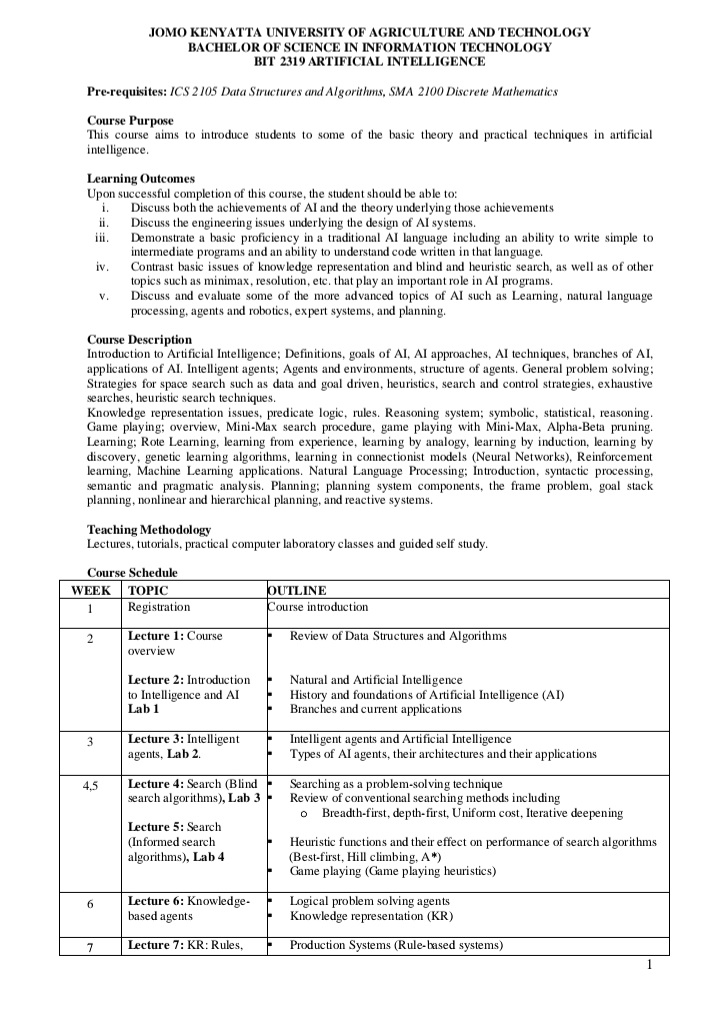

Artificial Intelligence course outline
An Artificial Intelligence (AI) course typically covers fundamental concepts, techniques, and applications of AI. It begins with an introduction to AI, its history, and its impact on various industries. Core topics include machine learning, deep learning, natural language processing, computer vision, robotics, and expert systems. Students learn about algorithms such as neural networks, decision trees, and reinforcement learning, along with ethical considerations and AI's societal impact. Practical components may involve programming with Python, using AI frameworks like TensorFlow or PyTorch, and developing real-world AI applications. The course concludes with projects or case studies to apply learned concepts.
2 Pages
409 Views
0 Downloads
85.83 KB