Introduction to SQL
| Institution | Jomo Kenyatta University of Science and Technology |
| Course | Information Technol... |
| Year | 3rd Year |
| Semester | Unknown |
| Posted By | Jeff Odhiambo |
| File Type | |
| Pages | 6 Pages |
| File Size | 620.17 KB |
| Views | 432 |
| Downloads | 0 |
| Price: |
Buy Now
 Buy via
whatsapp Buy via
whatsapp
|


Description
Introduction to SQL (Structured Query Language) provides a foundation for managing and manipulating relational databases. SQL is a standardized language used to create, retrieve, update, and delete data within databases. It consists of various commands categorized into Data Definition Language (DDL), Data Manipulation Language (DML), Data Control Language (DCL), and Transaction Control Language (TCL). SQL enables users to define database structures, query data efficiently, and enforce security through permissions and access controls. Widely used in applications ranging from small-scale software to enterprise-level systems, SQL is essential for database administrators, developers, and data analysts.
Below is the document preview.
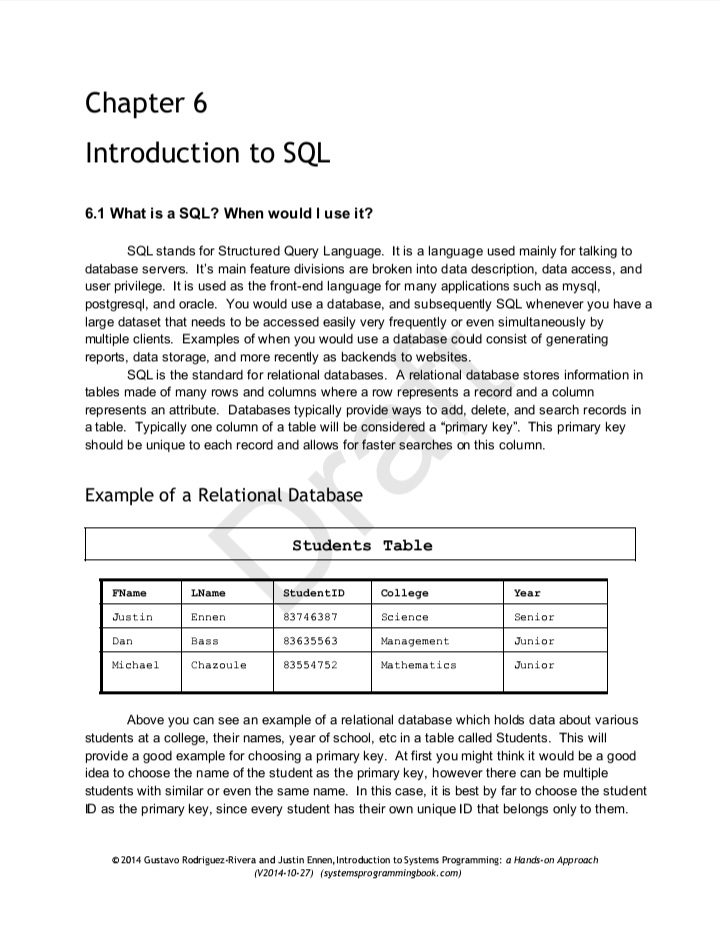

Introduction to SQL
Trending!
RDBMS is the basis for SQL, and for all modern database systems such as MS SQL Server, IBM DB2, Oracle, MySQL, and Microsoft Access. The data in RDBMS is stored in database objects called tables. A table is a collection of related data entries and it consists of columns and rows.
2927 Views
1 Downloads
181.5 KB
Introduction to SQL Notes
Trending!
Although SQL is an ANSI (American National Standards Institute) standard, there are many different versions of the SQL language. However, to be compliant with the ANSI standard, they all support at least the major commands (such as SELECT, UPDATE, DELETE, INSERT, WHERE) in a similar manner.
93 Pages
2165 Views
0 Downloads
971.46 KB