CMT 300: DATA COMMUNICATION
| Institution | Catholic University of Eastern Africa |
| Course | BACHELOR OF COMPUTER... |
| Year | 1st Year |
| Semester | Unknown |
| Posted By | stephen oyake rabilo |
| File Type | |
| Pages | 21 Pages |
| File Size | 1.48 MB |
| Views | 618 |
| Downloads | 0 |
| Price: |
Buy Now
 Buy via
whatsapp Buy via
whatsapp
|


Description
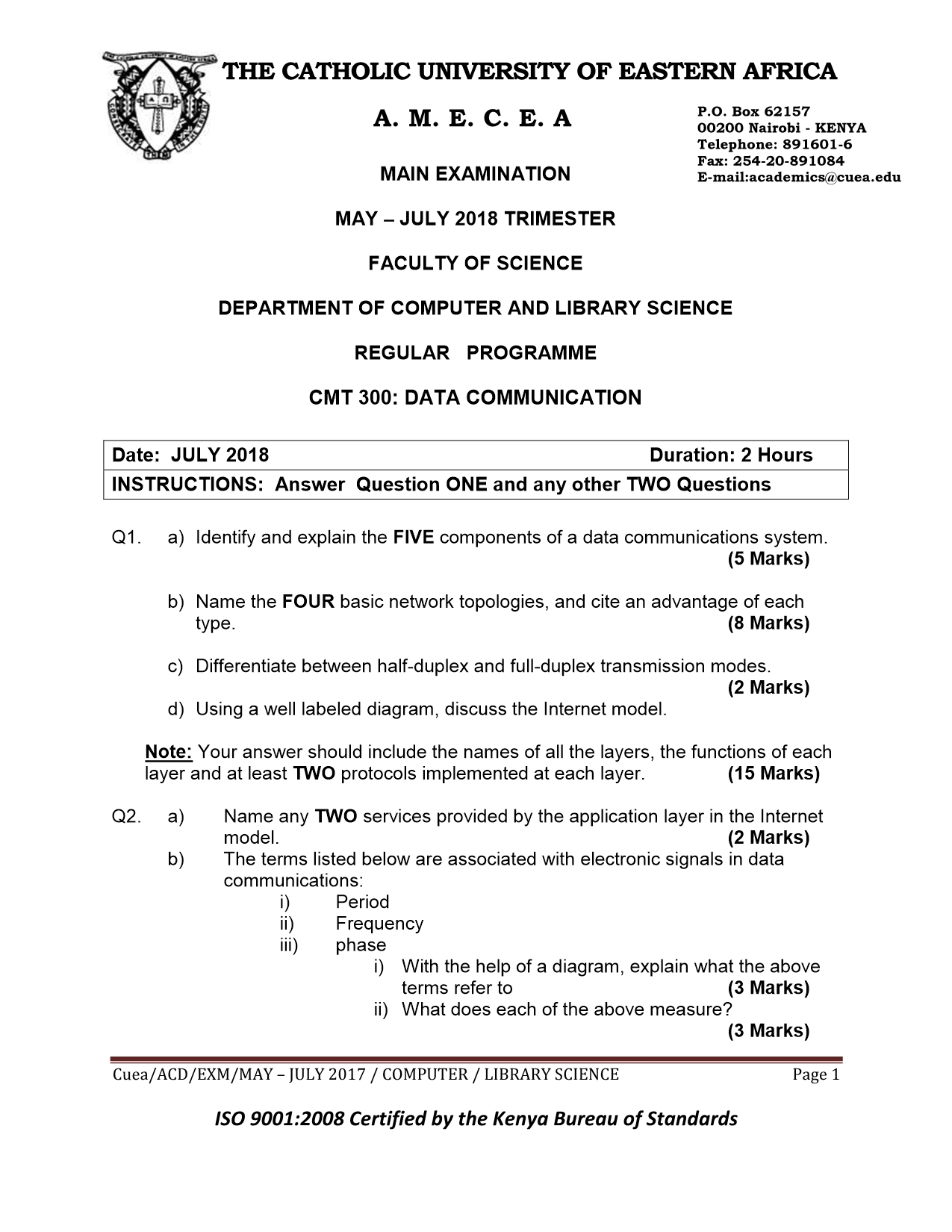
Q1. a) Identify and explain the FIVE components of a data communications system.
(5 Marks)
b) Name the FOUR basic network topologies, and cite an advantage of each type. (8 Marks)
c) Differentiate between half-duplex and full-duplex transmission modes.(2 Marks)
d) Using a well labeled diagram, discuss the Internet model.
Note: Your answer should include the names of all the layers, the functions of each
layer and at least TWO protocols implemented at each layer. (15 Marks)
Q2. a) Name any TWO services provided by the application layer in the Internet model. (2 Marks)
b) The terms listed below are associated with electronic signals in data communications:
i) Period
ii) Frequency
iii) phase
i) With the help of a diagram, explain what the above terms refer to (3 Marks)
ii) What does each of the above measure?
(3 Marks)
Below is the document preview.

CMT 438: ETHICAL HACKING
Q1.
a) Define the following terms as used in Ethical Hacking (5 Marks)
i. Hacking
ii. Ethical Hacking
iii. Ping Sweep
iv. Inverse TCP Flag Scanning
v. Footprinting
b) What is the overall purpose of the footprinting and reconnaissance and list the
major objectives of this phase (5 Marks)
c) List any three skills that a good ethical hacker should possess (3 Marks)
d) List and Explain the Vulnerability Score system as applicable in Ethical Hacking
(4 Marks)
2 Pages
551 Views
0 Downloads
124.29 KB
CMT 311:Fundamentals of Software Engineering
Software Crisis
Software Myths
What is Software Engineering
Evolution of Software Engineering
State-of-art in Software Engineering
567 Pages
621 Views
0 Downloads
11.52 MB
CMT 311: FUNDAMENTALS OF SOFTWARE ENGINEERING QUESTIONS & ANSWERS.
Q1.
a) The Software Development Life Cycle (SDLC) is a process used to design, develop, test, and maintain software applications. It consists of several stages including planning, analysis, design, development, testing, deployment, and maintenance. During each stage, the development team performs various
activities such as gathering requirements, creating a design, coding, testing, and documenting the software.
b) Two important documents in software engineering process are:
Software Requirements Specification (SRS): It is a document that captures the requirements for a software application. It includes details such as user requirements, functional requirements, performance requirements, and other specifications. Software Design Document (SDD): It is a document that describes the architecture, design, and
implementation details of a software application. It includes details such as system architecture, data flow, user interface design, and other technical specifications.
7 Pages
641 Views
0 Downloads
90.37 KB
CMT 311: FUNDAMENTALS OF SOFTWARE ENGINEERING QUESTIONS & ANSWERS
Q1a. Explain any TWO advantages of sketching a proposed user interface as opposed to using a drawing program or building a prototype. (4 Marks)
A: Two advantages of sketching a proposed user interface are that it is quick and inexpensive. Sketching allows for easy ideation and exploration of different design options without the need for specialized software or technical skills. It also provides an opportunity to get feedback early in the design process, helping to identify and address potential issues before investing significant resources in building a prototype.
9 Pages
330 Views
0 Downloads
96.14 KB
CMT 316: HUMAN COMPUTER INTERFACE
This course is an introduction to the fundamentals of human-computer interaction, user interface design, and usability analysis.
Students will learn principles and guidelines for usability, quantitative and qualitative analysis methods, and apply them through critiques of existing interfaces and development of new ones.
Topics covered will also include cognitive models, task analysis, psychology, experimental design, and prototyping and evaluating methods.
493 Pages
588 Views
0 Downloads
11.54 MB
GS 101: COMMUNICATION SKILLS PAST PAPER
Institution: Catholic University of Eastern Africa
Year: 2016/2017
Semester: 1st Year, 2nd Semester (1.2)