Motion capture and Physically based animation of characters
| Institution | Jomo Kenyatta University of Science and Technology |
| Course | Information Technol... |
| Year | 3rd Year |
| Semester | Unknown |
| Posted By | Jeff Odhiambo |
| File Type | |
| Pages | No pages found |
| File Size | 603.79 KB |
| Views | 500 |
| Downloads | 0 |
| Price: |
Buy Now
 Buy via
whatsapp Buy via
whatsapp
|


Description
Capture-based animation involves recording the movements of real-world objects or actors and translating them into digital characters using motion capture (mo-cap) technology. This process captures the actor’s movements through sensors placed on their body, allowing the animation system to recreate these motions in a virtual environment. Physically-based animation (PBA), on the other hand, simulates real-world physics to produce realistic motion of characters and objects. It uses principles like gravity, momentum, and material properties to drive the movement, resulting in animations that behave according to physical laws rather than being manually keyed by artists. When combined, both techniques allow for more lifelike and dynamic character animations in digital media.
Below is the document preview.
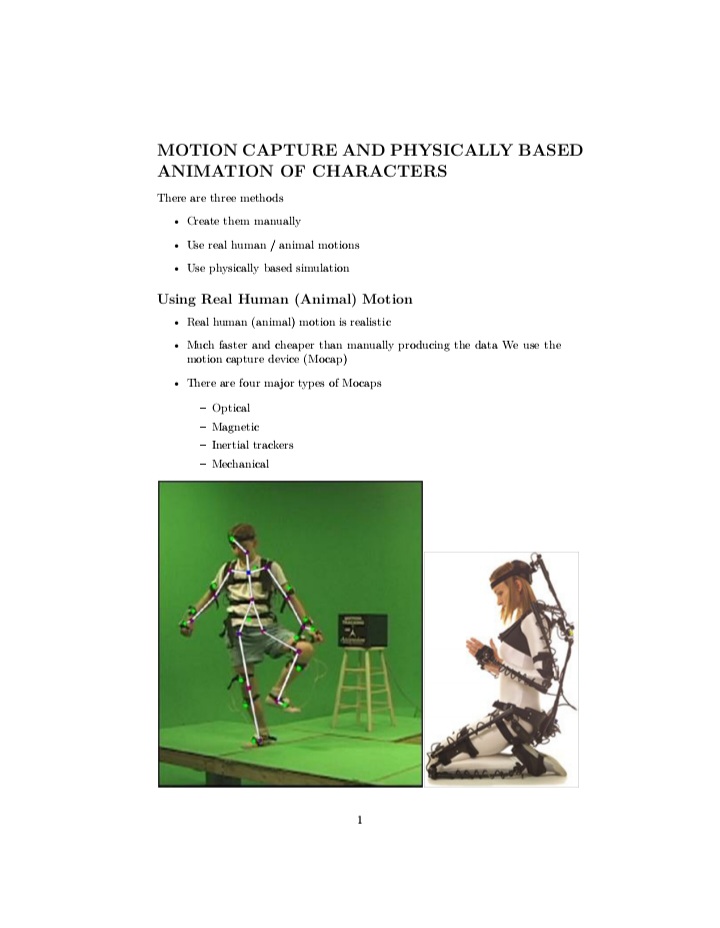

Lesson 9 Computer Animation - MOTION CAPTURE AND PHYSICALLY BASED ANIMATION OF CHARACTERS
Trending!
There are three methods
• Create them manually
• Use real human / animal motions
• Use physically based simulation
Using Real Human (Animal) Motion
• Real human (animal) motion is realistic
• Much faster and cheaper than manually producing the data We use the
motion capture device (Mocap)
• There are four major types of Mocaps
– Optical
– Magnetic
– Inertial trackers
No pages found
8430 Views
1 Downloads
603.79 KB
Lesson 10 Computer Animation - MOTION CAPTURE AND PHYSICALLY BASED ANIMATION OF CHARACTERS
Trending!
Motion tracking or motion capture started as a photogrammetric analysis tool
in biomechanics research in the 1970s and 1980s, and expanded into education,
training, sports and recently computer animation for television, cinema, and
video games as the technology matured. A performer wears markers near each
joint to identify the motion by the positions or angles between the markers.
Acoustic, inertial, LED, magnetic or reflective markers, or combinations of any
of these, are tracked, optimally at least two times the frequency rate of the
desired motion, to submillimeter positions. The resolution of the system is
important in both the spatial resolution and temporal resolution as motion blur
causes almost the same problems as low resolution.
No pages found
7559 Views
1 Downloads
585.08 KB