Skinning
| Institution | Jomo Kenyatta University of Science and Technology |
| Course | Information Technol... |
| Year | 3rd Year |
| Semester | Unknown |
| Posted By | Jeff Odhiambo |
| File Type | |
| Pages | No pages found |
| File Size | 223.91 KB |
| Views | 301 |
| Downloads | 0 |
| Price: |
Buy Now
 Buy via
whatsapp Buy via
whatsapp
|


Description
Skinning in computer animation refers to the process of attaching a 3D model's mesh (the "skin") to a rig (the skeleton) in a way that allows it to deform realistically when the underlying joints or bones move. During skinning, animators assign weights to various parts of the mesh, determining how much influence each joint has over the mesh's vertices. This process ensures that the mesh moves smoothly and naturally with the rig, preventing unnatural distortions or stretching. There are two main types of skinning: linear (smooth) skinning, which interpolates between joint influences, and dual quaternion skinning, which provides better deformation for more complex movements. Proper skinning is essential for creating believable character animations in both games and films.
Below is the document preview.

Lesson 5 Computer Animation - Skinning
Trending!
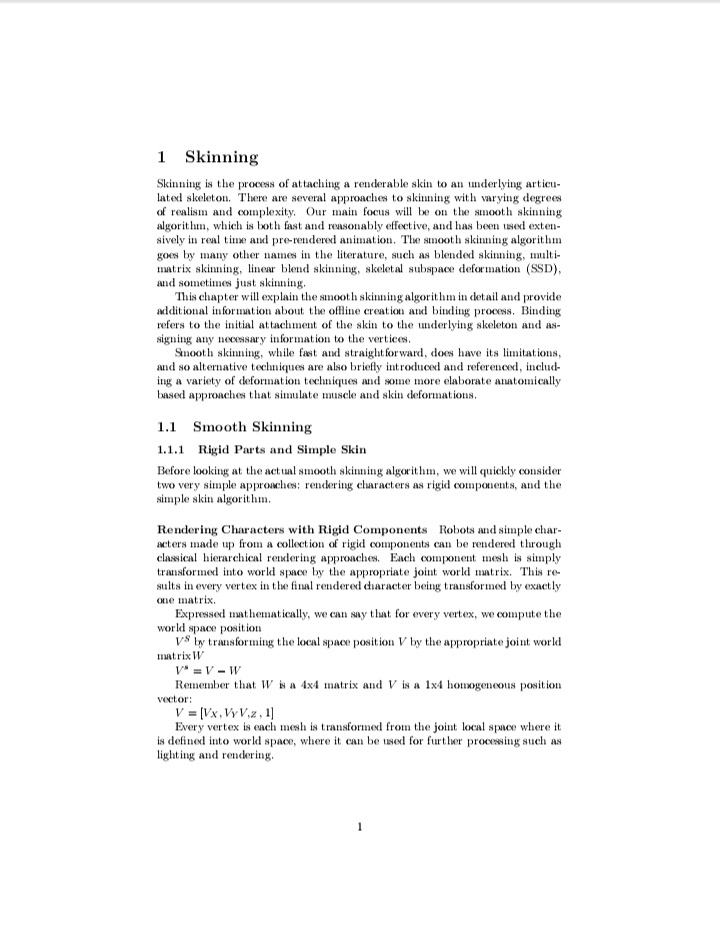
Skinning is the process of attaching a renderable skin to an underlying articulated skeleton. There are several approaches to skinning with varying degrees
of realism and complexity. Our main focus will be on the smooth skinning
algorithm, which is both fast and reasonably effective, and has been used extensively in real time and pre-rendered animation. The smooth skinning algorithm
goes by many other names in the literature, such as blended skinning, multimatrix skinning, linear blend skinning, skeletal subspace deformation (SSD),
and sometimes just skinning.
This chapter will explain the smooth skinning algorithm in detail and provide
additional information about the offline creation and binding process. Binding
refers to the initial attachment of the skin to the underlying skeleton and assigning any necessary information to the vertices.
Smooth skinning, while fast and straightforward, does have its limitations,
and so alternative techniques are also briefly introduced and referenced, including a variety of deformation techniques and some more elaborate anatomically
based approaches that simulate muscle and skin deformations
No pages found
8464 Views
0 Downloads
223.91 KB