Skeletal Animation
| Institution | Jomo Kenyatta University of Science and Technology |
| Course | Information Technol... |
| Year | 3rd Year |
| Semester | Unknown |
| Posted By | Jeff Odhiambo |
| File Type | |
| Pages | No pages found |
| File Size | 134.92 KB |
| Views | 391 |
| Downloads | 0 |
| Price: |
Buy Now
 Buy via
whatsapp Buy via
whatsapp
|


Description
Skeletal animation is a technique used in computer graphics and animation where a character is represented by two components: a surface mesh and an underlying skeleton or rig. The skeleton consists of interconnected bones or joints, which act as a framework that drives the motion of the character. Animators manipulate the skeleton to create movements, such as walking, running, or gestures, while the surface mesh follows these movements to form the character's visible appearance. This method allows for efficient and flexible animation, enabling complex motions and deformations, and is widely used in video games, films, and virtual environments.
Below is the document preview.

Lesson 3 Computer Animation - Skeletal Animation
Trending!
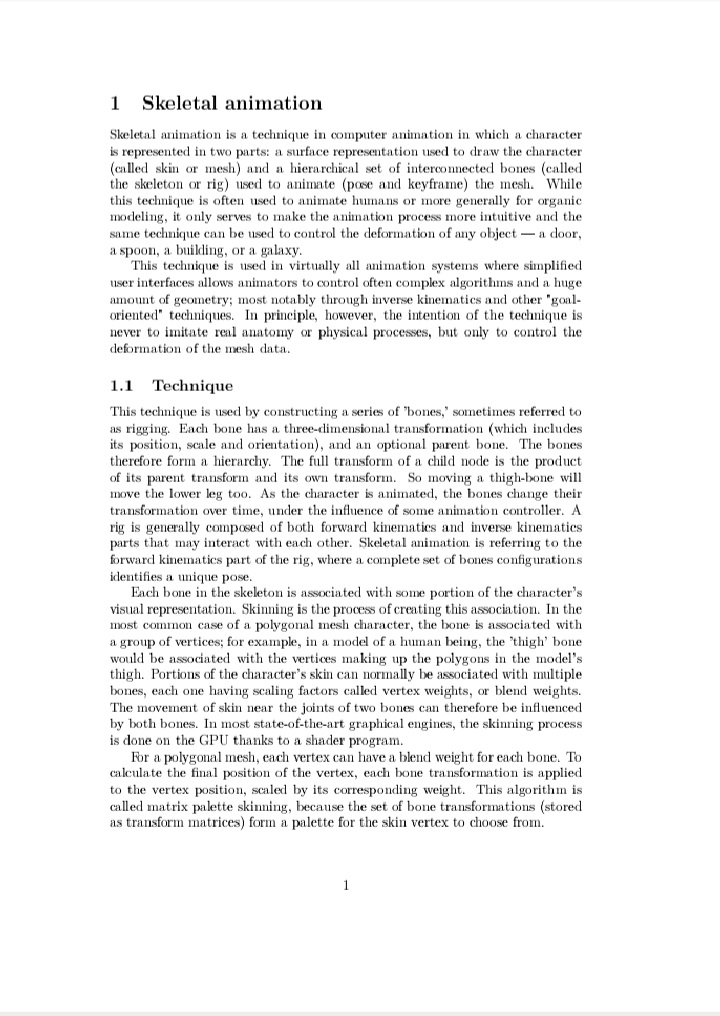
Skeletal animation is a technique in computer animation in which a character
is represented in two parts: a surface representation used to draw the character
(called skin or mesh) and a hierarchical set of interconnected bones (called
the skeleton or rig) used to animate (pose and keyframe) the mesh. While
this technique is often used to animate humans or more generally for organic
modeling, it only serves to make the animation process more intuitive and the
same technique can be used to control the deformation of any object — a door,
a spoon, a building, or a galaxy.
This technique is used in virtually all animation systems where simplified
user interfaces allows animators to control often complex algorithms and a huge
amount of geometry; most notably through inverse kinematics and other "goaloriented" techniques. In principle, however, the intention of the technique is never to imitate real anatomy or physical processes, but only to control the deformation of the mesh data.
No pages found
8286 Views
1 Downloads
134.92 KB