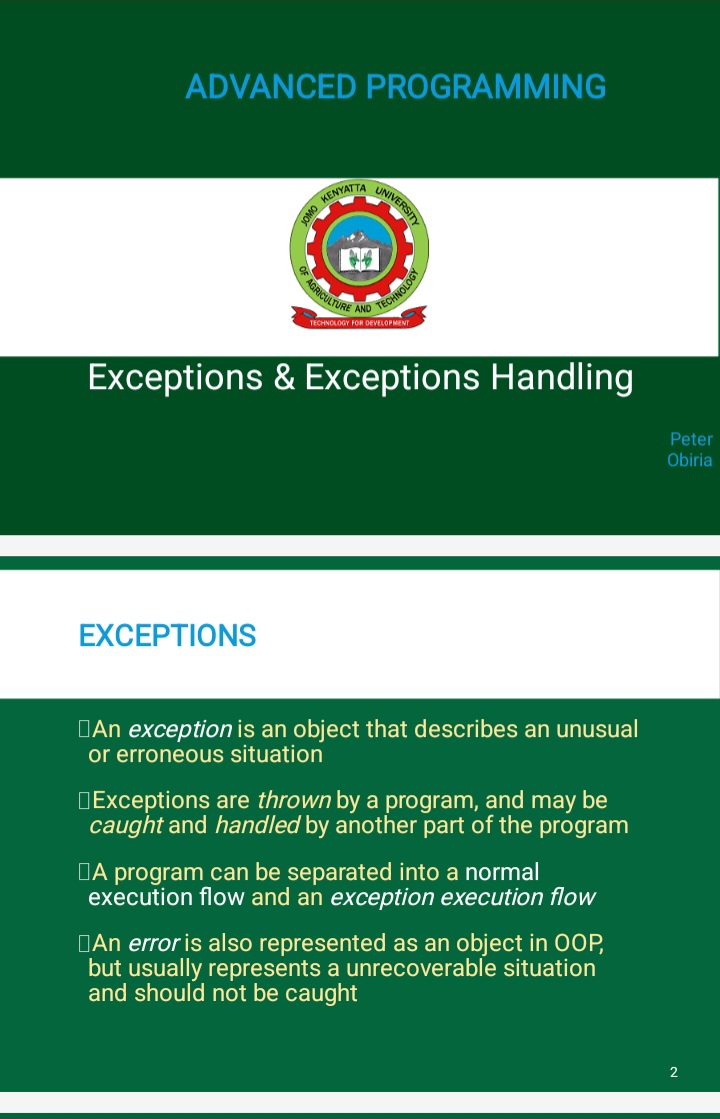
Exception and Exception Handling
| Institution | Jomo Kenyatta University of Science and Technology |
| Course | Information Technol... |
| Year | 3rd Year |
| Semester | Unknown |
| Posted By | Jeff Odhiambo |
| File Type | ppt |
| Pages | |
| File Size | 2.86 MB |
| Views | 3374 |
| Downloads | 0 |
| Price: |
Buy Now
 Buy via
whatsapp Buy via
whatsapp
|


Description
Exceptions are runtime errors or unexpected events that disrupt the normal flow of a program. They can occur due to various reasons, such as invalid user input, file not found, or division by zero. Exception handling is a mechanism used to manage these errors gracefully, ensuring the program doesn't crash and can recover or provide meaningful feedback. This is achieved using constructs like try, catch (or except), and finally. The try block contains code that might throw an exception, the catch block handles the exception, and the finally block executes cleanup code regardless of the outcome. Effective exception handling improves a program's robustness and user experience.
Below is the document preview.

ICS 2202: Virtual Memory
Trending!
Main memory management strategies have a common goal of keeping many processes in
memory simultaneously to allow multiprogramming. However, they tend to require that an entire
process be in memory before it can execute. This requirement that instructions must be loaded in
physical memory to be executed seems both necessary and reasonable, but has the disadvantage
of limiting the size of a program to the size of physical memory.
3 Pages
4172 Views
0 Downloads
206.68 KB
BIT 2120: Personal Computing History
Trending!
The history of personal computers (PCs) spans several decades and highlights the evolution of technology from bulky, expensive machines to sleek, powerful devices that are integral to modern life.
4158 Views
0 Downloads
155.5 KB
BIT 2120: How to Assemble a Desktop, PC
Trending!
Assembling a desktop computer involves several steps and requires attention to detail to ensure all components are installed correctly.
90 Pages
3958 Views
0 Downloads
979.67 KB
BIT 2120: Data representation
Trending!
Data representation refers to the methods used to encode and structure data so that it can be processed, stored, and transmitted by computers or systems.
4036 Views
0 Downloads
113 KB
BIT 2112: Introduction to System analysis and Design
Trending!
System analysis and design is a critical phase in the development of information systems. It involves understanding the needs of a business or organization, defining system requirements, and creating a plan to build or improve a system that meets those needs. This process is typically broken down into two main stages: analysis and design.
4265 Views
0 Downloads
49.41 KB
BIT 2112: Introduction to Systems
Trending!
A system is a collection of interrelated components or elements working together toward a common goal or purpose. In various fields, including engineering, business, biology, and information technology, systems are used to organize, analyze, and solve problems in a structured way. Systems can range from simple mechanical devices to complex organizational processes or software applications.
4233 Views
0 Downloads
17.86 KB
BIT 2112: Lesson 1 Information System Building blocks
Trending!
The building blocks of an Information System (IS) refer to the essential components or elements that work together to collect, store, process, and distribute information. These components are crucial for the proper functioning of an information system, whether for a business, organization, or any other entity.
64 Pages
4342 Views
0 Downloads
364.85 KB
BIT 2112: Lesson 2 Information Systems Development
Trending!
Information Systems Development refers to the process of creating and maintaining information systems that support business operations, decision-making, and organizational processes.
24 Pages
3965 Views
0 Downloads
248.35 KB
BIT 2112: Lesson 3 Project Initiation
Trending!
Project initiation is the first phase of a project where the foundational aspects are defined.
24 Pages
4128 Views
0 Downloads
241.19 KB
BIT 2112: Lesson 4 Systems Analysis
Trending!
Systems analysis is the process of studying and analyzing the components of a system to understand its structure, behavior, and function. It is typically used in fields like computer science, engineering, and business management to identify system requirements, problems, and inefficiencies, as well as to design improvements or solutions.
38 Pages
4097 Views
0 Downloads
292.56 KB