Statistics
| Institution | Jomo Kenyatta University of Science and Technology |
| Course | Information Technol... |
| Year | 2nd Year |
| Semester | Unknown |
| Posted By | Jeff Odhiambo |
| File Type | |
| Pages | 121 Pages |
| File Size | 2.15 MB |
| Views | 1764 |
| Downloads | 0 |
| Price: |
Buy Now
 Buy via
whatsapp Buy via
whatsapp
|


Description
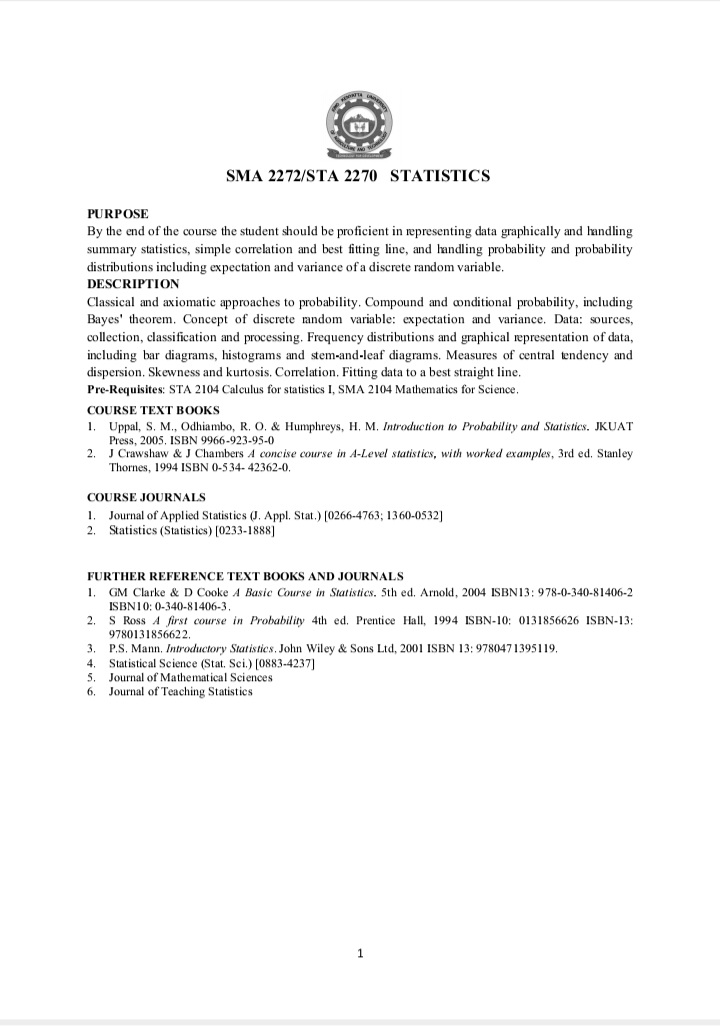
Statistics is the branch of mathematics that involves the collection, analysis, interpretation, presentation, and organization of data. It provides tools and methods to summarize data, identify patterns, and draw meaningful conclusions, often under conditions of uncertainty. By using statistical techniques, researchers can make informed decisions, test hypotheses, and predict future trends. Statistics is broadly divided into two areas: descriptive statistics, which focuses on summarizing and visualizing data, and inferential statistics, which uses sample data to make generalizations or predictions about a larger population. It plays a critical role in various fields, including science, business, healthcare, and social sciences.
Below is the document preview.

DAF1101 BUSINESS STATISTICS I
Business statistics is the science of good decision-making in the face of uncertainty and is used
in many disciplines such as financial analysis, econometrics, auditing, production, and
operations including services improvement, and marketing research.
1.2 Uses of Statistics
a) To present the data in a concise and definite form: Statistics helps in classifying and
tabulating raw data for processing and further tabulation for end users.
b) To make it easy to understand complex and large data: This is done by presenting the
data in the form of tables, graphs, diagrams, etc., or by condensing the data with the help
of means, dispersion, etc.
c) For comparison: Tables, measures of means, and dispersion can help in comparing
different sets of data.
d) In forming policies: It helps in forming policies like a production schedule, based on the
relevant sales figures. It is used in forecasting future demands.
e) Enlarging individual experiences: Complex problems can be well understood by
statistics, as the conclusions drawn by an individual are more definite and precise than
mere statements of facts.
f) In measuring the magnitude of a phenomenon:- Statistics has made it possible to count
the population of a country, the industrial growth, the agricultural growth, the educational
level (of course in numbers)
1.3 Limitations of Statistics
1. Statistics does not deal with individual measurements. Since statistics deals with
aggregates of facts, it cannot be used to study the changes that have taken place in
individual cases. For example, the wages earned by a single industry worker at any time,
taken by itself is not a statistical datum. However, the wages of workers in that industry
can be used statistically. Similarly, the marks obtained by Kamau of your class or the
height of Atieno (also of your class) are not the subject matter of statistical study. But the
average marks or the average height of your class has statistical relevance.
254 Pages
1299 Views
0 Downloads
3.33 MB
SMA 2371: Partial Differential Equations (Complete Notes, Examples & Solutions) – JKUAT Biostatistics Year 2 Semester 2
These are comprehensive and well-organized lecture notes for SMA 2371: Partial Differential Equations (PDE) offered to BSc. Biostatistics Year 2 Semester 2 students at JKUAT. The notes are neatly arranged from lecture one to the final topics, making them ideal for class learning, revision, CAT preparation, and final examinations.
The notes include detailed explanations, worked examples, step-by-step mathematical derivations, solved exercises, and applications of Partial Differential Equations. Topics covered include:
• Review of basic concepts and partial derivatives
• Jacobians, surfaces and curves in three dimensions
• Simultaneous first-order differential equations
• Methods of solving symmetric differential equations
• Orthogonal trajectories
• Pfaffian differential equations
• Linear first-order partial differential equations
• Formation of PDEs
• Elimination of arbitrary constants and arbitrary functions
• Heat, Wave, Laplace and Poisson equations
• Separation of variables
• Fourier and Laplace Transform methods
• Numerous worked examples, tutorial questions and examination-style problems with solutions.
These notes are suitable for JKUAT students and other university students studying Mathematics, Statistics, Biostatistics, Engineering, Applied Mathematics or related courses. They are an excellent revision resource for CATs and final examinations.
57 Pages
1359 Views
0 Downloads
1.77 MB