 Join Our WhatsApp Channel for Updates!
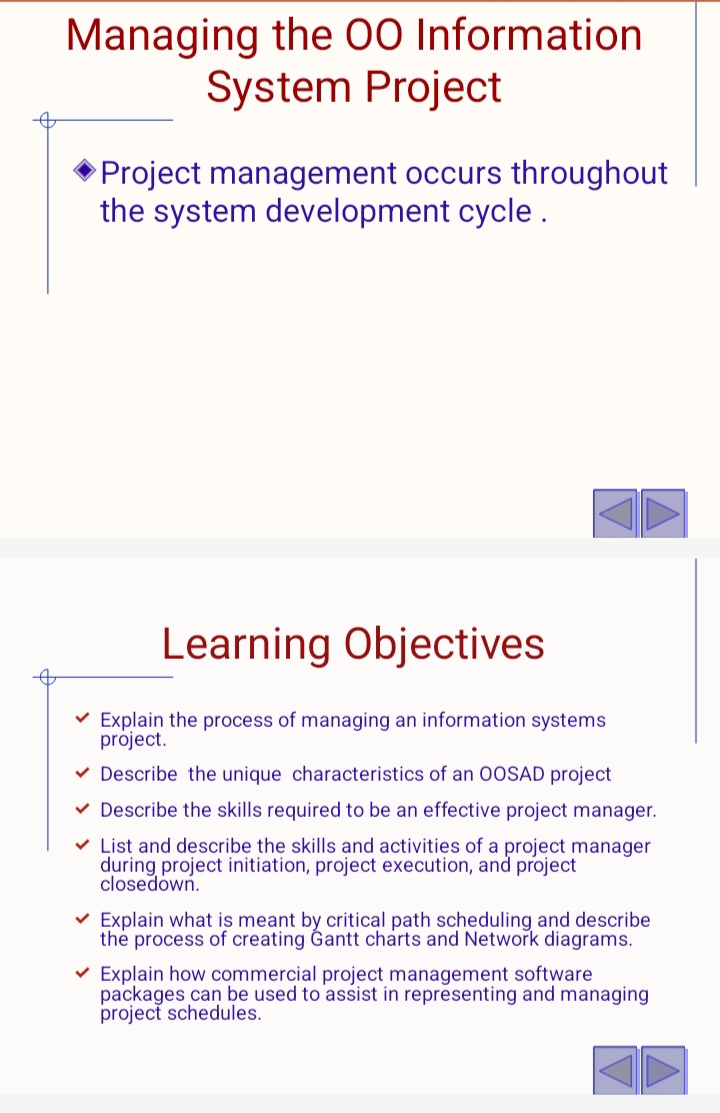
Managing the Object Oriented Information System Project
| Institution | Jomo Kenyatta University of Science and Technology |
| Course | Information Technol... |
| Year | 2nd Year |
| Semester | Unknown |
| Posted By | Jeff Odhiambo |
| File Type | ppt |
| Pages | |
| File Size | 402.5 KB |
| Views | 3368 |
| Downloads | 0 |
| Price: |
Buy Now
 Buy via
whatsapp Buy via
whatsapp
|


Description
Managing an Object-Oriented Information System (OOIS) project involves the application of structured methodologies and principles to ensure efficient design, development, and deployment. It includes defining clear objectives, gathering system requirements, and breaking down the project into manageable modules using object-oriented concepts like encapsulation, inheritance, and polymorphism. Effective management ensures seamless collaboration among team members, proper allocation of resources, adherence to timelines, and ongoing communication with stakeholders. The use of modeling tools such as Unified Modeling Language (UML) helps visualize and structure the system’s components, while iterative development methodologies ensure continuous testing and refinement. A strong focus on quality assurance, scalability, and adaptability ensures the project meets current needs while accommodating future expansions.
Below is the document preview.

WAN Technologies
On completion of this course, you will be able to:
Understand the basic concepts and development history of WANs.
Understand PPP and PPPoE implementations.
Master basic PPP and PPPoE configurations.
Understand basic MPLS/SR concepts.
29 Pages
256 Views
0 Downloads
1.04 MB
Network Management and O&M
On completion of this course, you will be able to:
Understand basic concepts of network management and O&M.
Master common network management and O&M methods.
Describe basic functions of network management and O&M.
Understand the fundamentals of SNMP.
Understand Huawei iMaster NCE and related technologies.
19 Pages
317 Views
0 Downloads
646.48 KB
SDN and NFV Overview
On completion of this course, you will be able to:
Describe the development of SDN and NFV.
Understand basic principles of OpenFlow.
Understand Huawei SDN solution.
Understand the standard NFV architecture.
Understand Huawei NFV solution.
29 Pages
327 Views
0 Downloads
1.35 MB
Network Programmability and Automation
On completion of this course, you will be able to:
Describe the difficulties of conventional network O&M.
Understand the implementation of network automation.
Understand the classification of programming languages.
Describe the Python code style.
Describe the basic usage of Python telnetlib
17 Pages
278 Views
0 Downloads
471.79 KB
Typical Campus Network Architectures and Practices
Trending!
On completion of this course, you will be able to:
Understand the definition of campus networks.
Understand the typical networking architectures of campus networks.
Master the planning and design methods of small campus networks.
Master the deployment and implementation methods of small campus networks.
Understand the small campus network O&M concepts.
Understand the small campus network optimization concepts.
Independently complete a campus network project.
25 Pages
2762 Views
0 Downloads
809.84 KB
BIT 2317: COMPUTER SECURITY
Trending!
Institution: Jomo Kenyatta University of Science and Technology
Year: 2016/2017
Semester: 4th Year, 1st Semester (4.1)
SMA 2101: CALCULUS I
Trending!
To understand the word function, we consider the following scenario and definitions. For example, the growth of a sidling is an instance of a functional relation, since the growth may be affected by variations in temperature, moisture, sunlight, etc. If all these factors remain constant, then the growth is a function of time.
117 Pages
3262 Views
0 Downloads
592.87 KB
BIT 2317: COMPUTER SYSTEM SECURITY
Trending!
Institution: Jomo Kenyatta University of Science and Technology
Year: 2016/2017
Semester: 3rd Year, 1st Semester (3.1)
BIT 2317: COMPUTER SYSTEMS SECURITY
Trending!
Institution: Jomo Kenyatta University of Science and Technology
Year: 2016/2017
Semester: 4th Year, 2nd Semester (4.2)
Computer system security
Computer system security refers to the protection of computer systems and networks from unauthorized access, data breaches, cyberattacks, and other threats that could compromise confidentiality, integrity, and availability. It involves implementing measures such as encryption, firewalls, antivirus software, multi-factor authentication, and intrusion detection systems to safeguard sensitive information. Security practices also include regular updates, vulnerability assessments, and user awareness training to mitigate risks. With the increasing reliance on digital systems, cybersecurity is essential for protecting personal data, business operations, and critical infrastructure from cyber threats like malware, phishing, and hacking attempts.
257 Pages
464 Views
1 Downloads
2.78 MB