ICS 2202: Processor
| Institution | Jomo Kenyatta University of Science and Technology |
| Course | Information Technol... |
| Year | 1st Year |
| Semester | Unknown |
| Posted By | Jeff Odhiambo |
| File Type | |
| Pages | 2 Pages |
| File Size | 123.84 KB |
| Views | 4083 |
| Downloads | 0 |
| Price: |
Buy Now
 Buy via
whatsapp Buy via
whatsapp
|


Description
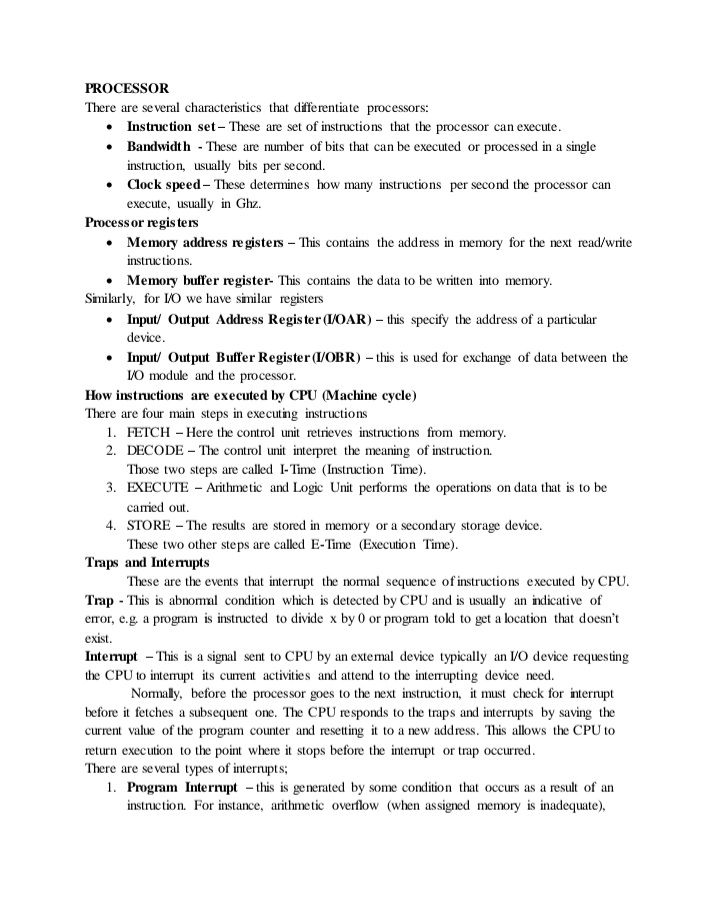
A processor, also known as a central processing unit (CPU), is the primary component of a computer that performs most of the processing inside the system. It acts as the "brain" of the computer, interpreting and executing instructions from software programs.
Below is the document preview.

Introduction to Data structure
A data structure is a way of organizing and storing data so it can be accessed and manipulated efficiently. It is a fundamental concept in computer science and programming, as it helps manage data effectively for various algorithms and operations.
762 Views
0 Downloads
70.34 KB
Data Structures and Algorithm Analysis
Trending!
Data Structure and Algorithm Analysis is a fundamental area in computer science focused on designing and analyzing efficient ways to organize and manipulate data and solve problems.
638 Pages
3885 Views
0 Downloads
2.03 MB
Data structure & Algorithm tutoral
Trending!
Data Structures are the programmatic way of storing data so that data can be used
efficiently. Almost every enterprise application uses various types of data structures in one
or the other way.
This tutorial will give you a great understanding on Data Structures needed to understand
the complexity of enterprise level applications and need of algorithms, and data structures
264 Pages
3691 Views
0 Downloads
2.85 MB
Data Structure & Algorithm simplified
Trending!
A data structure is a specialized format for organizing, managing, and storing data efficiently to perform operations like searching, inserting, and deleting.An algorithm is a step-by-step procedure or formula for solving a problem or performing a task.
3698 Views
0 Downloads
2.27 MB
Queue and Stack
Trending!
A queue is a linear data structure that follows the First In, First Out (FIFO) principle, where elements are added at the rear and removed from the front. It is commonly used in scenarios like task scheduling, managing resources, and breadth-first search in graphs. On the other hand, a stack follows the Last In, First Out (LIFO) principle, where elements are added and removed from the top. Stacks are often used in backtracking problems, function calls, and evaluating expressions. While queues prioritize the first element for removal, stacks prioritize the most recently added element.
3521 Views
0 Downloads
74.68 KB
Data Structure Tutorial
Trending!
A data structure is a specialized format used for organizing, managing, and storing data in a way that facilitates efficient access and modification. It defines the relationship between the data elements and the operations that can be performed on them. Data structures can be linear, such as arrays, linked lists, stacks, and queues, or non-linear, such as trees and graphs. The choice of data structure depends on the problem being solved, as different structures offer various trade-offs in terms of memory usage, speed of access, and ease of implementation.
354 Pages
3405 Views
0 Downloads
3.02 MB
Stacks and Queues
Trending!
Stacks and queues are fundamental data structures used to manage collections of elements. A stack follows the Last In, First Out (LIFO) principle, meaning the last element added is the first one to be removed. It is often used for tasks such as reversing data, function calls, and undo operations. A queue, on the other hand, follows the First In, First Out (FIFO) principle, where the first element added is the first one to be removed. Queues are commonly used in scenarios like task scheduling, data buffering, and handling requests in a system. Both structures enable efficient element access and manipulation through specific operations like push and pop for stacks, and enqueue and dequeue for queues.
3715 Views
0 Downloads
91.93 KB
Data Structure: Stack.
Trending!
A stack is a linear data structure that follows the Last In, First Out (LIFO) principle, meaning that the most recently added element is the first one to be removed. It operates with two main operations: push, which adds an element to the top of the stack, and pop, which removes the element from the top. Additionally, a peek or top operation allows viewing the element at the top without removing it. Stacks are commonly used in algorithms for parsing expressions, function calls (call stack), undo mechanisms, and managing recursive processes.
19 Pages
3873 Views
0 Downloads
949.06 KB
Network Services configuration
Trending!
Network Services configuration refers to the process of setting up and managing the various services that allow devices to communicate over a network. This includes configuring services such as DNS (Domain Name System) for domain resolution, DHCP (Dynamic Host Configuration Protocol) for assigning IP addresses automatically, and routing services for determining data paths. It also encompasses the configuration of security services like firewalls and VPNs to control access and protect data, as well as services for network monitoring and management to ensure the efficient operation of the network. Proper network service configuration ensures reliable, secure, and optimized communication within a network infrastructure.
6 Pages
3427 Views
0 Downloads
2.06 MB
Ten Commandments of computer ethics
Trending!
Ten Commandments of computer ethics
3357 Views
0 Downloads
49.24 KB