
MICROSOFT POWERPOINT NOTES
| Institution | Maseno University |
| Course | UCI |
| Year | 2nd Year |
| Semester | Unknown |
| Posted By | Mwalimu Evans Okoyo. |
| File Type | doc |
| Pages | |
| File Size | 317 KB |
| Views | 10881 |
| Downloads | 6 |
| Price: |
Buy Now
 Buy via
whatsapp Buy via
whatsapp
|


Description
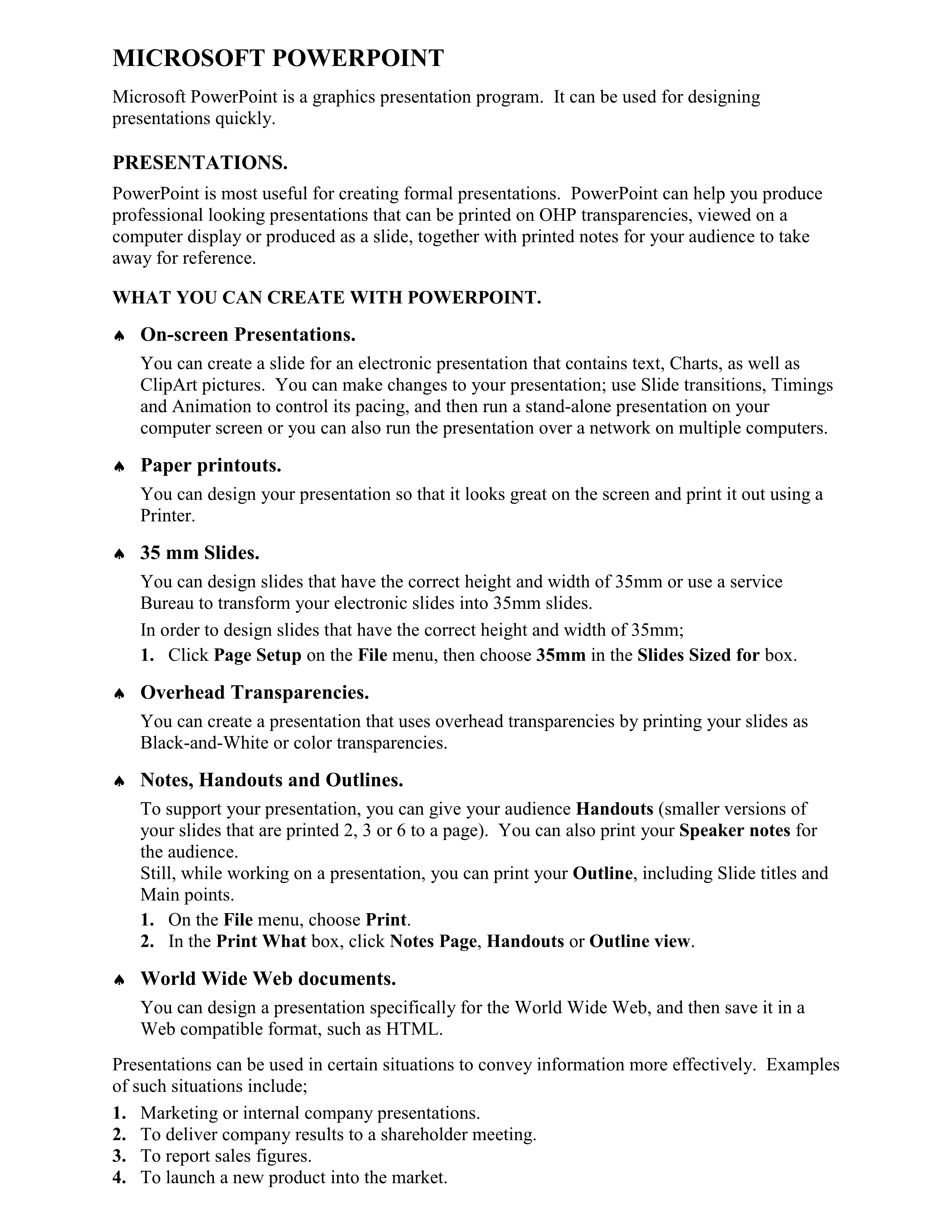
PowerPoint is most useful for creating formal presentations. PowerPoint can help you produce professional looking presentations that can be printed on OHP transparencies, viewed on a computer display or produced as a slide, together with printed notes for your audience to take away for reference.
Below is the document preview.

HE/CU/TT/CC/06/6/A: PROVISION OF HEALTH EDUCATION AND PROMOTION SERVICES
Trending!
This unit specifies the competencies required to Provide Health Education and Promotion. It involves identifying and assessing health education and promotion needs, developing objectives, planning, implementing, evaluating and documenting health promotion and education activities. Its main objective is to enlighten a person or a community on healthcare.
30 Pages
8360 Views
0 Downloads
527.5 KB
BAC 200 Accounting For Assets
Trending!
A conceptual framework is like a constitution. It is a coherent system of interrelated objectives and fundamentals that can lead to consistent standards and that prescribe the nature, function and limits of financial accounting in financial statements. A conceptual framework is essential in that to be useful, standard setting should be built on and relate to an established body of concepts and objectives. In addition new and emerging practical problems should be quickly solved by reference to an existing framework of basic theory
80 Pages
5108 Views
1 Downloads
720.74 KB
BAC 305 Financial Markets and Institutions
Trending!
• Financial market is a market in which financial assets (securities) such as stocks and bonds can be purchased or sold
• Financial markets are critical for producing an efficient allocation of capital, which contributes to higher production and efficiency for the overall economy, as well as economic security for the citizenry as a whole
• Financial markets also improve the lot of individual participants by providing investment returns to lender-savers and profit and/or use opportunities to borrower-spenders.
152 Pages
5578 Views
1 Downloads
1.39 MB
BAC 310 Management of Financial Institution
Trending!
Financial institutions perform the essential function of channeling funds from those with surplus funds to those with shortages of funds. Financial institutions provide a variety of services to sectors of the economy. Failure to provide these services or a breakdown in their efficient provision can be costly to both the ultimate suppliers of funds and users of funds as well as to the economy overall. For instance, bank failures may destroy household savings and at the same time restrict a firm’s access to credit. Insurance company failures may leave household members totally exposed in old age to the cost of catastrophic illnesses and to sudden drops in income on retirement. In addition individual financial institution failures may create doubts in savers ’minds regarding the stability and solvency of financial institutions and the financial system in general and cause panics and even withdrawal runs on sound institutions. Financial institutions are regulated in an attempt to prevent these types of market failures and the costs they would impose on the economy and society at large.
61 Pages
5982 Views
0 Downloads
512.93 KB
BAC 412 Entrepreneurial Finance
Entrepreneurial Finance is designed to help students and/or managers make better investment and financing decisions in entrepreneurial settings. The course covers all stages of the process, from startup to harvest. Though the course is called Entrepreneurial Finance, it differs in philosophy and style from a course like corporate Finance. It integrates people into the equation by taking into account their capabilities, their incentives, and the cognitive biases they bring to decision making. Students should not take the course as a remedial finance course but to enhance their understanding of entrepreneurship financial planning and execution.
The course is aimed primarily at people who may already or are planning to be involved entrepreneurial ventures at some point in their careers whether in a large organization, a turnaround, a management buyout or a startup. The course will also be useful for future private equity decision makes.
34 Pages
1431 Views
1 Downloads
1.74 MB
BBA 102 Principles of Management
Trending!
In modern business world job management is becoming very difficult. Therefore managers requires several skills for successful management.. These skills include the following :
Technical Skill – ability and knowledge to use tools, equipment, procedures & techniques in a specialized area. The manager must know the skills required in a certain business, the role of each skill and interrelationship between the skills. They should be ready to ask for technical assistance in cases where they are not familiar with a particular skill. Ability in programming operating a word processing program, designing a brochure, training people to use a budgeting system, understanding manufacturing systems, etc. are examples of technical skills.
Human Skill refers to ability to work with, understand, mentor & motivate people as individual or groups. This is a sense of feelings and reflects the manager’s perception of superiors, subordinate and peers. Human skills are concerned with understanding of ‘People’. Interviewing job applicants, forming partnerships with other businesses, and resolving conflicts all require these skills.
Conceptual Skill –mental ability to coordinate & integrate an organization’s activities, especially in the long-term decisions affecting the organization. It is needed to see the organization as a whole & recognize how the various factors in a situation are interrelated so actions taken are in the best interests of the organization. Conceptual skills also include the competence to understand a problem in all its aspects and to use original thinking in solving the problem. Such competence is necessary for rational decision-making. Decision making, planning, and organizing require these skills.
83 Pages
6407 Views
1 Downloads
5.63 MB
BBM 221;Management accounting 1 Notes 1st Year
Trending!
Management accounting is the application of professional knowledge and skills in preparation and presentation of accounting information in such a way as to assist management in formulation of policies and planning /control of operations of undertakings.
255 Pages
7156 Views
0 Downloads
763.22 KB
BBM 124;Principles of Marketing Notes 1st Year
Trending!
Marketing is the business function that delivers customer satisfaction at a profit. It creates values for the customers and receives values from the customers in return. Marketing focuses on getting customers and keeping customers by satisfying their needs. Marketing creates values and satisfaction for the customer. It is the delivery of satisfaction to the customers at a profit.
121 Pages
7539 Views
1 Downloads
616.05 KB
BBM 411; Company law Notes 1st Year
Trending!
The formation and winding up of any company in Kenya is governed by the Company’s Act Cap 486 of the Laws of Kenya. The company legislation in Kenya owes its origin to the English company law. The companies Act of Kenya which came into force on 1st January 1962 is based on English companies Act of 1948.This Act is still applicable together with later amendments. The Act provides a basic legal framework for the regulation of companies in Kenya. It makes provision for the legal incorporation of companies and lays down rules for their constitution, management and
winding up.
117 Pages
7245 Views
0 Downloads
731.85 KB
Excel spreadsheet notes
A Spreadsheet is a ledger sheet that lets the user enter, edit, and manipulate numerical data. A Spreadsheet usually consists of a series of rows & columns.
41 Pages
708 Views
2 Downloads
710.73 KB