ADOBE PAGEMAKER NOTES
| Institution | Maseno University |
| Course | UCI |
| Year | 2nd Year |
| Semester | Unknown |
| Posted By | Mwalimu Evans Okoyo. |
| File Type | doc |
| Pages | |
| File Size | 640 KB |
| Views | 10938 |
| Downloads | 2 |
| Price: |
Buy Now
 Buy via
whatsapp Buy via
whatsapp
|


Description
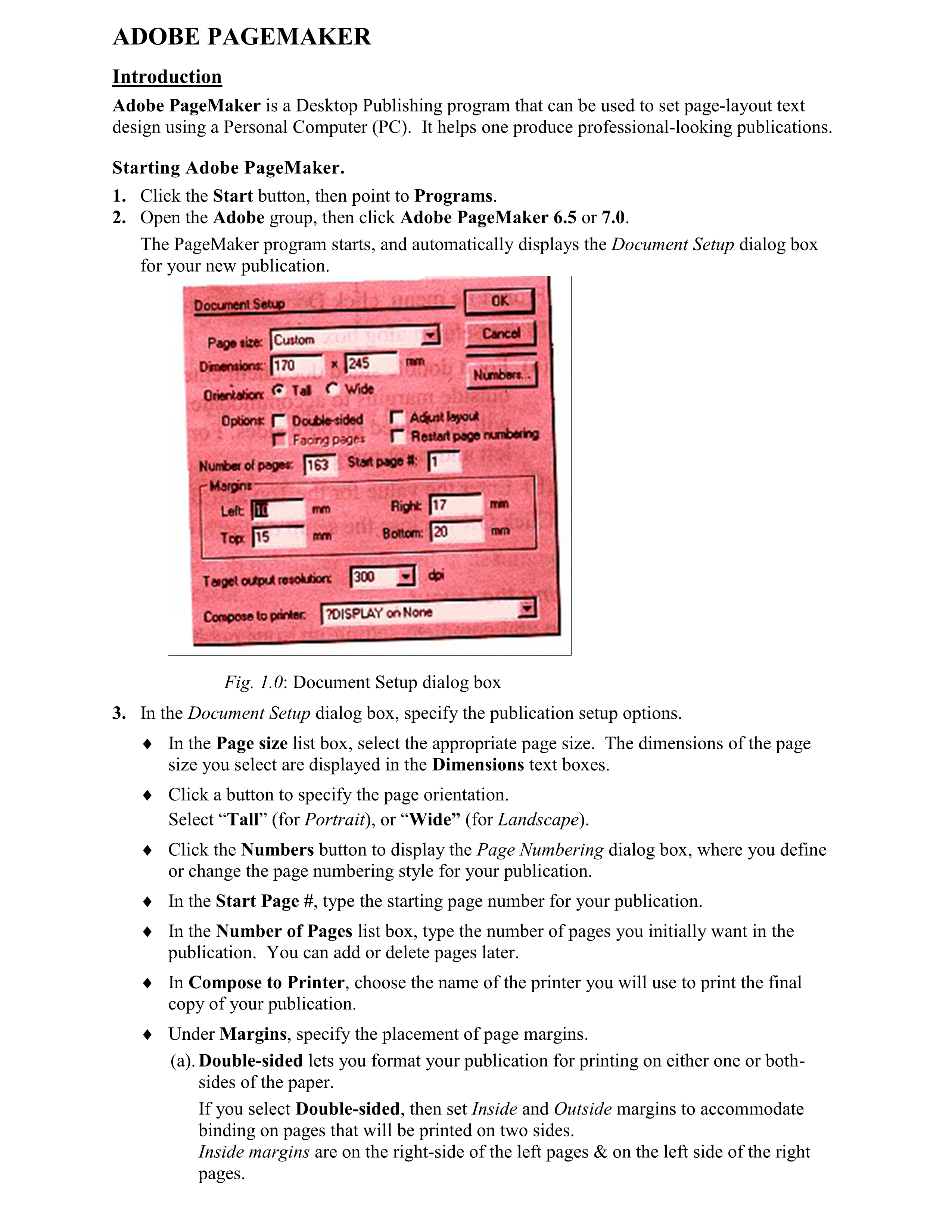
Adobe PageMaker is a Desktop Publishing program that can be used to set page-layout text design using a Personal Computer (PC). It helps one produce professional-looking publications.
Below is the document preview.

FUNCTIONAL WRITING FORM ONE
Trending!
Sending an e-mail
-To be able to send an e-mail, you must have the e-mail address of the recipient. e.g
To: You write the address of the recipient.
From: You write the address of the sender
Cc: meaning coupon copy- other people who can be sent copies of the same mail.
Bc: a blind copy to be seen by the recipient only.
157 Pages
7454 Views
0 Downloads
1.1 MB
INTERLOCUTORY INJUCTION
Trending!
IN THE COURT OF APPEAL
AT NAIROBI
(Coram: Gicheru, Akiwumi & Tunoi JJ A )
CIVIL APPEAL NO. 60 OF 1993
BETWEEN
ROCKLAND KENYA LIMITED.....................................................APPELLANT
AND
ELLIOT WHITE MILLER...........................................................RESPONDENT
(Appeal from an order of the High Court of Kenya at Nairobi (Shields J) dated 9th February, 1993
in HCCC No 342 of 1992
25 Pages
5906 Views
0 Downloads
93.46 KB
HORT 322: PRINCIPAL OF HORTICULTURAL CROP PRODUTION
Trending!
Horticulture
Is an Agricultural science that deals with production, utilization &improvement of fruits,vegetables and ornamental plant.
54 Pages
6990 Views
0 Downloads
1.16 MB
EVIDENCE OPINION
Trending!
As a general rule, opinion evidence is inadmissible; a
witness may only speak of facts which he personally
perceived, not the inferences drawn from those facts:
36 Pages
5050 Views
0 Downloads
2.13 MB
ORAL LITERATURE
Trending!
Have you ever imagined what life was like in the days of our great –great
grandfathers? How did
they spend their leisure time? Certainly they did no t spend their free
time reading the works of
their great writers. This is simply because they could not read. The
civilization of reading and
writing was still at its rudimentary stages and in some parts o f the
world this civilization was
104 Pages
2936 Views
1 Downloads
405.01 KB
BUSINESS STUDIES JOINT EXAMINATION REVISION BOOKLET Q AND A
Trending!
The purpose of this business studies joint examination Revision booklet Q and A is to equip the student with knowledge and skills to enable him or her pass the final exams with flying colours
272 Pages
7724 Views
2 Downloads
4.56 MB
EPY 310: HUMAN GROWTH AND DEVELOPMENT FULL NOTES
Trending!
The purpose of the course is to acquaint students with knowledge on theories of human development and the human development process so that they can apply these in their teaching profession.
73 Pages
7453 Views
0 Downloads
1.4 MB
ECT 212: CURRICULUM DEVELOPMENT
Trending!
Schooling refers to the act of physically attending a formal institution of learning e.g. primary or a secondary school. It involves systematic promotion through the grade range governing the learning institution with the assumption that at the end of their institutionalized cycle some learning will have taken place.
10 Pages
10572 Views
0 Downloads
776.26 KB
A Doll's House Notes and Analysis
Trending!
A Doll’s House opens on Christmas Eve. Nora Helmer enters her well-furnished living room—the setting of the entire play—carrying several packages. Torvald Helmer, Nora’s husband, comes out of his study when he hears her arrive. He greets her playfully and affectionately, but then chides her for spending so much money on Christmas gifts. Their conversation reveals that the Helmers have had to be careful with money for many years, but that Torvald has recently obtained a new position at the bank where he works that will afford them a more comfortable lifestyle.
25 Pages
8240 Views
0 Downloads
707.13 KB
AEN 102: THE USE OF ENGLISH FOR ACADEMIC PURPOSES
The general objective of this course is to enable students and other professionals skills which they may need to perform effectively their activities in the university and later on life.
16 Pages
598 Views
1 Downloads
936.04 KB