Introduction to Structured Programming
| Institution | Jomo Kenyatta University of Science and Technology |
| Course | Information Technol... |
| Year | 1st Year |
| Semester | Unknown |
| Posted By | Jeff Odhiambo |
| File Type | |
| Pages | 15 Pages |
| File Size | 210.51 KB |
| Views | 5030 |
| Downloads | 0 |
| Price: |
Buy Now
 Buy via
whatsapp Buy via
whatsapp
|


Description
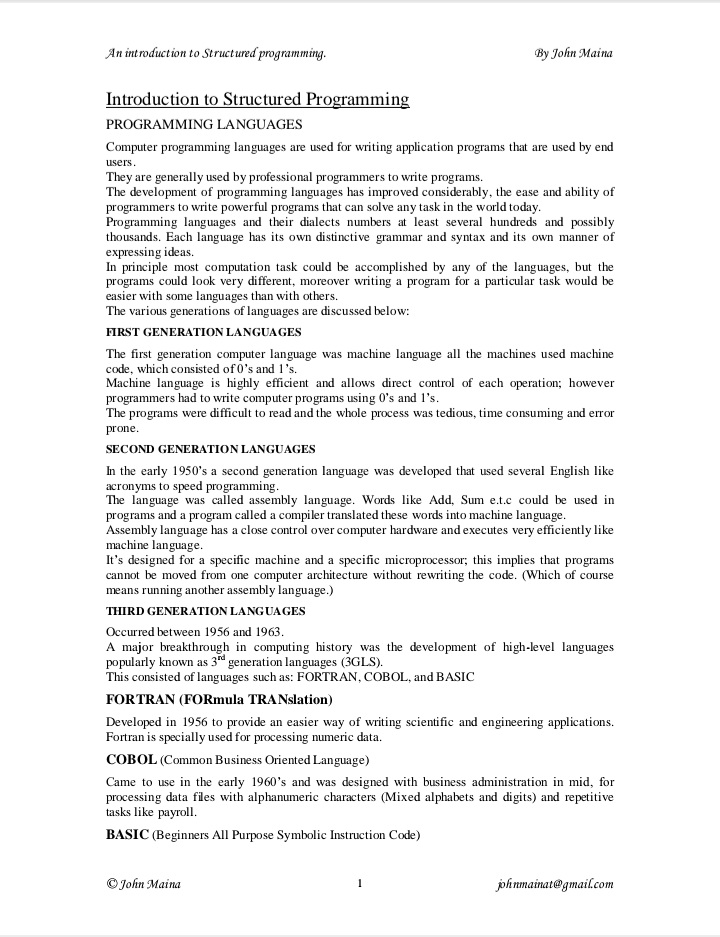
Structured programming is a programming paradigm that emphasizes the use of a logical structure to improve clarity, quality, and development time. It is based on the idea of dividing a program into smaller, manageable sections or modules, making it easier to write, debug, and maintain.
Below is the document preview.

Database development Lifecycle
Trending!
The Database Development Lifecycle (DBLC) is a structured process for designing, implementing, and maintaining a database system to meet specific organizational needs. It consists of several phases: requirements analysis, where data needs are identified; conceptual design, where data relationships and models are created; logical design, where data structures are refined for the database management system; physical design, involving the implementation of the database on specific hardware and software; implementation, where the database is developed and populated with data; and testing, deployment, and maintenance, ensuring functionality, performance, and updates as needed. This lifecycle ensures systematic development, scalability, and efficient data management.
3766 Views
0 Downloads
38 KB
Introduction to Object Oriented Software Analysis and Design
Trending!
Introduction to Object-Oriented Software Analysis and Design is a foundational course that focuses on applying object-oriented principles to analyze, design, and develop software systems. It emphasizes the use of modeling techniques, such as Unified Modeling Language (UML), to represent system components and their interactions effectively. The course covers key concepts like classes, objects, inheritance, polymorphism, and encapsulation, enabling developers to create modular, reusable, and scalable software solutions. By integrating theoretical knowledge with practical design patterns and problem-solving strategies, it prepares learners to handle complex software development projects systematically and efficiently.
3909 Views
0 Downloads
178 KB
The Systems Development Environment
Trending!
The Systems Development Environment refers to the comprehensive framework within which software and systems are conceived, developed, tested, and maintained. It includes a combination of methodologies, tools, technologies, and practices designed to ensure efficient and effective development processes. This environment supports the entire systems development life cycle (SDLC), encompassing phases such as planning, analysis, design, implementation, testing, deployment, and maintenance. The environment also includes collaboration between stakeholders like developers, project managers, and end-users, as well as the use of software development methodologies like Agile, Waterfall, or DevOps. By integrating these elements, the systems development environment ensures that projects are delivered on time, within budget, and meet quality standards while addressing user requirements.
36 Pages
3774 Views
0 Downloads
2.23 MB
Object Oriented Software Analysis and Design methodology
Object-Oriented Software Analysis and Design (OOSAD) is a methodology that emphasizes modeling software systems based on real-world entities, encapsulating data and behavior within objects. It utilizes object-oriented principles such as encapsulation, inheritance, and polymorphism to create modular and reusable systems. The process typically involves analyzing user requirements to identify key objects, defining their attributes and behaviors, and designing interactions among them to achieve the desired functionality. OOSAD promotes iterative development, enabling teams to refine designs through feedback and testing, resulting in scalable and maintainable software solutions. It is widely used due to its ability to closely align system designs with user needs and real-world scenarios.
369 Views
0 Downloads
553 KB
Managing the Object Oriented Information System Project
Trending!
Managing an Object-Oriented Information System (OOIS) project involves the application of structured methodologies and principles to ensure efficient design, development, and deployment. It includes defining clear objectives, gathering system requirements, and breaking down the project into manageable modules using object-oriented concepts like encapsulation, inheritance, and polymorphism. Effective management ensures seamless collaboration among team members, proper allocation of resources, adherence to timelines, and ongoing communication with stakeholders. The use of modeling tools such as Unified Modeling Language (UML) helps visualize and structure the system’s components, while iterative development methodologies ensure continuous testing and refinement. A strong focus on quality assurance, scalability, and adaptability ensures the project meets current needs while accommodating future expansions.
3740 Views
0 Downloads
402.5 KB
Object Oriented Software Analysis and Design methodology
Object-Oriented Software Analysis and Design (OOSAD) is a methodology used to design and develop software systems by modeling them as a collection of interacting objects. These objects represent real-world entities, encapsulating data (attributes) and behavior (methods). The approach emphasizes principles like abstraction, inheritance, polymorphism, and encapsulation to enhance modularity, reusability, and maintainability. OOSAD typically follows a lifecycle that includes requirements gathering, analysis, design, implementation, and testing. It employs visual modeling tools like Unified Modeling Language (UML) to create diagrams that illustrate system structure and behavior, such as class diagrams, sequence diagrams, and use case diagrams. This methodology is widely used in complex, large-scale projects due to its ability to simplify system complexity by focusing on the relationships and interactions among objects.
44 Pages
325 Views
0 Downloads
477.13 KB
Use case Modeling
Trending!
Use case modeling is a technique used in software development to capture and describe the functional requirements of a system from the user's perspective. It focuses on identifying the various actors (users or external systems) that interact with the system and the specific goals or tasks they aim to accomplish, known as use cases. This approach helps visualize how the system should behave in different scenarios, ensuring alignment with user needs and expectations. Use case models typically include diagrams and descriptions that outline the interactions, providing a clear and structured framework for system design, development, and testing.
3537 Views
0 Downloads
381.5 KB
Techniques of Integration
Techniques of integration are mathematical methods used to find the antiderivative or integral of a function. These techniques include substitution, which simplifies integrals by changing variables; integration by parts, based on the product rule for differentiation; and partial fraction decomposition, which breaks down rational functions into simpler fractions for easier integration. Trigonometric substitution is employed for integrals involving square roots of quadratic expressions, while trigonometric identities simplify integrals containing trigonometric functions. Numerical methods, such as the trapezoidal rule and Simpson's rule, approximate definite integrals when exact solutions are difficult to obtain. These techniques allow for solving a wide range of integrals in calculus and applied mathematics.
7 Pages
357 Views
0 Downloads
174.7 KB
Expectation and Variance
Trending!
Expectation and Variance are fundamental concepts in probability and statistics. The expectation (or expected value) of a random variable represents its theoretical average over an infinite number of trials, essentially summarizing the central tendency of its probability distribution. It is calculated as the weighted sum of all possible values of the variable, where the weights are their respective probabilities. Variance, on the other hand, measures the dispersion or spread of the random variable around its expectation. It quantifies how much the values deviate, on average, from the mean, and is calculated as the expected value of the squared differences between the variable and its mean. Together, expectation and variance provide a comprehensive understanding of a random variable’s behavior, highlighting both its central value and the variability around it.
30 Pages
3424 Views
0 Downloads
233.95 KB