 Join Our WhatsApp Channel for Updates!
2920/102 Computer application 1 - presentation lecture notes
| Institution | Collage/university |
| Course | Diploma in informati... |
| Year | 1st Year |
| Semester | Unknown |
| Posted By | MAKORI KERECHA |
| File Type | |
| Pages | 30 Pages |
| File Size | 621.92 KB |
| Views | 4939 |
| Downloads | 0 |
| Price: |
Buy Now
 Buy via
whatsapp Buy via
whatsapp
|


Description
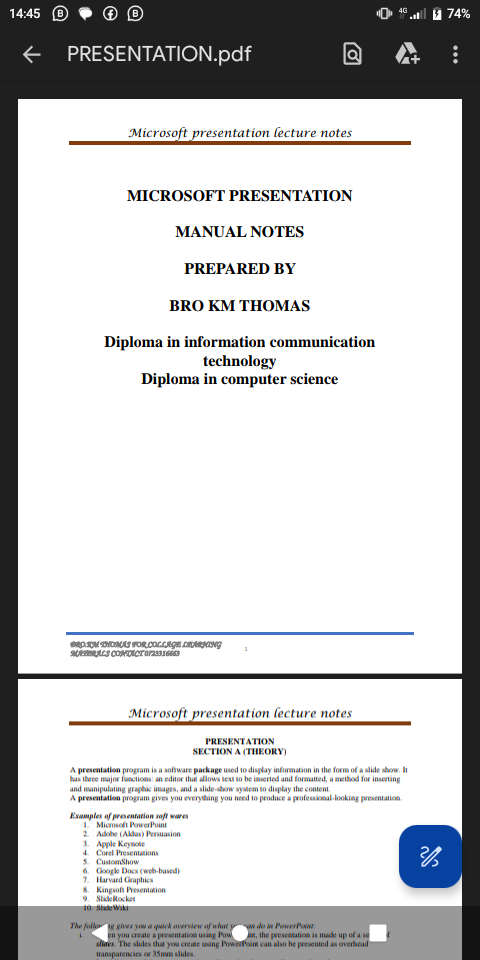
This are presentation lecture notes. It outline and makes students under how to use Ms office publisher
Below is the document preview.

SMA 2104: Mathematics for Sciences - Lesson 4 Factorisable polynomials
Trending!
Upon completing this topic, you should be able to factorise and solve polynomials of degree higher than 2
No pages found
4439 Views
0 Downloads
277.4 KB
SMA 2104: Mathematics for Sciences - Lesson 5 Permutations and Combination
Trending!
Permutations and Combination
Permutations - This is defined as the number of different ways of arranging different objects in order.
No pages found
4044 Views
0 Downloads
273.38 KB
SMA 2104: Mathematics for Sciences - Lesson 6 Binomial expansion
Trending!
Upon completing this topic you should be able to understand the binomial theorem and it’s application in the expansion of expressions and in approximations.
No pages found
3990 Views
0 Downloads
282.79 KB
SMA 2104: Mathematics for Sciences - Lesson 7 Probability
Trending!
Upon completing this topic,you should be able to;- Apply the principles of probability to solve problems in real-world contexts. Understand and use the language of probability and to compute the probabilities of composite events using the basic rules of probability.
No pages found
4433 Views
0 Downloads
395.57 KB
SBC100: STRUCTURE OF BIOMOLECULES
Trending!
They are well descritive
30 Pages
5589 Views
0 Downloads
2.65 MB
SMA 2104: Mathematics for Sciences - Lesson 8 Statistics
Trending!
Upon completing this topic,you should be able to Collect, organize, and represent data, and be able to recognize and describe relationships. Apply the principles of statistics to solve problems in real world contexts. Demonstrate knowledge of statistical terms. Differentiate between the two branches of statistics. Identify types of data. Understand and use the basic measure of central tendency
No pages found
3813 Views
0 Downloads
282.84 KB
SMA 2104: Mathematics for Sciences - Lesson 9 TRIGONOMETRY
Trending!
Upon completing this topic, you should be able to Define, manipulate and apply trigonometric functions. Define the basic trigonometric ratios, sine, cosine and tangent of an angle and derive the other trigonometric ratios; cosecant, secant and cotangent using the basic trigonometric ratios. Derive identities involving the trigonometric ratios
11 Pages
5042 Views
0 Downloads
635.34 KB
SMA 2104: Quadratic Equations Practice Problems
Trending!
Quadratic Equations Practice Problems, Solving Quadratic Equations When the Product of Two Numbers is Zero
12 Pages
4527 Views
0 Downloads
602.99 KB
SMA 2104: Factorisation Practice Questions
Get a copy Factorisation Practice Questions, this is suitable for your revision
2 Pages
415 Views
0 Downloads
38.59 KB
SMA 2104: Factorisation Practice Questions Answers
Trending!
Factorisation Practice Questions Answers
2 Pages
4512 Views
0 Downloads
38.59 KB