SCH 200: ATOMIC STRUCTURE AND CHEMICAL BONDING
| Institution | Machakos University |
| Course | CHEMISTRY |
| Year | 1st Year |
| Semester | Unknown |
| Posted By | Rose Oloo |
| File Type | |
| Pages | 88 Pages |
| File Size | 1.86 MB |
| Views | 11108 |
| Downloads | 2 |
| Price: |
Buy Now
 Buy via
whatsapp Buy via
whatsapp
|


Description
This course covers an experimental foundation of quantum theory; particles and waves; uncertainty principles; wave and wave equation; properties of a well-behaved
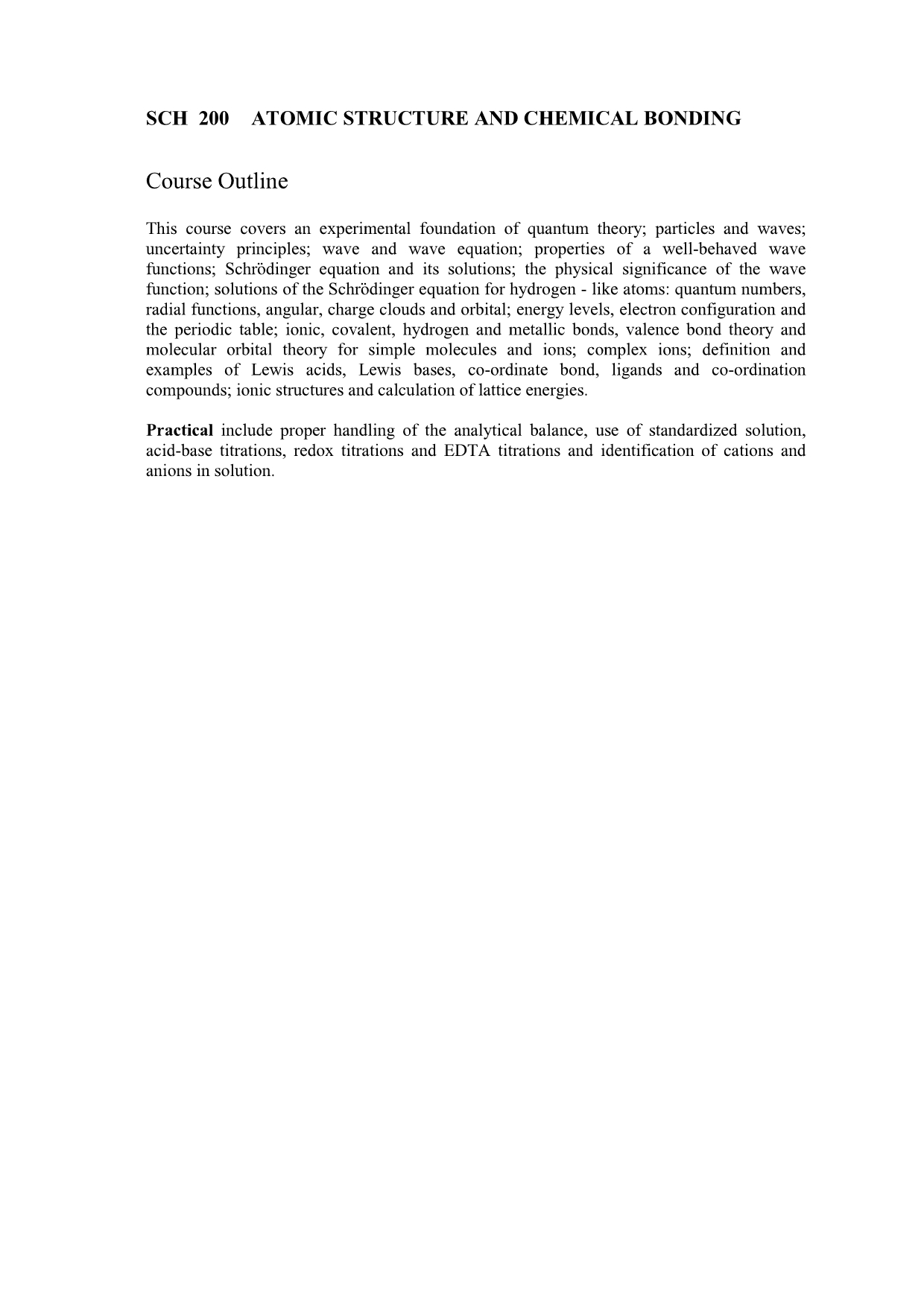
wave functions; Schrödinger equation and its solutions; the physical significance of the wave function; solutions of the Schrödinger equation for hydrogen - like atoms: quantum numbers, radial functions, angular, charge clouds and orbital; energy levels, electron configuration and the periodic table; ionic, covalent, hydrogen and metallic bonds, valence bond theory and molecular orbital theory for simple molecules and ions; complex ions; definition and examples of Lewis acids, Lewis bases, co-ordinate bond, ligands and co-ordination compounds; ionic structures and calculation of lattice energies.
Below is the document preview.

Elegant business card template
Trending!
Photoshop psd elegant business card template free
13109 Views
0 Downloads
2.62 MB
Awesome insiring web design template
Trending!
Free awesome responsive bootstrap web design template
8215 Views
0 Downloads
2.8 MB
BIOCHEMISTRY
Polyurethanes are prepared from diisocyanates
and diols. Urethane (also called a carbamate) is a
functional group that contains both an ester and an
amide at a single carbonyl group.
Nucleophilic Addition Reaction: Example 1:
Sevin is a highly effective, biodegradable insecticide. It
affects the nervous systems of insects by blocking
access to the neurotransmitter acetylcholine.
57 Pages
1431 Views
0 Downloads
1.68 MB
BIOCHEMISTRY
PETROLEUM CHEMISTRY
Carbon is so Important in the Life Cycle. It has
numerous ways of bonding with many other
elements, particularly oxygen and hydrogen.
It can form both “organic” and “inorganic”
compounds. Organic compounds are considered
unstable in the biosphere because they are in the
reduced state.
Whereas Inorganic compounds, principally
calcite (CaCO3
) and dolomite (CaMg(CO3
)2
), are
stable because they are in the oxidized state.
Carbon is present in most substances that are
vital for the development of life (called
“biomolecules”): Proteins, lipids, sacharides, etc
76 Pages
1411 Views
0 Downloads
1.86 MB
BIOCHEMISTRY
Alkyl halides are organic molecules containing a halogen
atom bonded to an sp3 hybridized carbon atom.
• Alkyl halides are classified as primary (1°), secondary (2°),
or tertiary (3°), depending on the number of carbons bonded
to the carbon with the halogen atom.
• The halogen atom in halides is often denoted by the symbol
“X”.
53 Pages
1496 Views
0 Downloads
2.07 MB
BIOCHEMISTRY
Natural Gas
Natural gas is a gaseous fossil fuel consisting
primarily of methane but including significant
quantities of ethane, butane, propane, carbon
dioxide, nitrogen, helium and hydrogen sulfide.
Obtained from oil fields and natural gas fields,
and in coal beds.
Methane-rich gases are produced by the
anaerobic decay of non-fossil organic material, ie
biogas.
Total world production of natural gas in 1986
was 100 trillion m3
.
It is used as feed stock as well as fuel. It is
preferred due to its high Calorific Value
52 Pages
1393 Views
0 Downloads
1.17 MB
Calculus 1 First Year
Trending!
Excelling in Calculus is the key
81 Pages
9550 Views
3 Downloads
841.91 KB
EPSC122: DEVELOPMENTAL PSYCHOLOGY
Trending!
Development refers to qualitative changes in behavioural characteristics of the individual leading towards maturity. Development can be inferred from the differentiation and emerging capabilities (functioning) of the individual e.g. cognitive, social, and moral, personality and motor abilities.
10169 Views
0 Downloads
331.5 KB
PHYS 121: GEOMETRICAL OPTICS
Trending!
The course will introduce you to
electromagnetic radiation, as light, mainly visible, which undergoes the
phenomena of reflection and refraction, which are applied to optical elements,
namely mirrors and lenses.
95 Pages
8467 Views
1 Downloads
977.28 KB