 Join Our WhatsApp Channel for Updates!
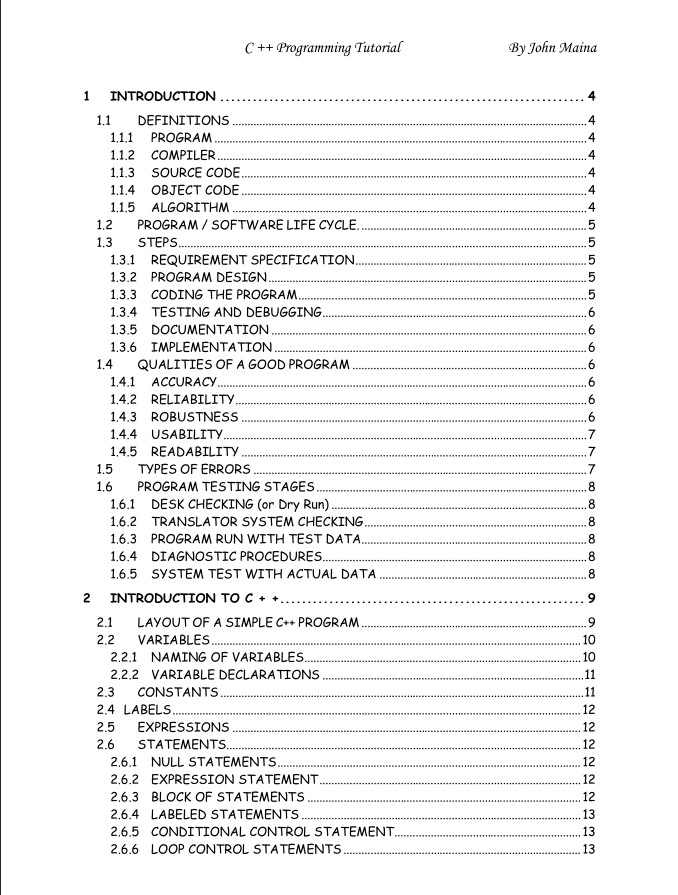
C ++ Programming Tutorial By John Maina
| Institution | JKUAT |
| Course | Information Technolo... |
| Year | 1st Year |
| Semester | Unknown |
| Posted By | Jeff Odhiambo |
| File Type | |
| Pages | 99 Pages |
| File Size | 461.91 KB |
| Views | 6716 |
| Downloads | 1 |
| Price: |
Buy Now
 Buy via
whatsapp Buy via
whatsapp
|


Description
C Language Overview
This chapter describes the basic details about C programming language, how it emerged,
What are strengths of C and why we should use C.
The C programming language is a general purpose, high level language that was
originally developed by Dennis M. Ritchie to develop the UNIX
operating system at Bell Labs. C was originally first implemented on the DEC PDP
11 computer in 1972.
In 1978, Brian Kernighan and Dennis Ritchie produced the first publicly available
description of C, now known as the K&R standard. The UNIX operating system, the C compiler, and essentially all UNIX applications programs have been written in C.
The C has now become a widely used professional language for various reasons.
Easy to learn
Structured language
It produces efficient programs.
It can handle low level activities.
It can be compiled on a variety of computer platforms.
Facts about C
C was invented to write an operating system called UNIX.
C is a successor of B language, which was introduced around 1970.
The language was formalized in 1988 by the American National Standard
Institute.(ANSI).
The UNIX OS was totally written in C by 1973
Below is the document preview.

SCH 103: INTRODUCTION TO ANALYTICAL CHEMISTRY
Trending!
In this lesson, we shall begin by making known to you what analytical chemistry is. The question of what, where, who and why of analytical chemistry will also be answered in this lesson. It will be interesting to learn that analytical chemistry is all around us and everything we do has an aspect of analytical chemistry.
129 Pages
7998 Views
1 Downloads
1.2 MB
2920/202 Computer application ll-notes - geographical information system lecture notes
Trending!
Geographical information system lecture notes
35 Pages
7022 Views
0 Downloads
469.69 KB
2920/202 Computer application ll-notes- artificial intelligence lecture notes
Trending!
Computer application ll-notes- artificial intelligence lecture notes
54 Pages
8206 Views
3 Downloads
704.47 KB
2920/205 Visual programming language looping notes
Trending!
Discribes in writing visual basic programs in implementing looping stutcures
26 Pages
6901 Views
1 Downloads
62.79 KB
2920/204 Qualitative methods/qualitative techniques - topic index numbers
Trending!
This will guide students in calculating and understanding what are index numbers.
22 Pages
7857 Views
1 Downloads
392.97 KB
2920/203 Object oriented programming -c++ concepts
Trending!
This are object oriented programming language programming concepts. It covers all concepts in c++ programming. It includes polymorphism, inheritance, and many others
16 Pages
6834 Views
0 Downloads
303.54 KB
2920/102 Computer application 1 - presentation lecture notes
Trending!
This are presentation lecture notes. It outline and makes students under how to use Ms office publisher
30 Pages
7398 Views
0 Downloads
621.92 KB
2920/206 Database management system - entity relationship model topic notes
Trending!
This is database management system notes. It is topical notes that covers various issues on entity relationship diagram
Covers entity relationship model basic concepts, characteristics of attributes, types of relation and referential integrity.
8 Pages
8000 Views
0 Downloads
172.32 KB
2920/206 Database management system - Database normalization topic notes
Trending!
This is a topic lecture notes on database management system. Topic is database normalization. It explains what is normalization, use of delete, insert and update anomaly. Explains how to normalize 1,2,3,boy cord, 4 and 5th forms. It ends with outlining the advantages and disadvantages of database normalization.
12 Pages
7476 Views
0 Downloads
165.81 KB