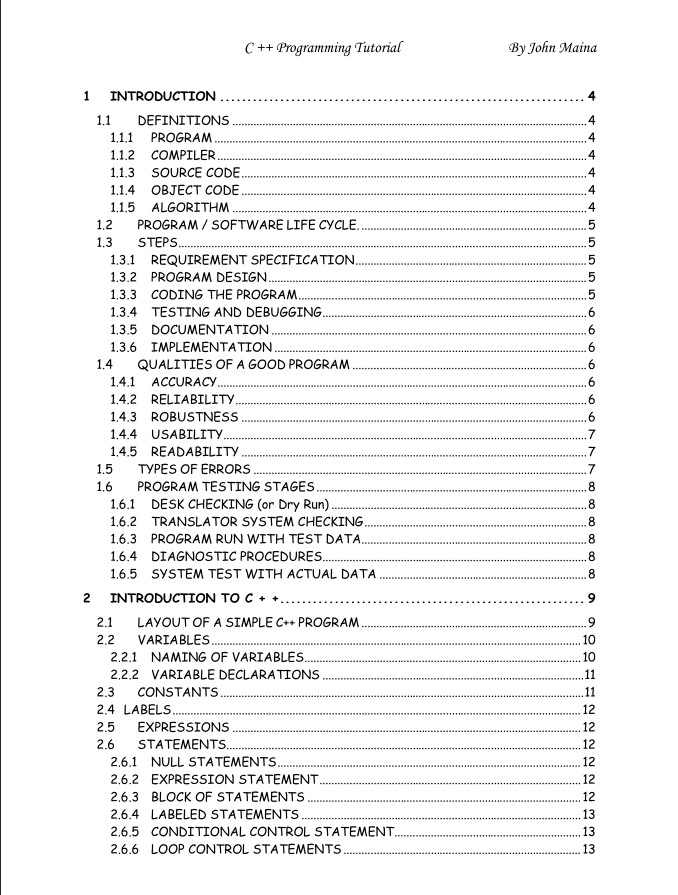
C ++ Programming Tutorial By John Maina
| Institution | JKUAT |
| Course | Information Technolo... |
| Year | 1st Year |
| Semester | Unknown |
| Posted By | Jeff Odhiambo |
| File Type | |
| Pages | 99 Pages |
| File Size | 461.91 KB |
| Views | 8390 |
| Downloads | 1 |
| Price: |
Buy Now
 Buy via
whatsapp Buy via
whatsapp
|


Description
C Language Overview
This chapter describes the basic details about C programming language, how it emerged,
What are strengths of C and why we should use C.
The C programming language is a general purpose, high level language that was
originally developed by Dennis M. Ritchie to develop the UNIX
operating system at Bell Labs. C was originally first implemented on the DEC PDP
11 computer in 1972.
In 1978, Brian Kernighan and Dennis Ritchie produced the first publicly available
description of C, now known as the K&R standard. The UNIX operating system, the C compiler, and essentially all UNIX applications programs have been written in C.
The C has now become a widely used professional language for various reasons.
Easy to learn
Structured language
It produces efficient programs.
It can handle low level activities.
It can be compiled on a variety of computer platforms.
Facts about C
C was invented to write an operating system called UNIX.
C is a successor of B language, which was introduced around 1970.
The language was formalized in 1988 by the American National Standard
Institute.(ANSI).
The UNIX OS was totally written in C by 1973
Below is the document preview.

GRADE 8 CRE EXAMS SET 1
Trending!
Download a copy of GRADE 8 CRE EXAMS SET 1 with a comprehensive and elaborate marking scheme attached.
11 Pages
9915 Views
3 Downloads
742.56 KB
GRADE 8 ENGLISH EXAMS SET 1
Trending!
Download a copy of GRADE 8 ENGLISH EXAMS SET 1 with a comprehensive and elaborate marking scheme attached.
8 Pages
9451 Views
1 Downloads
924.9 KB
GRADE 8 INTEGRATED SCIENCE EXAMS SET 1
Trending!
Download a copy of GRADE 8 INTEGRATED SCIENCE EXAMS SET 1 with a comprehensive and elaborate marking scheme attached.
10 Pages
14578 Views
17 Downloads
1.1 MB
GRADE 8 KISWAHILI EXAMS SET 1
Trending!
Download a copy of GRADE 8 KISWAHILI EXAMS SET 1 with a comprehensive and elaborate marking scheme attached.
5 Pages
8623 Views
0 Downloads
343.17 KB
GRADE 8 MATHS EXAMS SET 1
Trending!
Download a copy of GRADE 8 MATHS EXAMS SET 1 with a comprehensive and elaborate marking scheme attached.
7 Pages
13364 Views
12 Downloads
1.04 MB
GRADE 8 PRE-TECHNICAL EXAMS SET 1
Trending!
Download a copy of GRADE 8 PRE-TECHNICAL EXAMS SET 1 with a comprehensive and elaborate marking scheme attached.
12 Pages
11381 Views
12 Downloads
472.12 KB
GRADE 8 SOCIAL STUDIES EXAMS SET 1
Trending!
Download a copy of GRADE 8 SOCIAL STUDIES EXAMS SET 1 with a comprehensive and elaborate marking scheme attached.
14 Pages
9170 Views
5 Downloads
1.13 MB
GRADE 8 VISUAL ARTS EXAMS SET 1
Trending!
Download a copy of GRADE 8 VISUAL ARTS EXAMS SET 1 with a comprehensive and elaborate marking scheme attached.
13 Pages
8326 Views
0 Downloads
888.52 KB
GRADE 8 BUSINESS EDUCATION EXAMS SET 1
Trending!
Download a copy of GRADE 8 BUSINESS EDUCATION EXAMS SET 1 with a comprehensive and elaborate marking scheme attached.
6 Pages
7564 Views
0 Downloads
685.18 KB
GRADE 8 AGRICULTURE EXAMS SET 1
Trending!
Download a copy of GRADE 8 AGRICULTURE EXAMS SET 1 with a comprehensive and elaborate marking scheme attached.
7 Pages
9874 Views
1 Downloads
294.67 KB