LEGAL ASPECTS IN SOCIAL DEVELOPMENT
| Institution | TVET |
| Course | DIPLOMA IN SOCIAL WO... |
| Year | 1st Year |
| Semester | Unknown |
| Posted By | stephen |
| File Type | |
| Pages | 48 Pages |
| File Size | 871.3 KB |
| Views | 9763 |
| Downloads | 0 |
| Price: |
Buy Now
 Buy via
whatsapp Buy via
whatsapp
|


Description
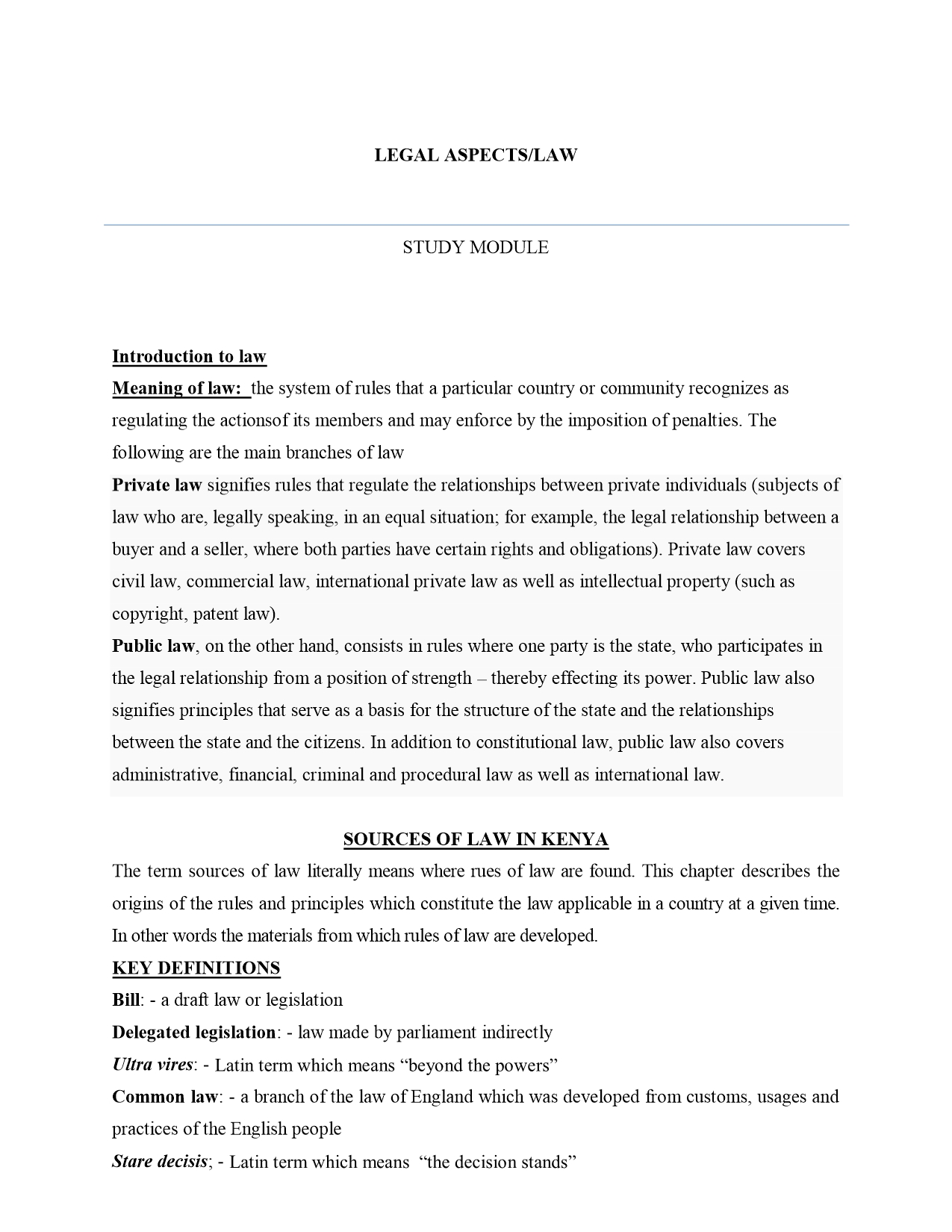
Meaning of law: the system of rules that a particular country or community recognizes as regulating the actionsof its members and may enforce by the imposition of penalties. The following are the main branches of law
Private law signifies rules that regulate the relationships between private individuals (subjects of law who are, legally speaking, in an equal situation; for example, the legal relationship between a buyer and a seller, where both parties have certain rights and obligations). Private law covers civil law, commercial law, international private law as well as intellectual property (such as copyright, patent law).
Public law, on the other hand, consists in rules where one party is the state, who participates in the legal relationship from a position of strength – thereby effecting its power. Public law also signifies principles that serve as a basis for the structure of the state and the relationships between the state and the citizens. In addition to constitutional law, public law also covers administrative, financial, criminal and procedural law as well as international law.
Below is the document preview.

Principles of Questionnaire Construction
Trending!
Rank ordering is a method that works well with a small number of objects, such as 10. For example, instead of rating how serious each of a set of organizational problems are, you could ask the respondent to simply sort them in order of most to least serious.
7299 Views
0 Downloads
23.36 KB
INTRODUCTION TO STATISTICS
Statistics is the study of how to collect, organize analyze and interpret numerical information (data).
554 Views
0 Downloads
24.68 KB
NGE 201: GEOGRAPHIC THOUGHT
Trending!
Friedrich Ratzel (1844-1904)
He dominated the geographical scene in the late 19th century. He got his early education at several universities in Germany. He travelled widely in the United States, Europe and Mexico and Worked at the Universities of Munich and Leipzig. He was trained in zoology, geology and comparative anatomy.
8655 Views
0 Downloads
59.5 KB
Writing Learning Objectives
Trending!
A learning objective answers the question: What is it that your students should be able to do at the end of the class session and course that they could not do before?
9 Pages
8129 Views
0 Downloads
111.8 KB
UCU101: Introduction to Development Studies
Trending!
Updated notes on Introduction to Development Studies
115 Pages
8626 Views
1 Downloads
4.2 MB
AGE 302: GEOGRAPHY OF AFRICA
Trending!
Geography of Africa is a unit which is developed on the knowledge that was
obtained from the study of Geography of East Africa (Age 203). This course (Age 302)
builds on the knowledge of two components namely; Physical Environment and
Human Environment.
128 Pages
3179 Views
1 Downloads
1.35 MB
AHT203: MODERN GOVERNMENTS IN AFRICA
Trending!
This module examines modern governments in Africa. These are governments
that emerged in African States in the independence and post independence period. The
module interrogates the socio-political and economic factors that have led to the growth of modern governments in Africa
67 Pages
10007 Views
2 Downloads
2.24 MB
EMP201: CURRICULUM CONTEXT
Trending!
The main purpose of education is to socialize an individual among peer groups. From the beginning of human society, the main objective of education has been that of transmitting to the child the accumulated experiences of his people and their culture as well as of training him to fit into the membership of the group. It was through this background that the society has managed to survive and gain increasing knowledge over all forms of human institutions: governance, rituals, survival etc.
8941 Views
0 Downloads
139.59 KB
HES 205: MOTOR DEVELOPMENT AND LEARNING
Trending!
This course is designed to equip the students with a framework for understanding and exploring how motor development and motor learning interact with and affect each other. The discussions in this course will encourage students to have a thorough understanding of the factors that influence and enhance the development of motor skills across the life span and approaches to teach movement skills effectively to learners at any chronological age and at any skill level
42 Pages
9036 Views
0 Downloads
1.4 MB
BAC408: APPLIED INVESTMENT
Trending!
The course covers the investment opportunities, the tools of investment analysis and performance measures.
89 Pages
7781 Views
2 Downloads
701.04 KB