AGD 201: GENDER AND DEVELOPMENT THEORIES
| Institution | KENYATTA UNIVERSITY |
| Course | BACHELOR OF ARTS GEN... |
| Year | 2nd Year |
| Semester | Unknown |
| Posted By | stephen oyake rabilo |
| File Type | |
| Pages | 48 Pages |
| File Size | 328.04 KB |
| Views | 9068 |
| Downloads | 1 |
| Price: |
Buy Now
 Buy via
whatsapp Buy via
whatsapp
|


Description
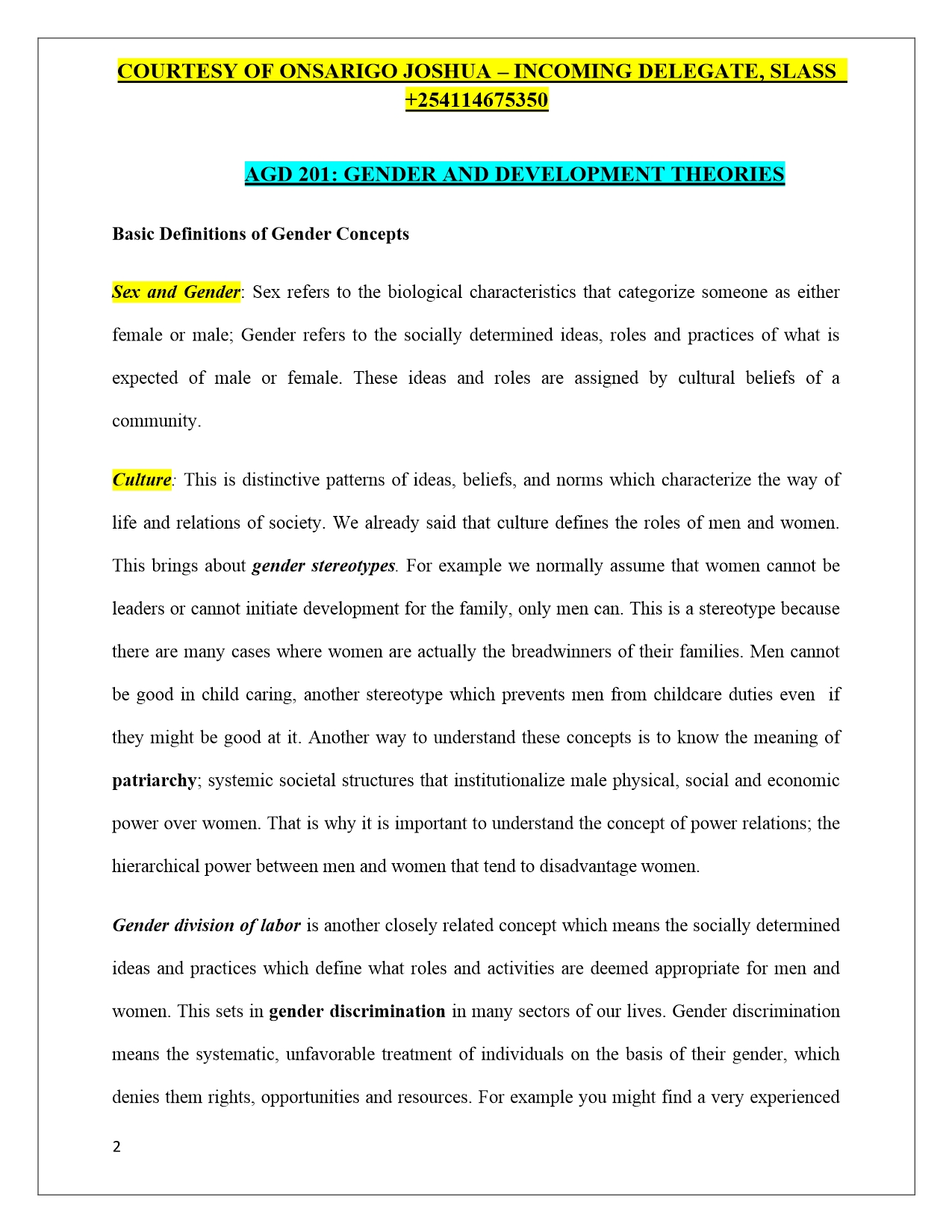
Sex and Gender: Sex refers to the biological characteristics that categorize someone as either female or male; Gender refers to the socially determined ideas, roles and practices of what is expected of male or female. These ideas and roles are assigned by cultural beliefs of a community. Culture: This is distinctive patterns of ideas, beliefs, and norms which characterize the way of life and relations of society. We already said that culture defines the roles of men and women. This brings about gender stereotypes. For example we normally assume that women cannot be leaders or cannot initiate development for the family, only men can. This is a stereotype because there are many cases where women are actually the breadwinners of their families. Men cannot be good in child caring, another stereotype which prevents men from childcare duties even if they might be good at it. Another way to understand these concepts is to know the meaning of patriarchy; systemic societal structures that institutionalize male physical, social and economic power over women. That is why it is important to understand the concept of power relations; the hierarchical power between men and women that tend to disadvantage women.
Below is the document preview.

TOPIC 1-2: INTRODUCTION TO ICT
Trending!
Information is derived from processing the data i.e. its first meaningful resources and therefore when processed manually, mechanically or electronically, information is obtained. Such form of processing task takes the form of classification, sorting, calculating, summarizing etc.
14 Pages
6117 Views
0 Downloads
703.69 KB
TOPIC 3-4: INFORMATION SYSTEMS ARCHITECTURE
Trending!
This is the smallest element in computer file. The bit notation forms the basis of the computer working and as such it is impossible for the human beings to appreciate its use and that is why for the logical files, which are the view of the file user, the bits are not significant.
13 Pages
7095 Views
1 Downloads
815.26 KB
TOPIC 5-6: INTRODUCTION TO SYSTEMS DEVELOPMENT
Trending!
A system is an organized, purposeful structure regarded as a whole and consisting of interrelated and interdependent elements. These elements continually influence one another (directly or indirectly) to maintain their activity and the existence of the system in order to achieve the goal of the system.
17 Pages
7046 Views
0 Downloads
670.26 KB
TOPIC 7-8: INFORMATION SYSTEMS IN AN ENTERPRISE
Trending!
An information system is a set of interrelated components that work together to collect, process, store, and disseminate information to support decision making, coordination, control, analysis and visualization in an organization.
19 Pages
7961 Views
0 Downloads
779.5 KB
TOPIC 9-10: DATA COMMUNICATION AND COMPUTER NETWORKS
Trending!
DATA COMMUNICATION is the electronic transmission of information that has been encoded digitally (as for storage and processing by computers). Telecommunication equipment are used to support data communication. Data refers to facts, concepts and instructions that are presented in the format that can be understood by all the parties involved.
12 Pages
8786 Views
1 Downloads
808.95 KB
TOPIC 11: INTERNET AND E-COMMERCE
Trending!
The Internet is a public network that allows access to a number of users globally with no time and location limitations. It’s commonly referred to as information superhighway because it is assumed that any information can be acquired from the Internet and can be added to the internet websites. It can also be defined as a wide area network (WAN) that enables organizations and individuals to communicate globally. Certain protocols like SMTP for e-mail, FTP for a file transfer and HTTP for accessing/transferring web pages are important when describing the internet.
16 Pages
7410 Views
0 Downloads
659.41 KB
TOPIC 11: LEGAL, ETHICAL AND SOCIAL ISSUES IN MANAGEMENT INFORMATION SYSTEMS
Trending!
Ethics refer to the principles of right and wrong that individuals who act as free moral agents use to make choices that will guide their behavior. Although protecting personal privacy and intellectual property are on the spotlight, there are other pressing ethical issues brought about by the widespread use of information systems. This is because ICT can be used to commit crime or to threaten social values.
5 Pages
8139 Views
0 Downloads
563.37 KB
BAF 315: AUDITING I
Trending!
ISA 315 further states that the auditor should obtain an understanding of the accounting and internal control systems sufficient to plan the audit and develop an effective audit approach. The auditor should use professional judgment to assess audit risk and to design audit procedures to ensure it is reduced to an acceptably low level.
21 Pages
6509 Views
1 Downloads
571.89 KB
Explanation of Simplex Method 1
Trending!
The Simplex method is an approach to solving linear programming models by hand using slack variables, tableaus, and pivot variables as a means to finding the optimal solution of an optimization problem.
11 Pages
6973 Views
0 Downloads
1.11 MB
BASIC STATISTICAL CONCEPTS
Trending!
Statistics is a mathematical body of science that pertains to the collection, analysis, interpretation or explanation, and presentation of data, or as a branch of mathematics. Some consider statistics to be a distinct mathematical science rather than a branch of mathematics. While many scientific investigations make use of data, statistics is concerned with the use of data in the context of uncertainty and decision making in the face of uncertainty.
43 Pages
7190 Views
0 Downloads
1.08 MB