PARLIAMENT OF OWLS ESSAYS AND ANSWERS SERIES 2
| Institution | SECONDARY |
| Course | ENGLISH LITERATURE |
| Year | 4th Year |
| Semester | Unknown |
| Posted By | Amos |
| File Type | |
| Pages | 25 Pages |
| File Size | 365.86 KB |
| Views | 15656 |
| Downloads | 45 |
| Price: |
Buy Now
 Buy via
whatsapp Buy via
whatsapp
|


Description
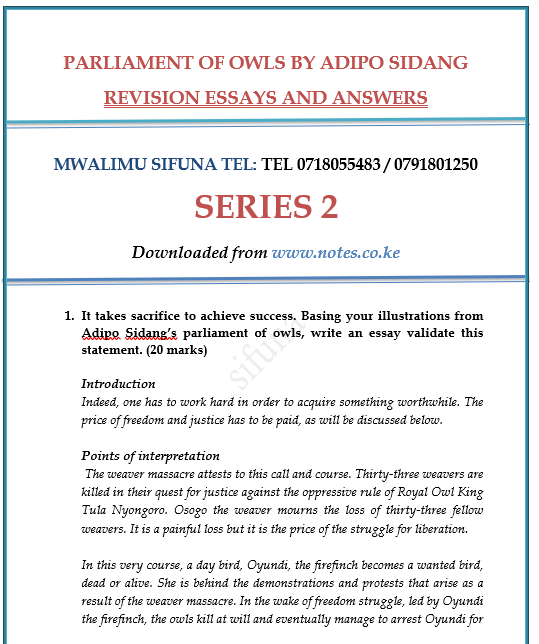
PARLIAMENT OF OWLS ESSAYS AND ANSWERS
SERIES 2
1. It takes sacrifice to achieve success. Basing your illustrations from Adipo Sidang’s parliament of owls, write an essay validate this statement. (20 marks)
Introduction
Indeed, one has to work hard in order to acquire something worthwhile. The price of freedom and justice has to be paid, as will be discussed below.
Points of interpretation
The weaver massacre attests to this call and course. Thirty-three weavers are killed in their quest for justice against the oppressive rule of Royal Owl King Tula Nyongoro. Osogo the weaver mourns the loss of thirty-three fellow weavers. It is a painful loss but it is the price of the struggle for liberation.
Below is the document preview.

A SILENT SONG ESSAYS QUESTIONS AND ANSWERS
Recommended!
Trending!
Get a copy of the A SILENT SONG ESSAYS QUESTIONS AND ANSWERS, This is a very vital resource in your revision and preparation for your upcoming exams. its contains questions and comprehensive answers/marking schemes attached. This will serve you well.
35 Pages
11258 Views
27 Downloads
969.77 KB
Maudhui katika Nguu za Jadi
Recommended!
Trending!
Ukabila ni hali ya kupendelea mtu, watu au Jamii fulani kutokana na misingi ya
kabila. Upendeleo huu huweza kuhusisha mambo mengi kama vile ajira, elimu,
makazi, vyeo, na kadhalika. Katika riwaya hii...
7 Pages
16039 Views
32 Downloads
465.29 KB
Wahusika wa Nguu za Jadi
Trending!
Wahusika wakuu: Hawa ni wahusika ambao hujitokeza mahali kwingi katika fasihi kiasi cha kwamba wanajitokeza kuanzia mwanzo wa kazi ya fasihi hadi mwisho. Kwa kawaida wahusika hawa hubeba maudhui makuu ya fasihi.
31 Pages
10553 Views
5 Downloads
495.46 KB
ENGLISH FORM 3 TERM 3 END YEAR FULL EXAMS WITH MARKING SCHEMES
Trending!
Get a copy of the ENGLISH FORM 3 TERM 3 END YEAR FULL EXAMS WITH MARKING SCHEMES. This is a well set and moderated exam paper with a well coordinated comprehensive marking scheme attached herein. Attached is also the EDITABLE Question Papers that you can customize to your preference.
37 Pages
9067 Views
1 Downloads
1014.01 KB
PARLIAMENT OF OWLS ESSAYS AND ANSWERS
Recommended!
Trending!
PARLIAMENT OF OWLS ESSAYS AND ANSWERS
SERIES 1
1. Misuse of power is a common phenomenon in most African countries. Validate this statement basing your arguments on the play “Parliament of Owls” 20 marks)
Introduction
Political office in a country comes with duties and responsibilities. Holders of such offices are expected to observe a high degree of integrity as they serve in those offices. It is also vital for the office- holder to perform their duties as dictated by their position without prejudice, bias, Malice, or other unwanted behaviour. However, it as been seen that some officeholders tend to use the privilege of being in such positions to advance their agenda and for self-gain.(accept any other relevant introduction)
26 Pages
19528 Views
59 Downloads
362.25 KB
AMC 800: RESEARCH METHODS NOTES
Trending!
Research involves a critical analysis of existing conclusions or theories with regard to
newly discovered facts i.e. it’s a continued search for new knowledge and
understanding of the world around us.
71 Pages
6188 Views
1 Downloads
714.06 KB
AN ARTIST OF THE FLOATING WORLD ESSAY QUESTIONS AND ANSWERS
Trending!
AN ARTIST OF THE FLOATING
WORLD ESSAY QUESTIONS AND
ANSWERS
1. Some of our past actions may cause us problems in the future.
Making reference to Kazuo Ishiguro’s An Artist of the Floating
World, write an essay to support this statement.
Some of the things we did in the past may come back to haunt us in the
future. Ono is deeply disturbed by some of his past actions as portrayed
in Kazuo Ishiguro’s An Artist of the Floating World.
Ono is worried that some of his past actions may have contribute... ....
41 Pages
11073 Views
10 Downloads
435.15 KB
FATHERS OF NATIONS EXCERPTS AND ANSWERS
Trending!
FATHERS OF NATIONS EXCERPTS
AND ANSWERS
EXCERPT 1
Red the excerpt below then answer the questions that follow
The door to the bathroom opened. Fiona emerged and started walking but
stopped. Her eyes had not adjusted to the darkness in the living room. “Where
are you?” she asked.
“Over here” he said. “I have taken a couch in the living room. Go take the bed in
the bedroom.”
“You’re acting as if you might have a wife,” she said. “Do you?” “No, she
divorced me last year.”
“Did she?”
“Yes”
“Let’s see now.......
22 Pages
11699 Views
11 Downloads
378.87 KB
ENGLISH FORM 2 TERM 3 END YEAR FULL EXAMS WITH MARKING SCHEMES
Trending!
Get a copy of the ENGLISH FORM 2 TERM 3 END YEAR FULL EXAMS WITH MARKING SCHEMES. This is a well set and moderated exam paper with a well coordinated comprehensive marking scheme attached herein. Attached is also the EDITABLE Question Papers that you can customize to your preference.
27 Pages
8573 Views
2 Downloads
745.29 KB
ENGLISH FORM 1 TERM 3 END YEAR FULL EXAMS WITH MARKING SCHEMES
Trending!
Get a copy of the ENGLISH FORM 1 TERM 3 END YEAR FULL EXAMS WITH MARKING SCHEMES. This is a well set and moderated exam paper with a well coordinated comprehensive marking scheme attached herein. Attached is also the EDITABLE Question Papers that you can customize to your preference.
20 Pages
16882 Views
0 Downloads
698.18 KB