XEA 406-POVERTY AND DEVELOPMENT
| Institution | UNIVERSITY |
| Course | Bachelors of Economi... |
| Year | 4th Year |
| Semester | Unknown |
| Posted By | stephen oyake rabilo |
| File Type | |
| Pages | 17 Pages |
| File Size | 340.5 KB |
| Views | 293 |
| Downloads | 0 |
| Price: |
Buy Now
 Buy via
whatsapp Buy via
whatsapp
|


Description
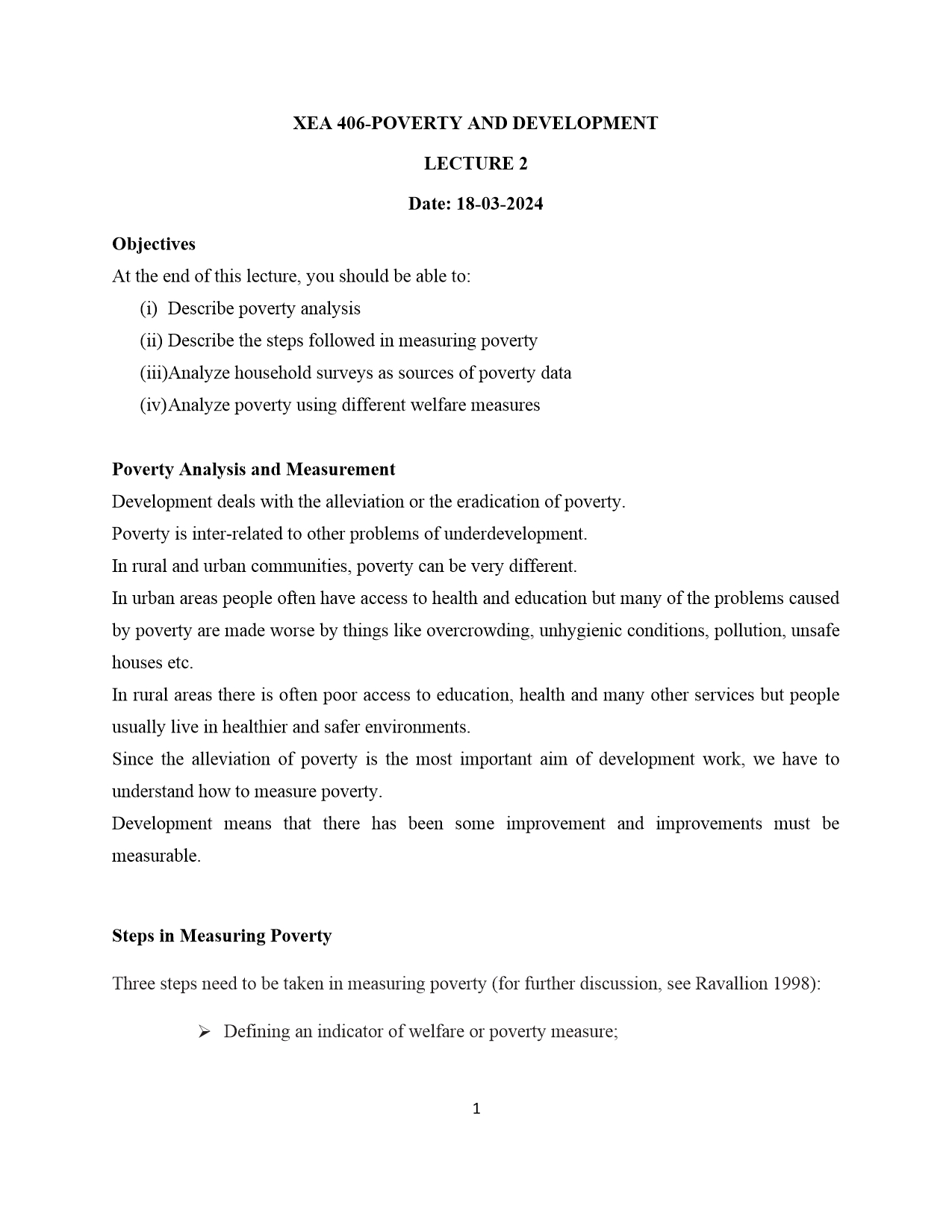
Poverty Analysis and Measurement
Development deals with the alleviation or the eradication of poverty. Poverty is inter-related to other problems of underdevelopment.
In rural and urban communities, poverty can be very different.
In urban areas people often have access to health and education but many of the problems caused by poverty are made worse by things like overcrowding, unhygienic conditions, pollution, unsafe
houses etc. In rural areas there is often poor access to education, health and many other services but people
usually live in healthier and safer environments.
Since the alleviation of poverty is the most important aim of development work, we have to understand how to measure poverty. Development means that there has been some improvement and improvements must be measurable.
Below is the document preview.

XEA 406-POVERTY AND DEVELOPMENT
Choosing and Estimating a Poverty Line
Once an aggregate income, consumption or non-monetary measure is defined at the household or
individual level, the next step is to define one or more poverty lines.
What is Poverty Line?
Poverty lines are cut-off points separating the poor from the non-poor. They can be monetary (for example a certain level of consumption) or non-monetary (for example a certain level of literacy). The use of multiple lines can help in distinguishing different levels of poverty
12 Pages
478 Views
0 Downloads
240.94 KB