The SN2 reaction
| Institution | UNIVERSITY |
| Course | BACHELOR OF SCIENCE... |
| Year | 4th Year |
| Semester | Unknown |
| Posted By | stephen oyake rabilo |
| File Type | |
| Pages | 13 Pages |
| File Size | 190.14 KB |
| Views | 6317 |
| Downloads | 0 |
| Price: |
Buy Now
 Buy via
whatsapp Buy via
whatsapp
|


Description
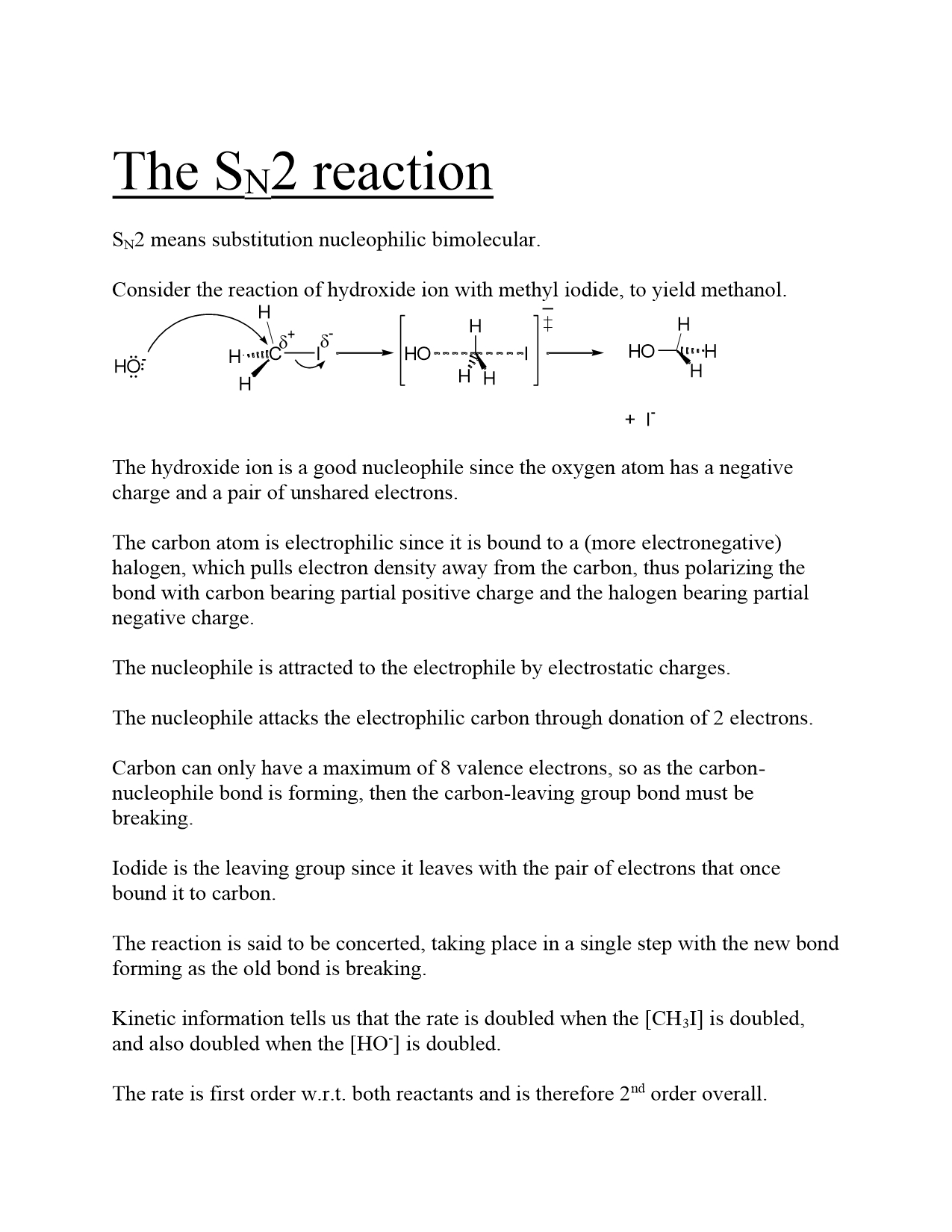
The hydroxide ion is a good nucleophile since the oxygen atom has a negative charge and a pair of unshared electrons.
The carbon atom is electrophilic since it is bound to a (more electronegative)
halogen, which pulls electron density away from the carbon, thus polarizing the
bond with carbon bearing partial positive charge and the halogen bearing partial negative charge.
The nucleophile is attracted to the electrophile by electrostatic charges.
The nucleophile attacks the electrophilic carbon through donation of 2 electrons. Carbon can only have a maximum of 8 valence electrons, so as the carbon nucleophile bond is forming, then the carbon-leaving group bond must be breaking. Iodide is the leaving group since it leaves with the pair of electrons that once bound it to carbon.
Below is the document preview.

KCSE FORM 1 CHEMISTRY NOTES
Trending!
UPDATED KCSE FORM1 CHEMISTRY NOTES
117 Pages
8624 Views
1 Downloads
2.43 MB
KCSE FORM 2 CHEMISTRY NOTES
Trending!
UPDATED KCSE FORM2 CHEMISTRY NOTES
137 Pages
5100 Views
0 Downloads
1.73 MB
KCSE FORM 3 CHEMISTRY NOTES
Trending!
UPDATED KCSE FORM3 CHEMISTRY NOTES
262 Pages
6404 Views
2 Downloads
2.11 MB
KCSE FORM 4 CHEMISTRY NOTES
Trending!
UPDATED KCSE FORM4 CHEMISTRY NOTES
334 Pages
4956 Views
2 Downloads
4.44 MB