 Join Our WhatsApp Channel for Updates!
Nanoparticles: synthesis and applications
| Institution | UNIVERSITY |
| Course | BACHELOR OF SCIENCE... |
| Year | 4th Year |
| Semester | Unknown |
| Posted By | stephen oyake rabilo |
| File Type | |
| Pages | 30 Pages |
| File Size | 1.73 MB |
| Views | 4627 |
| Downloads | 0 |
| Price: |
Buy Now
 Buy via
whatsapp Buy via
whatsapp
|


Description
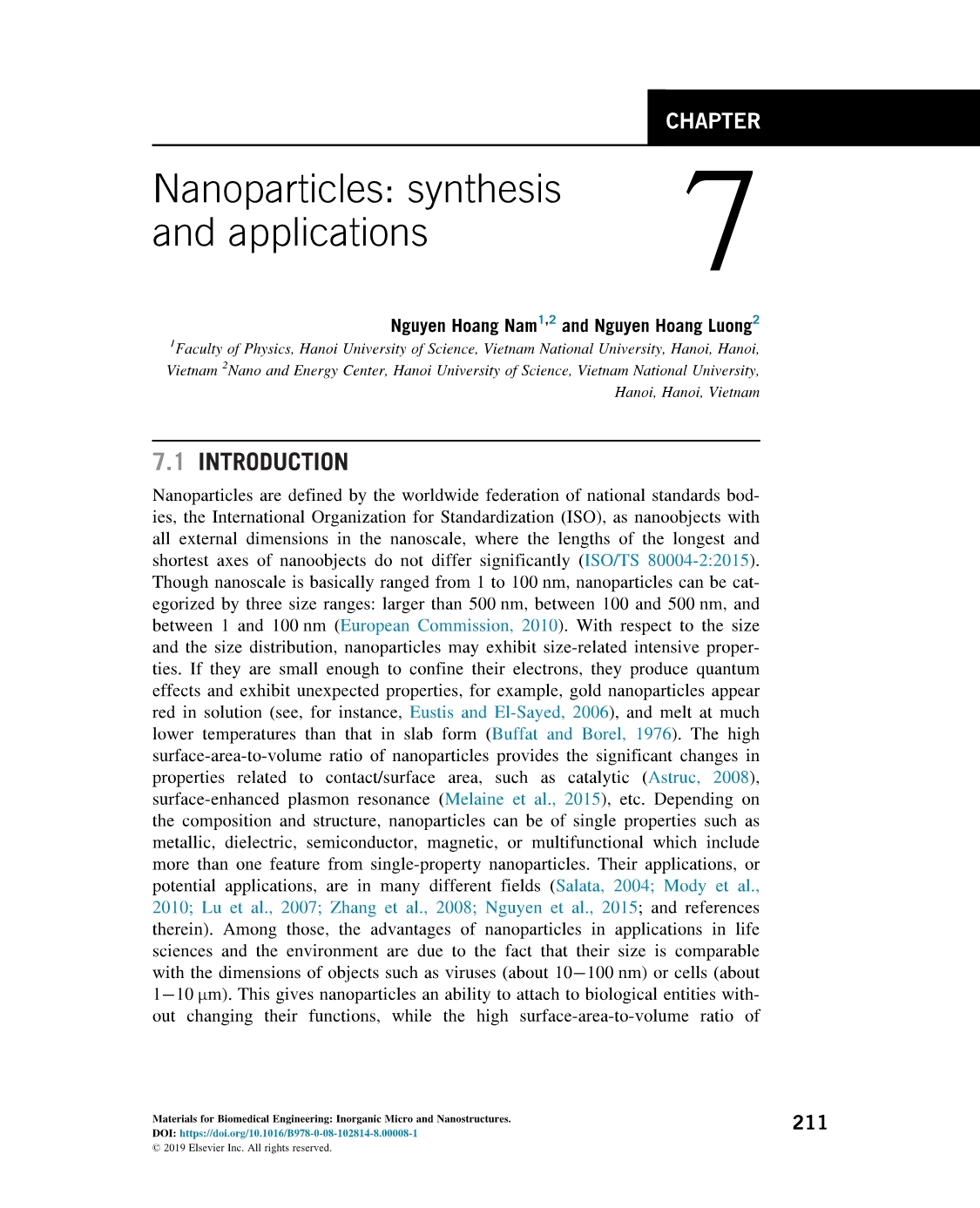
Nanoparticles are defined by the worldwide federation of national standards bodies, the International Organization for Standardization (ISO), as nanoobjects with
all external dimensions in the nanoscale, where the lengths of the longest andshortest axes of nanoobjects do not differ significantly . Though nanoscale is basically ranged from 1 to 100 nm, nanoparticles can be categorized by three size ranges: larger than 500 nm, between 100 and 500 nm, and
between 1 and 100 nm (European Commission, 2010). With respect to the size and the size distribution, nanoparticles may exhibit size-related intensive properties. If they are small enough to confine their electrons, they produce quantum effects and exhibit unexpected properties, for example, gold nanoparticles appear red in solution (see, for instance, Eustis and El-Sayed, 2006), and melt at much lower temperatures than that in slab form (Buffat and Borel, 1976). The high surface-area-to-volume ratio of nanoparticles provides the significant changes in properties related to contact/surface area, such as catalytic (Astruc, 2008),surface-enhanced plasmon resonance (Melaine et al., 2015), etc.
Below is the document preview.

SCH 103: INTRODUCTION TO ANALYTICAL CHEMISTRY
Trending!
In this lesson, we shall begin by making known to you what analytical chemistry is. The question of what, where, who and why of analytical chemistry will also be answered in this lesson. It will be interesting to learn that analytical chemistry is all around us and everything we do has an aspect of analytical chemistry.
129 Pages
8454 Views
1 Downloads
1.2 MB
2920/202 Computer application ll-notes - geographical information system lecture notes
Trending!
Geographical information system lecture notes
35 Pages
7409 Views
0 Downloads
469.69 KB
2920/202 Computer application ll-notes- artificial intelligence lecture notes
Trending!
Computer application ll-notes- artificial intelligence lecture notes
54 Pages
8478 Views
3 Downloads
704.47 KB
2920/205 Visual programming language looping notes
Trending!
Discribes in writing visual basic programs in implementing looping stutcures
26 Pages
7307 Views
1 Downloads
62.79 KB
2920/204 Qualitative methods/qualitative techniques - topic index numbers
Trending!
This will guide students in calculating and understanding what are index numbers.
22 Pages
8369 Views
1 Downloads
392.97 KB
2920/203 Object oriented programming -c++ concepts
Trending!
This are object oriented programming language programming concepts. It covers all concepts in c++ programming. It includes polymorphism, inheritance, and many others
16 Pages
7114 Views
0 Downloads
303.54 KB
2920/102 Computer application 1 - presentation lecture notes
Trending!
This are presentation lecture notes. It outline and makes students under how to use Ms office publisher
30 Pages
7664 Views
0 Downloads
621.92 KB
2920/206 Database management system - entity relationship model topic notes
Trending!
This is database management system notes. It is topical notes that covers various issues on entity relationship diagram
Covers entity relationship model basic concepts, characteristics of attributes, types of relation and referential integrity.
8 Pages
8128 Views
0 Downloads
172.32 KB
2920/206 Database management system - Database normalization topic notes
Trending!
This is a topic lecture notes on database management system. Topic is database normalization. It explains what is normalization, use of delete, insert and update anomaly. Explains how to normalize 1,2,3,boy cord, 4 and 5th forms. It ends with outlining the advantages and disadvantages of database normalization.
12 Pages
7745 Views
0 Downloads
165.81 KB