ASPECTS OF HUMAN GROWTH AND DEVELOPMENT
| Institution | TVET |
| Course | Diploma in Social Wo... |
| Year | 1st Year |
| Semester | Unknown |
| Posted By | stephen |
| File Type | |
| Pages | 3 Pages |
| File Size | 349.09 KB |
| Views | 10426 |
| Downloads | 2 |
| Price: |
Buy Now
 Buy via
whatsapp Buy via
whatsapp
|


Description
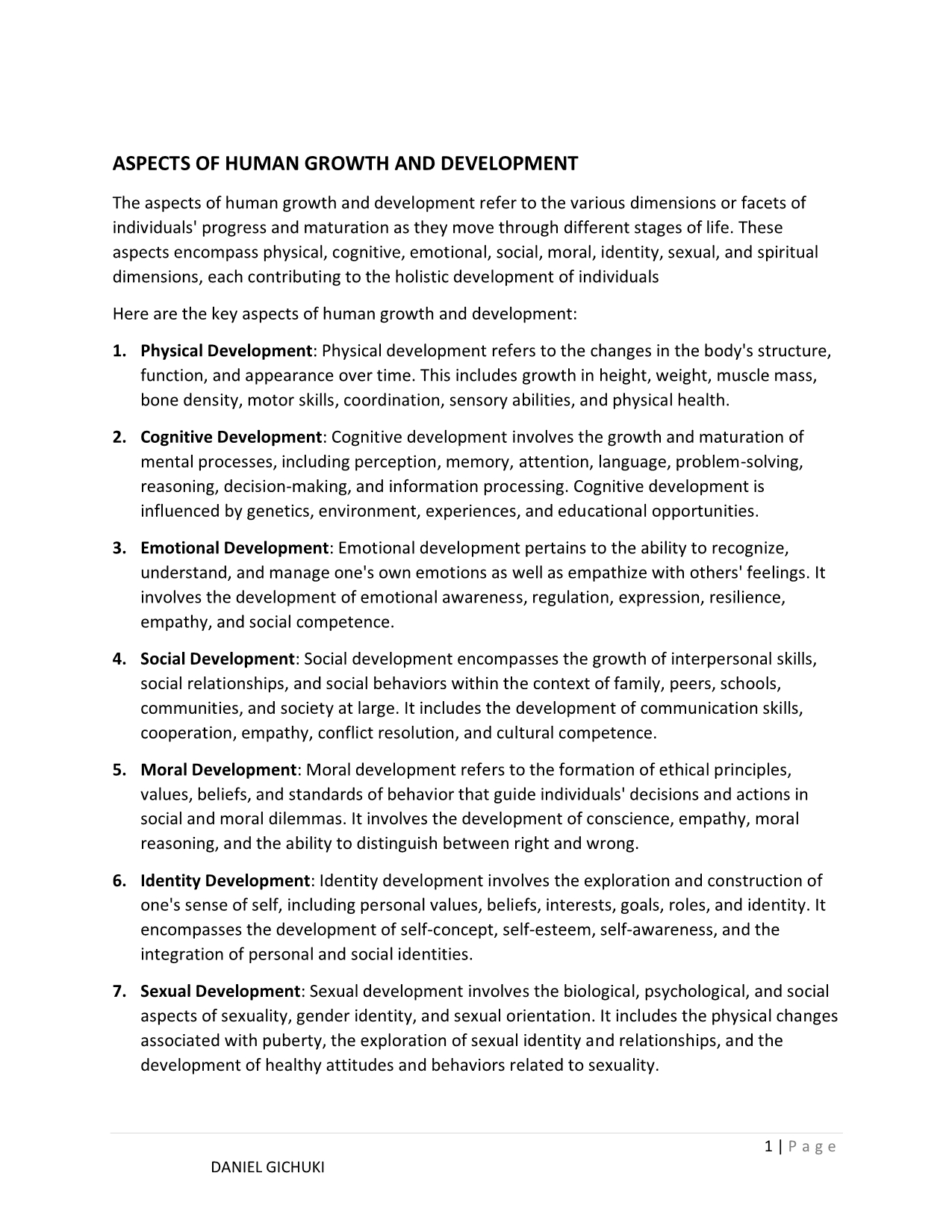
ASPECTS OF HUMAN GROWTH AND DEVELOPMENT
The aspects of human growth and development refer to the various dimensions or facets of individuals' progress and maturation as they move through different stages of life. These aspects encompass physical, cognitive, emotional, social, moral, identity, sexual, and spiritual dimensions, each contributing to the holistic development of individuals
Here are the key aspects of human growth and development:
1. Physical Development: Physical development refers to the changes in the body's structure, function, and appearance over time. This includes growth in height, weight, muscle mass, bone density, motor skills, coordination, sensory abilities, and physical health.
2. Cognitive Development: Cognitive development involves the growth and maturation of mental processes, including perception, memory, attention, language, problem-solving, reasoning, decision-making, and information processing. Cognitive development is influenced by genetics, environment, experiences, and educational opportunities.
3. Emotional Development: Emotional development pertains to the ability to recognize, understand, and manage one's own emotions as well as empathize with others' feelings. It involves the development of emotional awareness, regulation, expression, resilience, empathy, and social competence.
4. Social Development: Social development encompasses the growth of interpersonal skills, social relationships, and social behaviors within the context of family, peers, schools, communities, and society at large. It includes the development of communication skills, cooperation, empathy, conflict resolution, and cultural competence.
5. Moral Development: Moral development refers to the formation of ethical principles, values, beliefs, and standards of behavior that guide individuals' decisions and actions in social and moral dilemmas. It involves the development of conscience, empathy, moral reasoning, and the ability to distinguish between right and wrong.
6. Identity Development: Identity development involves the exploration and construction of one's sense of self, including personal values, beliefs, interests, goals, roles, and identity. It encompasses the development of self-concept, self-esteem, self-awareness, and the integration of personal and social identities.
7. Sexual Development: Sexual development involves the biological, psychological, and social aspects of sexuality, gender identity, and sexual orientation. It includes the physical changes associated with puberty, the exploration of sexual identity and relationships, and the development of healthy attitudes and behaviors related to sexuality.
Below is the document preview.

POSITIONING OF PATIENTS
Trending!
This refers to moving a patient into a specific position or posture to facilitate examination, surgery or therapeutic functions. It involves placing the person in proper body alignment for the purpose of preventive, promotive, curative, and rehabilitative aspect of health.
7603 Views
0 Downloads
171.18 KB
EDU 411E: BASIC HEALTH AND FIRST AID
Trending!
The module EDU 411E intends to equip you with knowledge, skills and attitudes required to enable you to identify how to keep healthy physically, socially, mentally and emotionally and be able to handle First Aid cases.
8654 Views
1 Downloads
1.94 MB
CHANGE AND MANAGEMENT OF CHANGE
Trending!
Change is the process of altering the behaviour, structures, procedures, purposes and or outputs of unit or units in an organization. Change is a process not an event. As a process change involves:- Initiation,Implementation & Evaluation
9442 Views
2 Downloads
34.5 KB
CHEMISTRY PRACTICAL STUDY PACK
Trending!
This booklet contains practical questions, coordinated mark schemes, preparation and confidential instructions. It’s ideal for your preparations for National Exams.Download your copy today!
No pages found
2711 Views
1 Downloads
1.67 MB
EDF 410: SOCIAL EDUACATION NOTES
Trending!
The term Sociology originated from two words: Socius which is Latin, and means sharing in a group or companionship and Logos which is Greek, meaning reasoning or science.
7915 Views
0 Downloads
297 KB
SAFETY STANDARDS MANUAL
Trending!
This is a document that the school should use to maintain a Safe, Secure and Caring environment that fosters eaching and learning. This manual therefore sets out the Standards and Guidelines that a school should put in place to enhance Child Safety.
7858 Views
2 Downloads
1020.15 KB
ESM 412: SCIENCE, TECHNOLOGY, AND SOCIETY (3 UNITS)
Trending!
STS is the interdisciplinary study of how science and technology shape society and the environment, and conversely how society and the environment shape science and technology, from various perspectives in the humanities and social sciences: history, anthropology, sociology, philosophy/ethics, and political science/public policy.
7480 Views
2 Downloads
368.5 KB
ENVIRONMENTAL EDUCATION IN SCHOOLS
Trending!
Environmental Education varies in terms of its curriculum and teaching depending on the level of education i.e. Primary, Secondary or Tertiary institutions. Globally this is done using 3 approaches, interdisciplinary, multidisciplinary and issue-based approach. All these methods have their advantages and disadvantages which must be taken into consideration when making a school curriculum for teaching Environmental Education, EE.
7395 Views
0 Downloads
74 KB
MASENO SCHOOL MATH QUESTIONS - Approximation and errors
Trending!
MASENO SCHOOL MATH QUESTIONS - Approximation and errors
2 Pages
9424 Views
2 Downloads
378.54 KB
MASENO SCHOOL MATH QUESTIONS - Binomial Expansion
Trending!
MASENO SCHOOL MATH QUESTIONS - Binomial Expansion
2 Pages
10092 Views
5 Downloads
413.58 KB