ASPECTS OF HUMAN GROWTH AND DEVELOPMENT
| Institution | TVET |
| Course | Diploma in Social Wo... |
| Year | 1st Year |
| Semester | Unknown |
| Posted By | stephen |
| File Type | |
| Pages | 3 Pages |
| File Size | 349.09 KB |
| Views | 10631 |
| Downloads | 2 |
| Price: |
Buy Now
 Buy via
whatsapp Buy via
whatsapp
|


Description
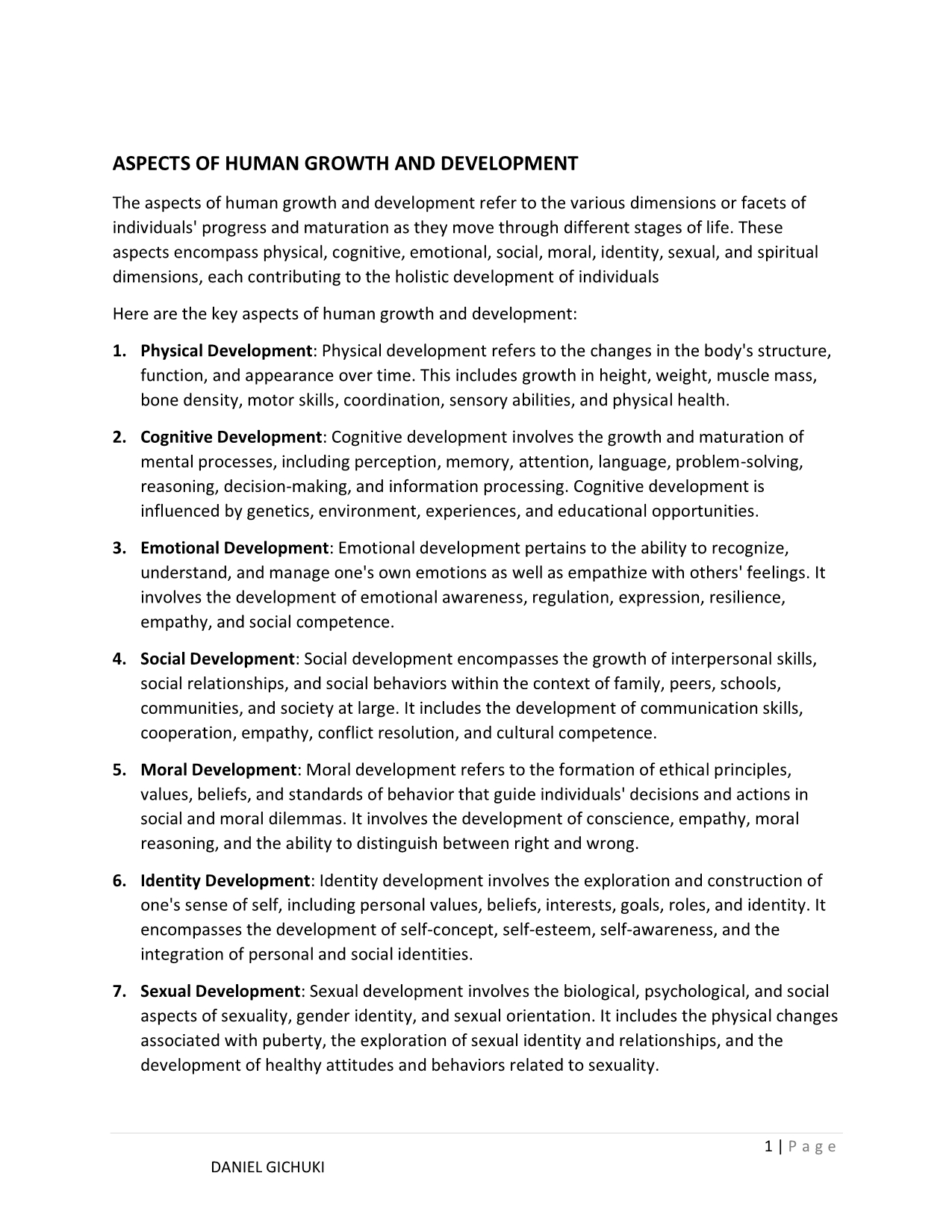
ASPECTS OF HUMAN GROWTH AND DEVELOPMENT
The aspects of human growth and development refer to the various dimensions or facets of individuals' progress and maturation as they move through different stages of life. These aspects encompass physical, cognitive, emotional, social, moral, identity, sexual, and spiritual dimensions, each contributing to the holistic development of individuals
Here are the key aspects of human growth and development:
1. Physical Development: Physical development refers to the changes in the body's structure, function, and appearance over time. This includes growth in height, weight, muscle mass, bone density, motor skills, coordination, sensory abilities, and physical health.
2. Cognitive Development: Cognitive development involves the growth and maturation of mental processes, including perception, memory, attention, language, problem-solving, reasoning, decision-making, and information processing. Cognitive development is influenced by genetics, environment, experiences, and educational opportunities.
3. Emotional Development: Emotional development pertains to the ability to recognize, understand, and manage one's own emotions as well as empathize with others' feelings. It involves the development of emotional awareness, regulation, expression, resilience, empathy, and social competence.
4. Social Development: Social development encompasses the growth of interpersonal skills, social relationships, and social behaviors within the context of family, peers, schools, communities, and society at large. It includes the development of communication skills, cooperation, empathy, conflict resolution, and cultural competence.
5. Moral Development: Moral development refers to the formation of ethical principles, values, beliefs, and standards of behavior that guide individuals' decisions and actions in social and moral dilemmas. It involves the development of conscience, empathy, moral reasoning, and the ability to distinguish between right and wrong.
6. Identity Development: Identity development involves the exploration and construction of one's sense of self, including personal values, beliefs, interests, goals, roles, and identity. It encompasses the development of self-concept, self-esteem, self-awareness, and the integration of personal and social identities.
7. Sexual Development: Sexual development involves the biological, psychological, and social aspects of sexuality, gender identity, and sexual orientation. It includes the physical changes associated with puberty, the exploration of sexual identity and relationships, and the development of healthy attitudes and behaviors related to sexuality.
Below is the document preview.

ASC 427: SOCIOLOGY OF YOUTH
Trending!
The youth have been facing have been facing a lot of challenges in the past years hence barring them from achieving their full potential in the society. This is but a few of their problems.
14 Pages
10154 Views
0 Downloads
236.35 KB
Lab Report Format
Trending!
Theory/Introduction: This step should introduce the experiment. Include background
information relevant to the experiment, important definitions, theoretical and historical
background, and general methods that are going to be used.
7 Pages
8665 Views
0 Downloads
674.79 KB
GEOGRAPHY SYLLABUS F1 TO F4 COMBINED
Trending!
The purpose of this geography syllabus form 1 to form 4 combined is to equip the student with knowledge and skills to study and revise well to save time
10 Pages
11036 Views
10 Downloads
59.27 KB
GEOGRAPHY FORM 4 NOTES
Trending!
The purpose of this geography notes is to equip the student with knowledge and skills to enable him or her understand this subject better
No pages found
8731 Views
3 Downloads
5.44 MB
AMS 308 Lecture 1: INTRODUCTION TO ANAYLYSIS OF EXPERIMENTS
Trending!
Observing a system or process while it is in operation is an important part of the
learning process, and is an integral part of understanding and learning about how
systems and processes work.
11 Pages
8045 Views
2 Downloads
441.8 KB
AMS 308 Lecture 2: SIMPLE COMPARATIVE EXPERIMENTS
Trending!
Hypothesis testing allows the comparison of the two formulations to be made on
objective terms, with knowledge of the risks associated with reaching the wrong
conclusion.
9 Pages
7007 Views
2 Downloads
791.97 KB
AMS 308 Lecture 3: EXPERIMENTS WITH A SINGLE FACTOR
Trending!
In such a single factor experiment with a completely randomized design, the
levels of the factor are randomly assigned to the experimental units in some cases,
randomly selecting experimental units from each level of the factor.
28 Pages
7755 Views
1 Downloads
1.88 MB
AMS 308 Lecture 4: THE RANDOMIZED COMPLETE BLOCK DESIGN
Trending!
In any experiment, variability arising from a nuisance factor can affect the results.
Generally, we define a nuisance factor as a design factor that probably has an effect
on the response, but we are not interested in that effect.
8 Pages
8204 Views
1 Downloads
644.64 KB
AMS 308 Lecture 5: THE LATIN SQUARE DESIGN
Trending!
Suppose that an experimenter is studying the effects of five different formulations of
a rocket propellant used in aircrew escape systems on the observed burning rate.
Each formulation is mixed from a batch of raw material that is only large enough for
five formulations to be tested.
6 Pages
7332 Views
2 Downloads
690.8 KB
AMS 309 Lecture 1: Probability Generating Functions
Trending!
A mathematical model which specifies complete probability distribution of the number of individuals in a given system at each point of time is a stochastic model.
9 Pages
9878 Views
3 Downloads
452.97 KB