BIOCHEMISTRY
| Institution | MOUNT KENYA UNIVERSITY |
| Course | Diploma in Animal He... |
| Year | 1st Year |
| Semester | Unknown |
| Posted By | stephen oyake rabilo |
| File Type | |
| Pages | 96 Pages |
| File Size | 5.18 MB |
| Views | 1395 |
| Downloads | 0 |
| Price: |
Buy Now
 Buy via
whatsapp Buy via
whatsapp
|


Description
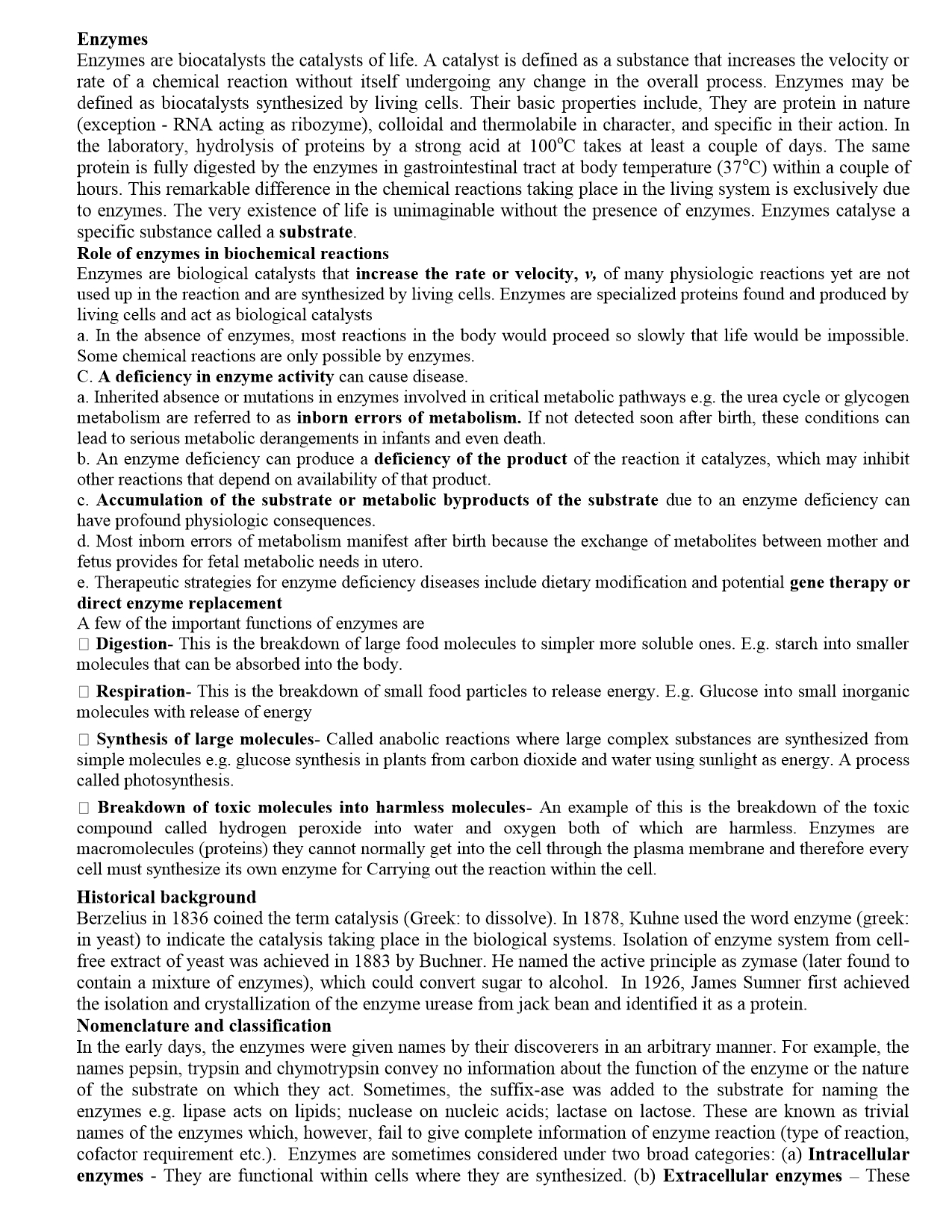
Enzymes
Enzymes are biocatalysts the catalysts of life. A catalyst is defined as a substance that increases the velocity or
rate of a chemical reaction without itself undergoing any change in the overall process. Enzymes may be
defined as biocatalysts synthesized by living cells. Their basic properties include, They are protein in nature
(exception - RNA acting as ribozyme), colloidal and thermolabile in character, and specific in their action. In
the laboratory, hydrolysis of proteins by a strong acid at 100oC takes at least a couple of days. The same
protein is fully digested by the enzymes in gastrointestinal tract at body temperature (37oC) within a couple of
hours. This remarkable difference in the chemical reactions taking place in the living system is exclusively due
to enzymes. The very existence of life is unimaginable without the presence of enzymes. Enzymes catalyse a
specific substance called a substrate.
Role of enzymes in biochemical reactions
Enzymes are biological catalysts that increase the rate or velocity, v, of many physiologic reactions yet are not
used up in the reaction and are synthesized by living cells. Enzymes are specialized proteins found and produced by
living cells and act as biological catalysts
a. In the absence of enzymes, most reactions in the body would proceed so slowly that life would be impossible.
Some chemical reactions are only possible by enzymes.
C. A deficiency in enzyme activity can cause disease.
a. Inherited absence or mutations in enzymes involved in critical metabolic pathways e.g. the urea cycle or glycogen
metabolism are referred to as inborn errors of metabolism. If not detected soon after birth, these conditions can
lead to serious metabolic derangements in infants and even death.
b. An enzyme deficiency can produce a deficiency of the product of the reaction it catalyzes, which may inhibit
other reactions that depend on availability of that product.
c. Accumulation of the substrate or metabolic byproducts of the substrate due to an enzyme deficiency can
have profound physiologic consequences.
d. Most inborn errors of metabolism manifest after birth because the exchange of metabolites between mother and
fetus provides for fetal metabolic needs in utero.
e. Therapeutic strategies for enzyme deficiency diseases include dietary modification and potential gene therapy or
direct enzyme replacement
Below is the document preview.

NURS 113: MEDICAL BIOCHEMISTRY 1 EXAM PAPER
Trending!
Institution:
Year: 2020/2021
Semester: 1st Year, 2nd Semester (1.2)
NURU 119: MEDICAL BIOCHEMISTRY II EXAM PAPER
Institution:
Year: 2020/2021
Semester: 1st Year, 3rd Semester (1.3)
NURU115: MEDICAL BIOCHEMISTRY I EXAM PAPER
Trending!
Institution:
Year: 2020/2021
Semester: 1st Year, 3rd Semester (1.3)
NURS 113: MEDICAL BIOCHEMISTRY I EXAM PAPER
Trending!
Institution:
Year: 2017/2018
Semester: 1st Year, 1st Semester (1.1)
NURU 119: MEDICAL BIOCHEMISTRY II EXAM PAPER
Institution:
Year: 2017/2018
Semester: 1st Year, 3rd Semester (1.3)
NURS 113: MEDICAL BIOCHEMISTRY I EXAM PAPER
Trending!
Institution:
Year: 2017/2018
Semester: 1st Year, 1st Semester (1.1)
NURU 119: MEDICAL BIOCHEMISTRY II EXAM PAPER
Institution:
Year: 2019/2020
Semester: 1st Year, 2nd Semester (1.2)
NURU 115: MEDICAL BIOCHEMISTRY I EXAM PAPER
Trending!
Institution:
Year: 2019/2020
Semester: 1st Year, 2nd Semester (1.2)
BIOC 207/201: PHYSICAL BIOCHEMISTRY EXAM PAPER
Trending!
Institution:
Year: 2025/2026
Semester: 2nd Year, 1st Semester (2.1)
BIOC 201: PHYSICAL BIOCHEMISTRY
Trending!
Institution:
Year: 2020/2021
Semester: 1st Year, 1st Semester (1.1)