SCH 100: Fundamentals of Inorganic Chemistry
| Institution | Kenyatta University |
| Course | Chemistry |
| Year | 1st Year |
| Semester | Unknown |
| Posted By | Mwalimu Evans Okoyo. |
| File Type | |
| Pages | 84 Pages |
| File Size | 1.47 MB |
| Views | 9397 |
| Downloads | 4 |
| Price: |
Buy Now
 Buy via
whatsapp Buy via
whatsapp
|


Description
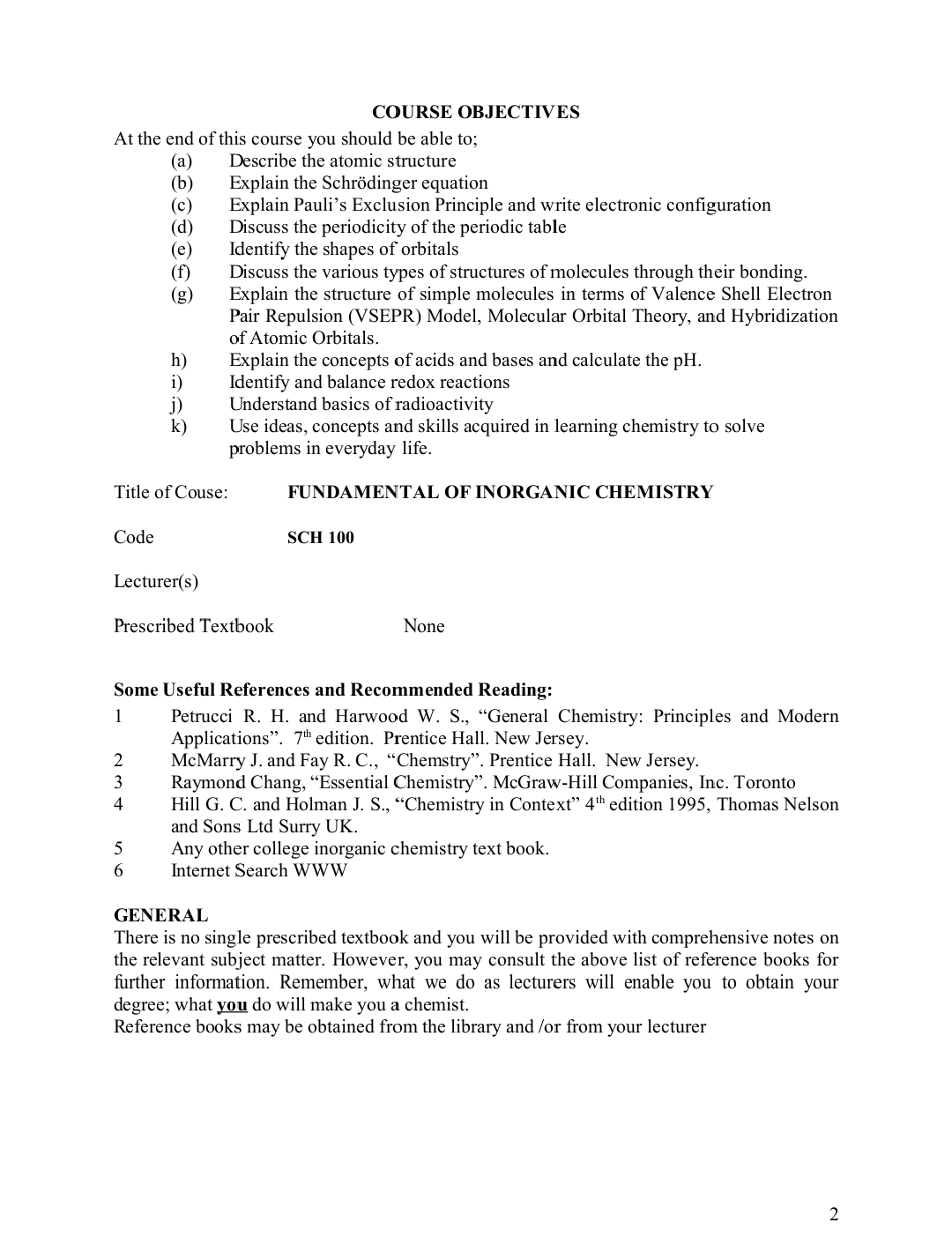
Fundamental of Inorganic chemistry is a core unit in chemistry at the undergraduate level for
the Bachelor of Education as well as Bachelor of Science degrees. The unit aims at
introducing the learner to various basic concepts in chemistry. It endeavours to equip the
learner with sufficient knowledge to enable him/her to comprehend and relate to other
concepts encountered at a later stage, as he or she dwells more in chemistry and other related
sciences.
Below is the document preview.

BIT 2108: Lesson 5 Networking Hardware.
Trending!
Networking hardware refers to the physical devices required to establish, operate, and maintain computer networks. These devices enable data transfer, communication, and connectivity between systems within a network or across multiple networks
33 Pages
9084 Views
0 Downloads
503.2 KB
BIT 2108: Transmission Media.
Trending!
Transmission media refers to the physical pathways or communication channels through which data, information, or signals travel from one device or system to another.
41 Pages
9152 Views
0 Downloads
308.92 KB
BIT 2108: Access methods.
Trending!
Access methods refer to the techniques and protocols used to retrieve, store, and manipulate data or resources in a computer system or network. These methods determine how users, devices, or applications interact with data or services.
11 Pages
9480 Views
0 Downloads
390.92 KB
BIT 2108: Introduction to Network Protocol Architectures
Trending!
Network protocol architectures refer to the structured frameworks that define the rules, standards, and procedures enabling devices to communicate effectively in a network. These architectures are hierarchical models comprising layers, each assigned specific responsibilities, ensuring seamless communication across diverse systems and technologies.
42 Pages
10330 Views
0 Downloads
1.21 MB
BIT 2108: Networking Media.
Trending!
Networking media refers to the physical materials or communication channels used to transmit data between devices in a network. These media serve as the backbone of computer networks, enabling connectivity, communication, and data exchange. Networking media can be broadly categorized into wired and wireless types, each suited for specific applications based on factors such as speed, distance, cost, and reliability.
71 Pages
9639 Views
0 Downloads
1.81 MB
BIT 2103: Lesson 1 Introduction to Computer Applications and Concept
Trending!
Introduction to Computer Applications is a foundational course or subject designed to familiarize students with the basic concepts and practical uses of computers in various fields. It emphasizes the role of computers in enhancing productivity and efficiency across personal, academic, and professional contexts.
7 Pages
11177 Views
1 Downloads
115.88 KB
BIT 2103: Lesson 5 How to Insert and Position Graphics in Word Documents.
Trending!
Inserting and positioning graphics in a Word document can enhance its visual appeal and make the content more engaging.
3 Pages
9667 Views
0 Downloads
121.04 KB
BIT 2103: Formatting in MS Word
Trending!
Formatting in MS Word involves various tools and techniques to enhance the presentation of text, images, and other elements in a document.
2 Pages
8765 Views
1 Downloads
78.03 KB
BIT 2103: Lesson 1 Ms Excel Basics
Trending!
Microsoft Excel is a powerful spreadsheet application developed by Microsoft, widely used for data analysis, calculations, and data visualization. It allows users to organize, manipulate, and analyze data in a tabular format, consisting of rows and columns that form a grid.
4 Pages
9990 Views
0 Downloads
80.18 KB
SCH 200: ATOMIC STRUCTURE AND CHEMICAL BONDING
Trending!
This course covers an experimental foundation of quantum theory; particles and waves; uncertainty principles; wave and wave equation; properties of a well-behaved
wave functions; Schrödinger equation and its solutions; the physical significance of the wave function; solutions of the Schrödinger equation for hydrogen - like atoms: quantum numbers, radial functions, angular, charge clouds and orbital; energy levels, electron configuration and the periodic table; ionic, covalent, hydrogen and metallic bonds, valence bond theory and molecular orbital theory for simple molecules and ions; complex ions; definition and examples of Lewis acids, Lewis bases, co-ordinate bond, ligands and co-ordination compounds; ionic structures and calculation of lattice energies.
88 Pages
10980 Views
2 Downloads
1.86 MB