 Join Our WhatsApp Channel for Updates!
CPA-1-Business Law
| Institution | KASNEB |
| Course | CPA |
| Year | 1st Year |
| Semester | Unknown |
| Posted By | stephen |
| File Type | |
| Pages | 488 Pages |
| File Size | 3.14 MB |
| Views | 6119 |
| Downloads | 0 |
| Price: |
Buy Now
 Buy via
whatsapp Buy via
whatsapp
|


Description
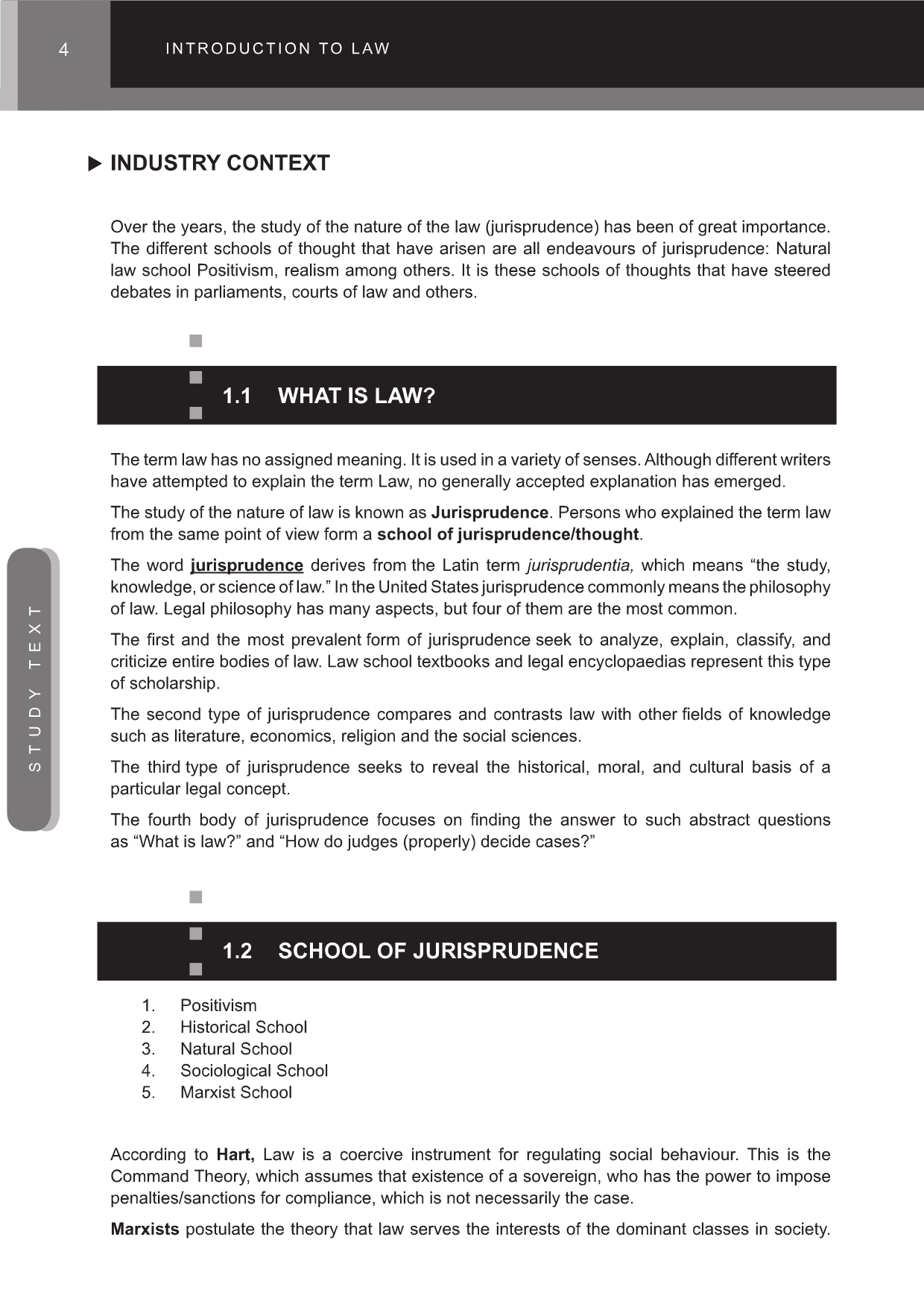
The term law has no assigned meaning. It is used in a variety of senses. Although different writers
have attempted to explain the term Law, no generally accepted explanation has emerged.
The study of the nature of law is known as Jurisprudence. Persons who explained the term law
from the same point of view form a school of jurisprudence/thought.
The word jurisprudence derives from the Latin term jurisprudentia, which means “the study,
knowledge, or science of law.” In the United States jurisprudence commonly means the philosophy
of law. Legal philosophy has many aspects, but four of them are the most common.
The first and the most prevalent form of jurisprudence seek to analyze, explain, classify, and
criticize entire bodies of law. Law school textbooks and legal encyclopaedias represent this type
of scholarship.
The second type of jurisprudence compares and contrasts law with other fields of knowledge
such as literature, economics, religion and the social sciences.
The third type of jurisprudence seeks to reveal the historical, moral, and cultural basis of a
particular legal concept.
The fourth body of jurisprudence focuses on finding the answer to such abstract questions
as “What is law?” and “How do judges (properly) decide cases?
Below is the document preview.

HRD 2101: LESSON 5 sources & use of technology in communication.
Trending!
Upon completion of this topic you should be able to:
Outline the types of interviews. Discuss the interview process - preparation and execution by both the interviewer and interviewee. Prepare and use questionnaires to collect data. Apply observation and experimentation techniques in collecting information for purposes of research.
37 Pages
6086 Views
0 Downloads
327.7 KB
HRD 2101: LESSON 6 INFORMATION LITERACY SKILLS
Trending!
We are all living in a knowledge Society with proliferating information resources and drastic changes in our environments. In our everyday life, we confront dramatic challenges coming from the rapidly changing social, political and economic environments of our society.
48 Pages
6082 Views
0 Downloads
401.01 KB
HRD 2101: LESSON 7 Access to Information
Trending!
There is a plenty of information sources nowadays. Books, Journals, Magazines, Newspapers and Library catalogues are some traditional sources of information that we may use. These are often presented in print format or electronic format.
42 Pages
6023 Views
0 Downloads
2.19 MB
HRD 2101: LESSON 8 Evaluating Information Sources
Trending!
In the note, you will encounter numerous information resources, both print and digital. You will need to consider how to tell whether those sources are reputable and of quality.
20 Pages
6062 Views
0 Downloads
286.61 KB
HRD 2101: LESSON 9 Ethical, Legal and Social Issues for Use of Information
Trending!
There are a number of ethical, legal and socioeconomic issues that surround the access and use of information for your research. This module introduces you to some of the main issues and considerations you should be aware of in order to ensure appropriate use of information
44 Pages
5587 Views
0 Downloads
369.34 KB
HRD 2101: LESSON 10 The impact of information and communication technologies in society
Trending!
We are now living in an information age and the focus on information and technology has profoundly affected the nature of society and the world of work. More information is accessible to all people in our society, and more businesses are seeking employees who are proficient in information retrieval, analysis, and communication in conjunction with highly developed technological skills.
38 Pages
6546 Views
0 Downloads
339.57 KB
BIT 2108: Lesson 1 Introduction to Computer Networking
Trending!
Computer networking is defined as A computer network is a group of computer systems and other computing hardware devices that are linked together through communication channels to facilitate communication and resource-sharing among a wide range of users.
20 Pages
6489 Views
0 Downloads
203.36 KB
BIT 2108: LESSON 3 Network Topology
Trending!
Topology: The term topology refers to the way a network is laid out, either physically or logically. A topology can be considered as the network's shape. It is the geometric representation of the relationship of all the links.
33 Pages
6488 Views
0 Downloads
516.8 KB
MARANDA HIGH JULY MOCK 2024; Chemistry PP1,PP2 & PP3 Q&A
Download a copy of the MARANDA HIGH JULY MOCK 2024; Chemistry PP1,PP2 & PP3 Question Papers with well coordinated Marking Schemes attached. This is a good revision material for your upcoming exams.
70 Pages
527 Views
0 Downloads
5.29 MB
Risk Management Principles for Electronic Banking
Trending!
Continuing technological innovation and competition among existing banking organizations and new entrants have allowed for a much wider array of banking products and services to become accessible and delivered to retail and wholesale customers through an electronic distribution channel collectively referred to as e-banking. However, the rapid development of e-banking capabilities carries risks as well as benefits. The Basel Committee on Banking Supervision expects such risks to be recognised, addressed and managed by banking institutions in a prudent manner according to the fundamental characteristics and challenges of e-banking services. These characteristics include the unprecedented speed of change related to technological and customer service innovation, the ubiquitous and global nature of open electronic networks, the integration of ebanking applications with legacy computer systems and the increasing dependence of banks on third parties that provide the necessary information technology. While not creating inherently new risks, the Committee noted that these characteristics increased and modified some of the traditional risks associated with banking activities, in particular strategic,
operational, legal and reputational risks, thereby influencing the overall risk profile of
banking.
35 Pages
6311 Views
0 Downloads
190.54 KB