INTRODUCTION TO C++ PROGRAMMING YEAR 1
| Institution | UNIVERSITY |
| Course | BACHELOR OF SCIENCE... |
| Year | 1st Year |
| Semester | Unknown |
| Posted By | stephen oyake rabilo |
| File Type | |
| Pages | 33 Pages |
| File Size | 207.62 KB |
| Views | 5139 |
| Downloads | 0 |
| Price: |
Buy Now
 Buy via
whatsapp Buy via
whatsapp
|


Description
First Class In C++
Adapted from : http://www.cplusplus.com/doc/tutorial/tut1-1.html
Structure of a C++ program
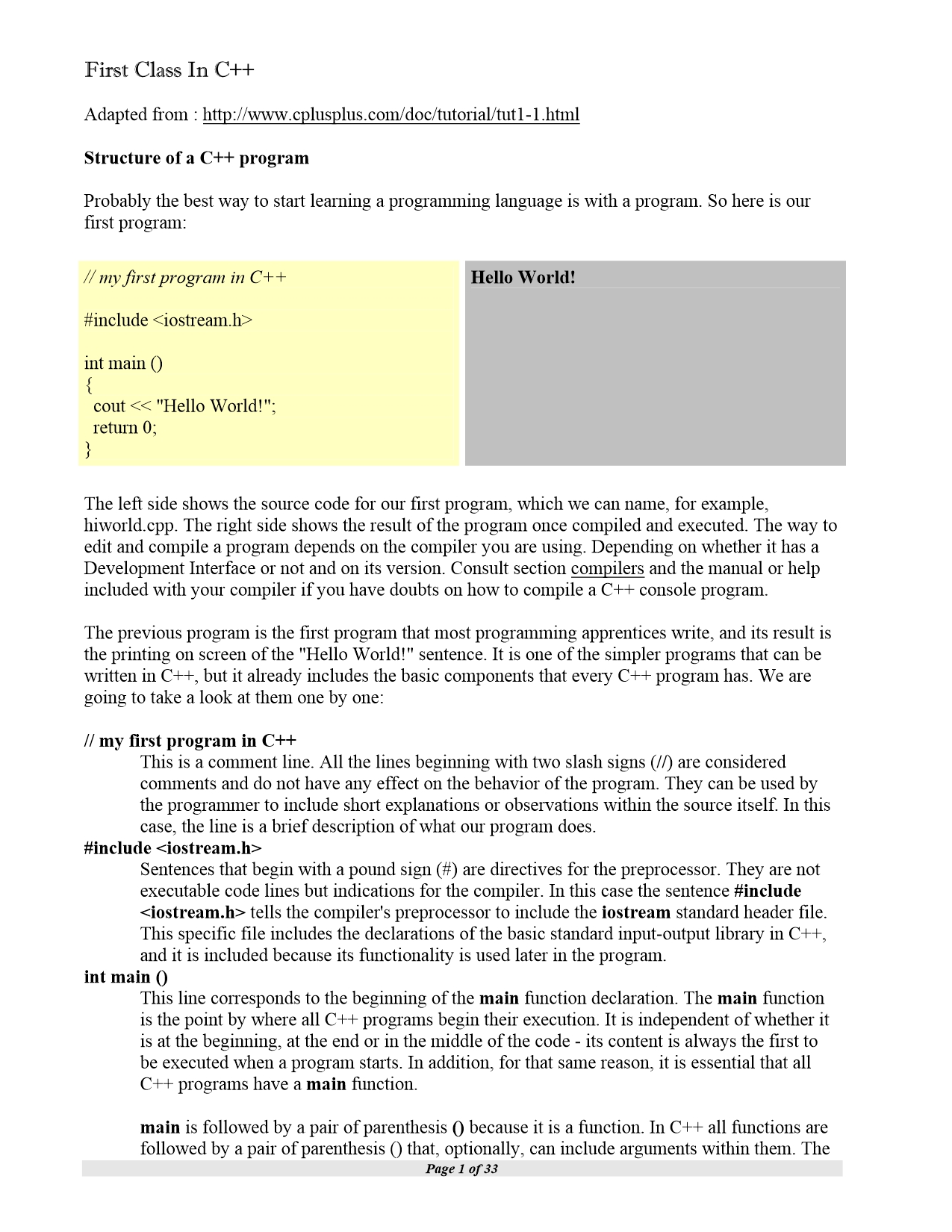
Probably the best way to start learning a programming language is with a program. So here is our
first program:
// my first program in C++
#include <iostream.h>
int main ()
{
cout << "Hello World!";
return 0;
}
Hello World!
The left side shows the source code for our first program, which we can name, for example,
hiworld.cpp. The right side shows the result of the program once compiled and executed. The way to
edit and compile a program depends on the compiler you are using. Depending on whether it has a
Development Interface or not and on its version. Consult section compilers and the manual or help
included with your compiler if you have doubts on how to compile a C++ console program.
The previous program is the first program that most programming apprentices write, and its result is
the printing on screen of the "Hello World!" sentence. It is one of the simpler programs that can be
written in C++, but it already includes the basic components that every C++ program has. We are
going to take a look at them one by one:
Below is the document preview.

FOOD AND BEVERAGE PRODUCTION THEORY NOTES
Trending!
This unit is intended to impart in trainees cooking skills and attitudes required for professional cookery. It gives the trainees a broad knowledge of raw food materials and their application in food production.
106 Pages
10890 Views
12 Downloads
715.64 KB
OPERATING SYSTEMS NOTES
Trending!
A computer system has many resources (hardware and software), which may be require to complete a task. The commonly required resources are input/output devices, memory, file storage space, CPU etc. The operating system acts as a manager of the above resources and allocates them to specific programs and users as necessary for their task.
43 Pages
7170 Views
0 Downloads
1.38 MB
INTRODUCTION TO COMPUTERS NOTES
Trending!
A Computer is an electronic device that operates (works) under the control of programs stored in its own memory unit.
41 Pages
8309 Views
0 Downloads
1.05 MB
FUNDAMENTALS OF ICT NOTES
Trending!
ICT - Information Process Computers + Computer Technology Networks. Hardware - is tangible or physical parts of a computer e.g keyboards, mouses, screen, printer. Software - is intangible parts of a computer it refers to instructions that direct computer hardware on what to do.
60 Pages
10335 Views
3 Downloads
804.89 KB
INTEGRATED SCIENCE EXPLAINED NOTES
Trending!
Download a copy of INTEGRATED SCIENCE EXPLAINED. The notes are precise, complete and comprehensive. This will serve you well!
21 Pages
9314 Views
1 Downloads
435.98 KB
Business Studies Grade 7 Term 1 Notes
Trending!
Business refers to any activity that is carried out by an individual or an organization concerned with provision of goods and services with the aim of making profits
15 Pages
8176 Views
0 Downloads
306.62 KB
COST ACCOUNTING NOTES
Introduce students to aspects of cost and management accounting in the creation of
information for management decision making.
211 Pages
753 Views
0 Downloads
2.82 MB
HUMAN RESOURCE MANAGEMENT (HRM) NOTES
Trending!
This chapter introduces the students with the basic concepts of the human resource
management (HRM). HRM is the study of activities regarding people working in an organization.
115 Pages
7259 Views
1 Downloads
363.61 KB
INTERMEDIATE ACCOUNTING NOTES
The conceptual framework of accounting, also called the theoretical framework of
accounting is a coherent system of interrelated objectives and fundamentals that
can lead to consistent standards and that prescribes the nature, function and limits
of financial accounting and financial accounting statements.
97 Pages
811 Views
0 Downloads
1.13 MB
INTERMEDIATE MICROECONOMIC NOTES
Trending!
Introduction: Meaning and purpose of microeconomic theory, Basic concepts and
mode of analysis, Traditional vs modern microeconomics, The Theory Of Consumer
Behaviour: Consumer Theory, The Budget Constraint, Consumer Preferences,
Utility: The Utility Function, Marginal Utility and Marginal Rate of Substitution,
Revealed Preference Theory, The Slutsky Equation, Production Theory,
Markets: Perfect Competition, Imperfect Competition, Game Theory: Elements of
Game theory, The Payoff matrix of a game, Nash Equilibrium, Secure Strategies,
General Equilibrium, Market Disequilibrium, Production, Distribution of Welfare
163 Pages
4750 Views
0 Downloads
1.03 MB