INTRODUCTION TO C++ PROGRAMMING YEAR 1
| Institution | UNIVERSITY |
| Course | BACHELOR OF SCIENCE... |
| Year | 1st Year |
| Semester | Unknown |
| Posted By | stephen oyake rabilo |
| File Type | |
| Pages | 33 Pages |
| File Size | 207.62 KB |
| Views | 5251 |
| Downloads | 0 |
| Price: |
Buy Now
 Buy via
whatsapp Buy via
whatsapp
|


Description
First Class In C++
Adapted from : http://www.cplusplus.com/doc/tutorial/tut1-1.html
Structure of a C++ program
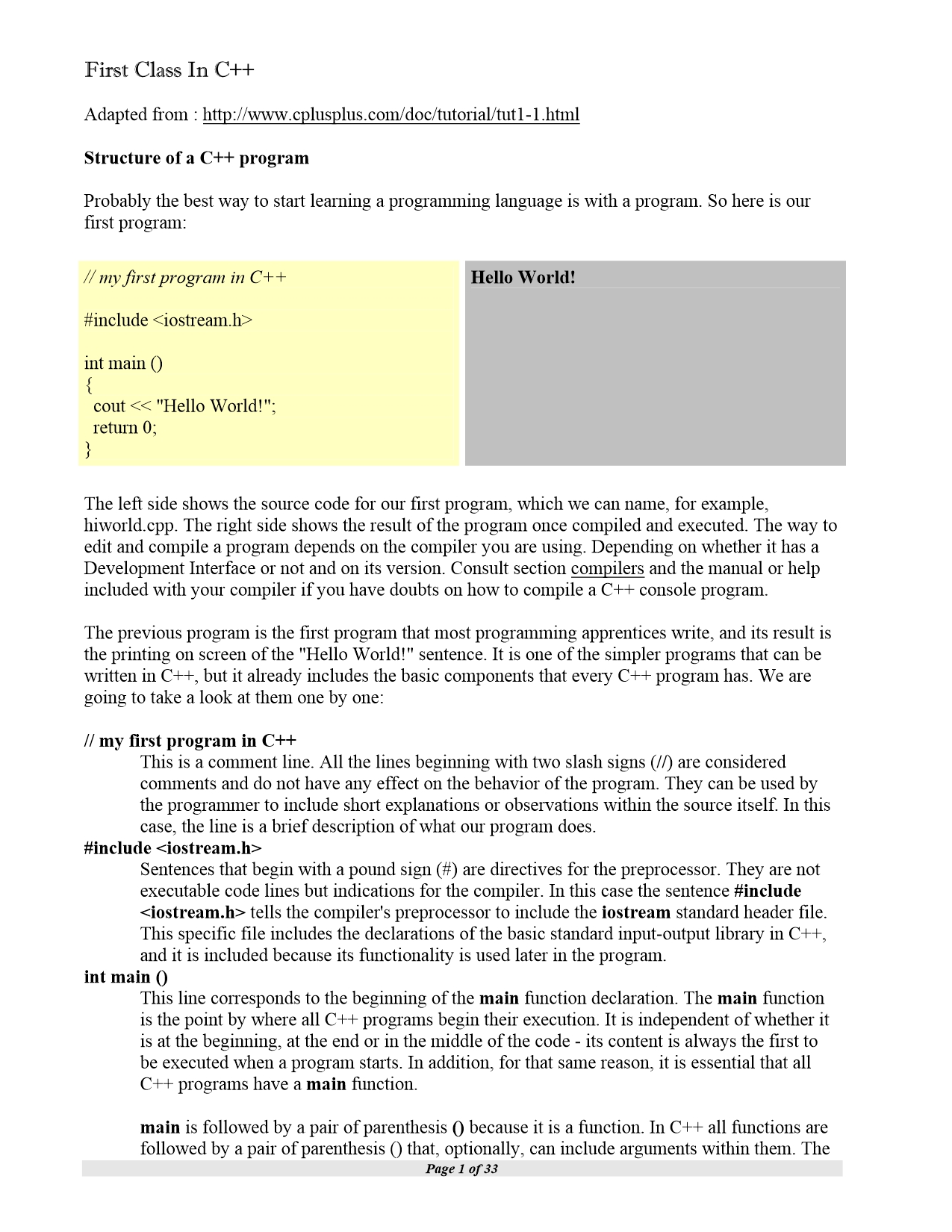
Probably the best way to start learning a programming language is with a program. So here is our
first program:
// my first program in C++
#include <iostream.h>
int main ()
{
cout << "Hello World!";
return 0;
}
Hello World!
The left side shows the source code for our first program, which we can name, for example,
hiworld.cpp. The right side shows the result of the program once compiled and executed. The way to
edit and compile a program depends on the compiler you are using. Depending on whether it has a
Development Interface or not and on its version. Consult section compilers and the manual or help
included with your compiler if you have doubts on how to compile a C++ console program.
The previous program is the first program that most programming apprentices write, and its result is
the printing on screen of the "Hello World!" sentence. It is one of the simpler programs that can be
written in C++, but it already includes the basic components that every C++ program has. We are
going to take a look at them one by one:
Below is the document preview.

APS 310: INTRODUCTION TO PSYCHOLOGY FULL NOTES
Trending!
Neuropsychology is a branch of psychology that studies how the nervous system
(particularly the brain) influences behaviour and mental processes. It is the study of how the complex properties of the brain allow for the behaviour to occur.
141 Pages
7900 Views
1 Downloads
1.69 MB
COMMUNITY HEALTH III
Principles of epidemiology: Definitions of terms, purpose of epidemiology, differences
between epidemiological and clinical focus, sources of epidemiological information, mortality and morbidity statistics, epidemiological concepts, epidemiological studies.
2. Communicable diseases: Definition, standard case definition, classification, principles in management, prevention and control, notification and reporting of emerging and re-emerging infections, infestations, specific communicable diseases.
431 Pages
535 Views
1 Downloads
3.75 MB
CONDITIONS FOR THE UPPER RESPIRATORY TRACT
Trending!
Hemorrhage from the nose
Attributed to rupture of distended tiny blood vessels in the mucous membrane of the nasal cavity
Commonly occur at the anterior nasal septum, where 3 blood vessels meet at the nasal cavity;
Anterior ethmoidal artery on the anterosuperior of the roof
Sphenopalatine artery in the posterosuperior region
Internal maxillary branches
Causes:
Trauma
Infections
Inhalation of illicit drugs
Cardiovascular diseases
Nasal tumors
Low humidity
Foreign body in the nose
38 Pages
7467 Views
2 Downloads
630.09 KB
CARDIOVASCULAR SYSTEM PHARMACOLOGY
Trending!
An Inotrope is an agent which increases or decreases the
force of muscular contraction of the heart and Cardiac output.
Inotropes act on the alpha, beta1 and beta2 receptors.
Physiologically:
a. Alpha receptors causes peripheral vasoconstriction and
increased vascular resistance
43 Pages
8460 Views
0 Downloads
870.41 KB
KMTC COMMUNITY HEALTH Notes
Trending!
The purpose of this unit or module is to equip the student or trainee with knowledge and skills to enable him or her understand the concepts of community health in their local regions deeply
99 Pages
11140 Views
11 Downloads
2.71 MB
APS 215: PSYCHOLOGY OF GENDER
Trending!
The purpose of this module is to equip students with knowledge on how Gender issues affect Human behavior and Society. It examines various theories of gender, stereotypes and the impact of gender prejudices on society.
102 Pages
6082 Views
2 Downloads
1.3 MB
APH 202: EPISTEMOLOGY
Trending!
This unit introduces you to the discipline of philosophy which is an activity of life. At the end of this unit you will realize that most people like philosophy if they understand it, and that most understand it if it is presented to them exhaustively. In this course, I have tried to make it simpler for you to understand philosophy as a service discipline.
26 Pages
4877 Views
0 Downloads
942.19 KB
APS 409: LIFESTYLE DISEASES AND REHABILITATION
Trending!
The purpose of this module is to help you (the learner) to gain requisite knowledge and skills in the area of lifestyle diseases and rehabilitation.
111 Pages
5624 Views
1 Downloads
1.65 MB
APS 321: ENVIRONMENTAL PSYCHOLOGY
Environmental psychology is an interdisciplinary field focused on the interplay between human’s actions or behaviors and their surroundings. The field defines the term environment broadly, encompassing natural environments, social settings, built environments, learning environments and informational environment.
30 Pages
508 Views
0 Downloads
1.21 MB
APS 323: BEHAVIOUR MODIFICATION
Trending!
Kazdin (2001) defines behavior modification as an approach to assessment, evaluation and alteration of behavior. Miltenberger (2012) on the other hand describes behavior modification as the field of psychology concerned with analyzing and modifying human behavior.
134 Pages
3896 Views
1 Downloads
1.03 MB