
Lesson 3 Computer Animation - Skeletal Animation
| Institution | University |
| Course | BSc. Information Tec... |
| Year | 3rd Year |
| Semester | Unknown |
| Posted By | Jeff Odhiambo |
| File Type | |
| Pages | No pages found |
| File Size | 134.92 KB |
| Views | 6960 |
| Downloads | 1 |
| Price: |
Buy Now
 Buy via
whatsapp Buy via
whatsapp
|


Description
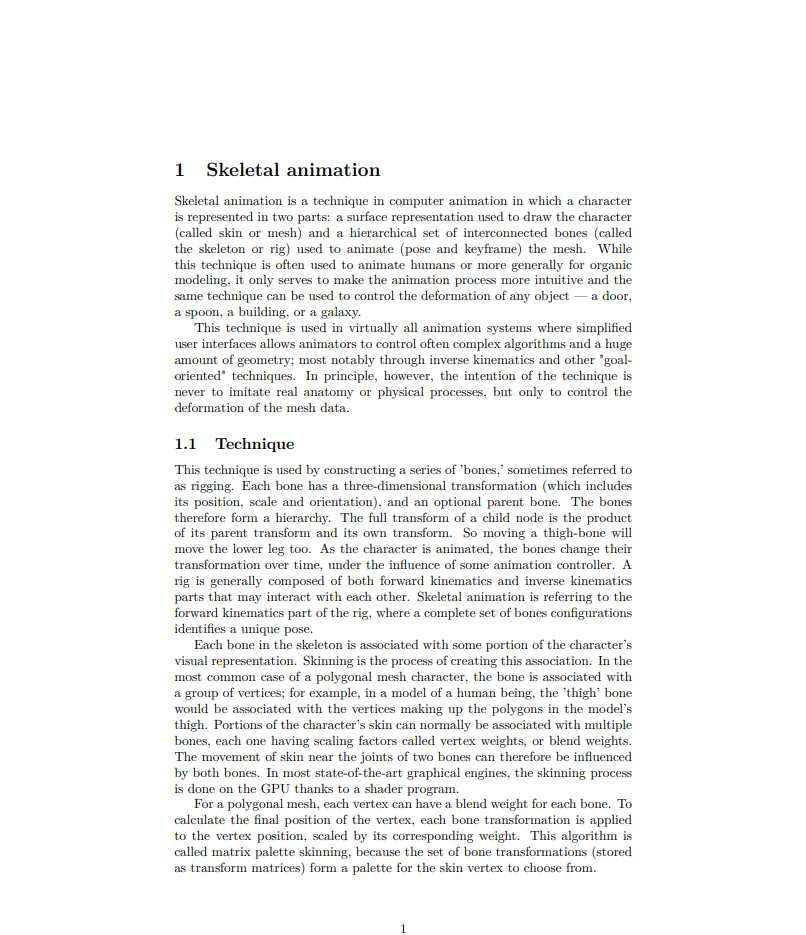
Skeletal animation is a technique in computer animation in which a character
is represented in two parts: a surface representation used to draw the character
(called skin or mesh) and a hierarchical set of interconnected bones (called
the skeleton or rig) used to animate (pose and keyframe) the mesh. While
this technique is often used to animate humans or more generally for organic
modeling, it only serves to make the animation process more intuitive and the
same technique can be used to control the deformation of any object — a door,
a spoon, a building, or a galaxy.
This technique is used in virtually all animation systems where simplified
user interfaces allows animators to control often complex algorithms and a huge
amount of geometry; most notably through inverse kinematics and other "goaloriented" techniques. In principle, however, the intention of the technique is never to imitate real anatomy or physical processes, but only to control the deformation of the mesh data.
Below is the document preview.

A Quick Guide on the Electrical Parts Retail Business
Trending!
This guide looks at the business of selling electrical parts at a retail level. This generally includes parts and equipment used to connect power to buildings; residential, commercial or otherwise. It also includes electrical utilities used by those who are already connected such as bulbs, sockets and heaters.
27 Pages
6847 Views
0 Downloads
920.08 KB
ADVANCED COMPUTER AIDED DESIGN
Trending!
Computer graphics is an art of drawing pictures, lines, charts, etc. using computers
with the help of programming. Computer graphics image is made up of number of pixels. Pixel is the smallest addressable graphical unit represented on the computer screen.
98 Pages
6218 Views
0 Downloads
6.81 MB
ALI 204: LITERARY THEORY AND CRITICISM
Trending!
This course introduces you to criticism and theory. You cannot study theory without critiquing literary works from specific theoretical standpoints. It entails subjecting a literary work to a given theory stating the merits and demerits of such an engagement. We shall begin by defining theory, then define literary theory and also define literary criticism.
15 Pages
7106 Views
1 Downloads
606.68 KB
DBMS NOTES
Trending!
A DBMS is a software that allows creation, definition and manipulation of database. Dbms is actualy a tool used to perform any kind of operation on data in database. Dbms also provides protection and security to database. It maintains data consistency in case of multiple users. Here are some examples of popular dbms, MySql, Oracle, Sybase, Microsoft Access and IBM DB2 etc.
5773 Views
0 Downloads
313.84 KB
UCI 204: RELATIONAL DATABASE SYSTEMS
Trending!
Databases store data in tables. So what are these tables? In simplest terms, tables consist of rows and columns. Each column defines data of a particular type. Rows contain individual records.
6429 Views
0 Downloads
219.5 KB
Introduction to SQL
Trending!
RDBMS is the basis for SQL, and for all modern database systems such as MS SQL Server, IBM DB2, Oracle, MySQL, and Microsoft Access. The data in RDBMS is stored in database objects called tables. A table is a collection of related data entries and it consists of columns and rows.
2706 Views
1 Downloads
181.5 KB
CONTRACT OF INSURANCE
Trending!
Insurance is a contract whereby one person undertakes to indemnify another person
against a loss which may arise, or to pay a sum of money to him, on the happening of some specified uncertain event in consideration for a single or periodical payment, called premium.
31 Pages
6186 Views
0 Downloads
398.12 KB
LAW OF PARTNERSHIP
Trending!
The partnership is an association between two or more persons, thus, there can be no partnership consisting of a single individual. Only persons recognized by law can enter into an agreement of partnership. A firm, since it is not a person recognized in the eyes of law cannot enter into an agreement of partnership.
34 Pages
7265 Views
0 Downloads
403.15 KB