 Join Our WhatsApp Channel for Updates!
Design & Analysis of Algorithm
| Institution | University |
| Course | BSc. Information Tec... |
| Year | 3rd Year |
| Semester | Unknown |
| Posted By | Jeff Odhiambo |
| File Type | |
| Pages | 638 Pages |
| File Size | 2.03 MB |
| Views | 5290 |
| Downloads | 0 |
| Price: |
Buy Now
 Buy via
whatsapp Buy via
whatsapp
|


Description
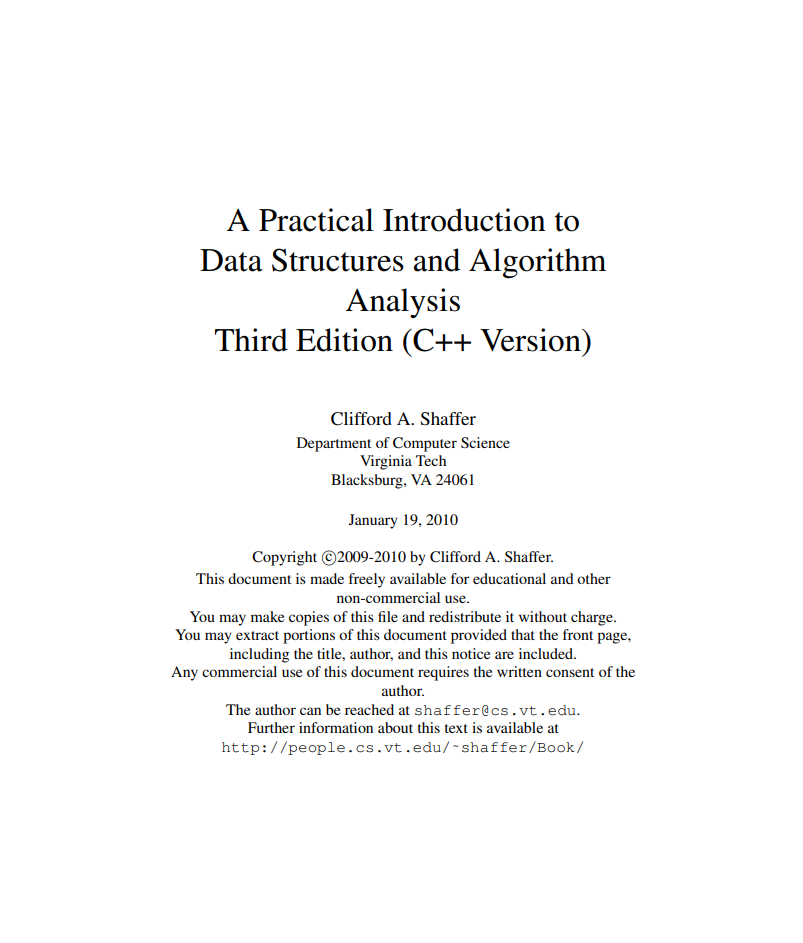
We study data structures so that we can learn to write more efficient programs. But
why must programs be efficient when new computers are faster every year? The
reason is that our ambitions grow with our capabilities. Instead of rendering efficiency needs obsolete, the modern revolution in computing power and storage capability merely raises the efficiency stakes as we computerize more complex tasks.
The quest for program efficiency need not and should not conflict with sound
design and clear coding. Creating efficient programs has little to do with “programming tricks” but rather is based on good organization of information and good algorithms. A programmer who has not mastered the basic principles of clear design
is not likely to write efficient programs. Conversely, “software engineering” cannot
be used as an excuse to justify inefficient performance. Generality in design can
and should be achieved without sacrificing performance, but this can only be done
if the designer understands how to measure performance and does so as an integral
part of the design and implementation process. Most computer science curricula
recognize that good programming skills begin with a strong emphasis on fundamental software engineering principles. Then, once a programmer has learned the
principles of clear program design and implementation, the next step is to study the
effects of data organization and algorithms on program efficiency
Below is the document preview.

History form 2 exams paper 1 and 2 (with marking schemes)
Trending!
This entails form 2 exams for term two.Besides,it has both paper 1 and 2.Therefore it is very useful for your students
10370 Views
10 Downloads
40.47 KB
Elegant business card template
Trending!
Photoshop psd elegant business card template free
9501 Views
0 Downloads
2.62 MB
Awesome insiring web design template
Trending!
Free awesome responsive bootstrap web design template
5596 Views
0 Downloads
2.8 MB
BIOCHEMISTRY
Polyurethanes are prepared from diisocyanates
and diols. Urethane (also called a carbamate) is a
functional group that contains both an ester and an
amide at a single carbonyl group.
Nucleophilic Addition Reaction: Example 1:
Sevin is a highly effective, biodegradable insecticide. It
affects the nervous systems of insects by blocking
access to the neurotransmitter acetylcholine.
57 Pages
1037 Views
0 Downloads
1.68 MB
BIOCHEMISTRY
PETROLEUM CHEMISTRY
Carbon is so Important in the Life Cycle. It has
numerous ways of bonding with many other
elements, particularly oxygen and hydrogen.
It can form both “organic” and “inorganic”
compounds. Organic compounds are considered
unstable in the biosphere because they are in the
reduced state.
Whereas Inorganic compounds, principally
calcite (CaCO3
) and dolomite (CaMg(CO3
)2
), are
stable because they are in the oxidized state.
Carbon is present in most substances that are
vital for the development of life (called
“biomolecules”): Proteins, lipids, sacharides, etc
76 Pages
980 Views
0 Downloads
1.86 MB
BIOCHEMISTRY
Alkyl halides are organic molecules containing a halogen
atom bonded to an sp3 hybridized carbon atom.
• Alkyl halides are classified as primary (1°), secondary (2°),
or tertiary (3°), depending on the number of carbons bonded
to the carbon with the halogen atom.
• The halogen atom in halides is often denoted by the symbol
“X”.
53 Pages
992 Views
0 Downloads
2.07 MB
BIOCHEMISTRY
Natural Gas
Natural gas is a gaseous fossil fuel consisting
primarily of methane but including significant
quantities of ethane, butane, propane, carbon
dioxide, nitrogen, helium and hydrogen sulfide.
Obtained from oil fields and natural gas fields,
and in coal beds.
Methane-rich gases are produced by the
anaerobic decay of non-fossil organic material, ie
biogas.
Total world production of natural gas in 1986
was 100 trillion m3
.
It is used as feed stock as well as fuel. It is
preferred due to its high Calorific Value
52 Pages
932 Views
0 Downloads
1.17 MB
Calculus 1 First Year
Trending!
Excelling in Calculus is the key
81 Pages
5567 Views
2 Downloads
841.91 KB