 Join Our WhatsApp Channel for Updates!
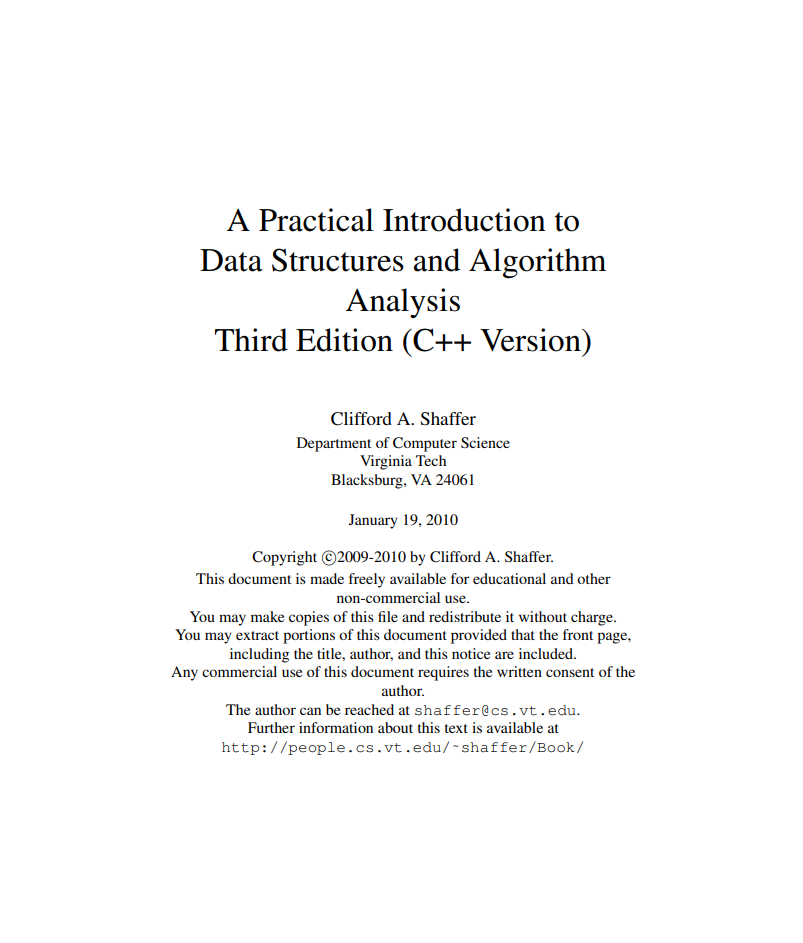
Design & Analysis of Algorithm
| Institution | University |
| Course | BSc. Information Tec... |
| Year | 3rd Year |
| Semester | Unknown |
| Posted By | Jeff Odhiambo |
| File Type | |
| Pages | 638 Pages |
| File Size | 2.03 MB |
| Views | 5203 |
| Downloads | 0 |
| Price: |
Buy Now
 Buy via
whatsapp Buy via
whatsapp
|


Description
We study data structures so that we can learn to write more efficient programs. But
why must programs be efficient when new computers are faster every year? The
reason is that our ambitions grow with our capabilities. Instead of rendering efficiency needs obsolete, the modern revolution in computing power and storage capability merely raises the efficiency stakes as we computerize more complex tasks.
The quest for program efficiency need not and should not conflict with sound
design and clear coding. Creating efficient programs has little to do with “programming tricks” but rather is based on good organization of information and good algorithms. A programmer who has not mastered the basic principles of clear design
is not likely to write efficient programs. Conversely, “software engineering” cannot
be used as an excuse to justify inefficient performance. Generality in design can
and should be achieved without sacrificing performance, but this can only be done
if the designer understands how to measure performance and does so as an integral
part of the design and implementation process. Most computer science curricula
recognize that good programming skills begin with a strong emphasis on fundamental software engineering principles. Then, once a programmer has learned the
principles of clear program design and implementation, the next step is to study the
effects of data organization and algorithms on program efficiency
Below is the document preview.

BUSINESS MATHEMATICS
Welcome to the First Lecture in this course unit. In this lecture we are going to learn about set theory.
716 Views
3 Downloads
11.5 MB
CCS 401: SOFTWARE PROJECT MANAGEMENT NOTES
Trending!
A project is a temporary endeavor undertaken to create a unique product, service, or result.
• Operations are work done to sustain the business.
• A project ends when its objectives have been reached, or the project has been terminated.
• Projects can be large or small and take a short or long time to complete.
68 Pages
5216 Views
0 Downloads
2.01 MB
INTRODUCTION TO ICT NOTES
Trending!
Information communication technology plays an important role in our day to day activities. It is common practice to find ICT systems in banks, supermarkets, government agencies, entertainment industries , media industries ,schools, hospitals and at home. To adapt to the ever changing technological world, one needs to be knowledgeable and competent user of computer based technologies.
6509 Views
2 Downloads
4.68 MB
KASNEB ATD Syllabus
Trending!
Accounting Technicians Diploma(ATD) Examination Syllabus
33 Pages
6062 Views
1 Downloads
649.89 KB
KASNEB CCP Syllabus
Trending!
Certified Credit Professionals (CCP) Examination Syllabus
54 Pages
5101 Views
1 Downloads
608.63 KB
KASNEB CICT Syllabus
Trending!
Certified Information Communication Technologists (CICT) Examination Syllabus
58 Pages
5513 Views
2 Downloads
636 KB
KASNEB CIFA Syllabus
Trending!
Certified Investment and Financial Analysts (CIFA) Examination Syllabus
60 Pages
5426 Views
1 Downloads
754.86 KB
KASNEB CS Syllabus
Trending!
Certified Secretaries (CS) Examination Syllabus
59 Pages
5591 Views
0 Downloads
553.66 KB
KASNEB DCM Syllabus
Trending!
Diploma in Credit Management (DCM) Examination Syllabus
32 Pages
5048 Views
0 Downloads
611.91 KB
KASNEB DICT Syllabus
Trending!
Diploma in Information Communication Technology (DICT) Examination Syllabus
28 Pages
5334 Views
2 Downloads
619.99 KB