 Join Our WhatsApp Channel for Updates!
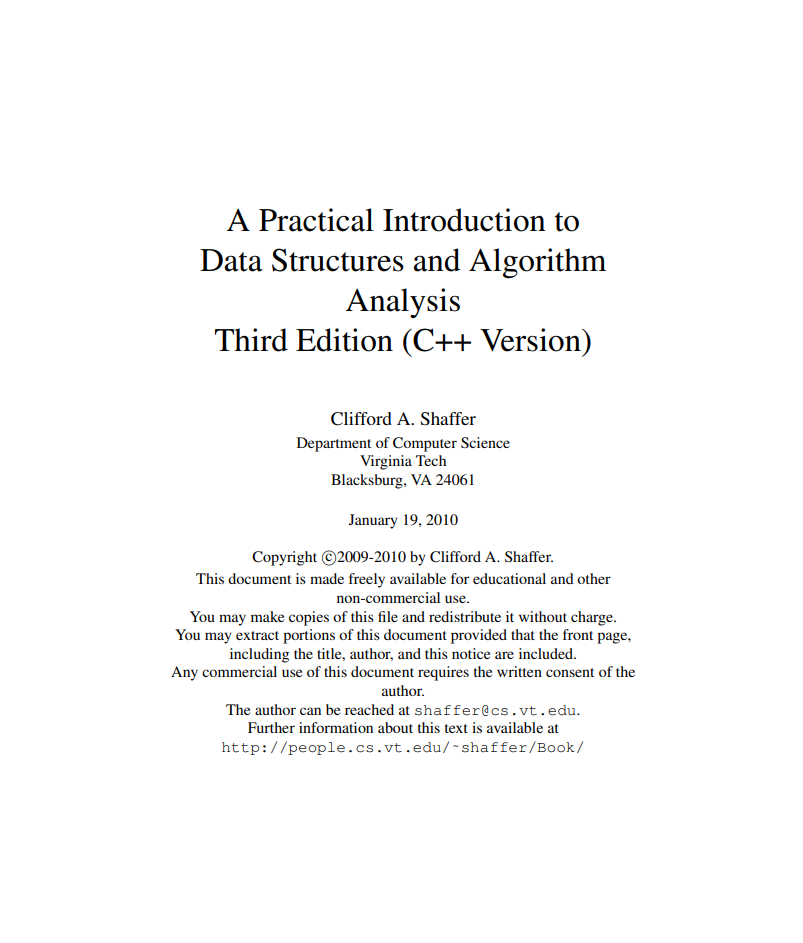
Design & Analysis of Algorithm
| Institution | University |
| Course | BSc. Information Tec... |
| Year | 3rd Year |
| Semester | Unknown |
| Posted By | Jeff Odhiambo |
| File Type | |
| Pages | 638 Pages |
| File Size | 2.03 MB |
| Views | 4679 |
| Downloads | 0 |
| Price: |
Buy Now
 Buy via
whatsapp Buy via
whatsapp
|


Description
We study data structures so that we can learn to write more efficient programs. But
why must programs be efficient when new computers are faster every year? The
reason is that our ambitions grow with our capabilities. Instead of rendering efficiency needs obsolete, the modern revolution in computing power and storage capability merely raises the efficiency stakes as we computerize more complex tasks.
The quest for program efficiency need not and should not conflict with sound
design and clear coding. Creating efficient programs has little to do with “programming tricks” but rather is based on good organization of information and good algorithms. A programmer who has not mastered the basic principles of clear design
is not likely to write efficient programs. Conversely, “software engineering” cannot
be used as an excuse to justify inefficient performance. Generality in design can
and should be achieved without sacrificing performance, but this can only be done
if the designer understands how to measure performance and does so as an integral
part of the design and implementation process. Most computer science curricula
recognize that good programming skills begin with a strong emphasis on fundamental software engineering principles. Then, once a programmer has learned the
principles of clear program design and implementation, the next step is to study the
effects of data organization and algorithms on program efficiency
Below is the document preview.

Employee Health and Safety
Trending!
Employee health and safety
Employee safety
Deal with safety hazards aspects of work
environment that have the potential of causing
immediate and sometimes violent harm or even
death
Examples of safety hazards include:
poorly maintained equipment
Unsafe machinery
Exposure to hazardous chemical
Employees health
Employee health ensures that employees are
physically, emotionally and psychologically
fit to do work
36 Pages
4563 Views
0 Downloads
281.08 KB
Employee Relations Management
Trending!
A continuous relationship between a defined group of employees (represented by a union or association) and an employer.
The relationship includes:
The initial recognition of the rights and responsibilities of
union and management
The negotiations of a written contract concerning wages, hour
and other conditions of employment
and the interpretation and administration of this contract over
its period of coverage.
54 Pages
4823 Views
0 Downloads
623.27 KB
KALA JOINT MAY MOCK 2024; Mathematics PP1 & PP2 Q&A
Trending!
Download a copy of the KALA JOINT MAY MOCK 2024; Mathematics PP1 & PP2 Q&A Question Papers with well coordinated Marking Schemes attached. This is good revision material for your upcoming exams.
46 Pages
5051 Views
0 Downloads
3.48 MB
2920/204 Qualitative methods lecture notes
Trending!
This are lecture on qualitative methods That will cover various topics. Data collection, repestation, measures of dispersion, measures central tendency , regression and correlation, network and time series, financial mathematics
211 Pages
5854 Views
0 Downloads
1021.78 KB
DESIGN OF CABLE FAULT DISTANCE LOCATOR- diploma electrical trade project
Trending!
CABLE FAULT DISTANCE LOCATOR.pdf
30 Pages
5402 Views
0 Downloads
422.54 KB
BIT 2108: Lesson 2 Categories of a network
Trending!
There are no generally accepted criteria to classify the computer networks however, two dimensions are considered more important, which are scale and transmission technology. On the basis of scale, computer networks can be classified into three types local area network (LAN), metropolitan area network (MAN) and wide area network (WAN).
32 Pages
4920 Views
0 Downloads
339.42 KB
BIT 2108: Lesson 5 Networking Hardware.
Trending!
Networking hardware refers to the physical devices required to establish, operate, and maintain computer networks. These devices enable data transfer, communication, and connectivity between systems within a network or across multiple networks
33 Pages
4447 Views
0 Downloads
503.2 KB
BIT 2108: Transmission Media.
Trending!
Transmission media refers to the physical pathways or communication channels through which data, information, or signals travel from one device or system to another.
41 Pages
4716 Views
0 Downloads
308.92 KB
BIT 2108: Access methods.
Trending!
Access methods refer to the techniques and protocols used to retrieve, store, and manipulate data or resources in a computer system or network. These methods determine how users, devices, or applications interact with data or services.
11 Pages
4655 Views
0 Downloads
390.92 KB