Expanding Social Horizons: Socioemotional Development in Middle Childhood
| Institution | Keiser University |
| Course | Pschology |
| Year | 4th Year |
| Semester | Unknown |
| Posted By | Faith Kagwi |
| File Type | |
| Pages | 34 Pages |
| File Size | 174.87 KB |
| Views | 6470 |
| Downloads | 0 |
| Price: |
Buy Now
 Buy via
whatsapp Buy via
whatsapp
|


Description
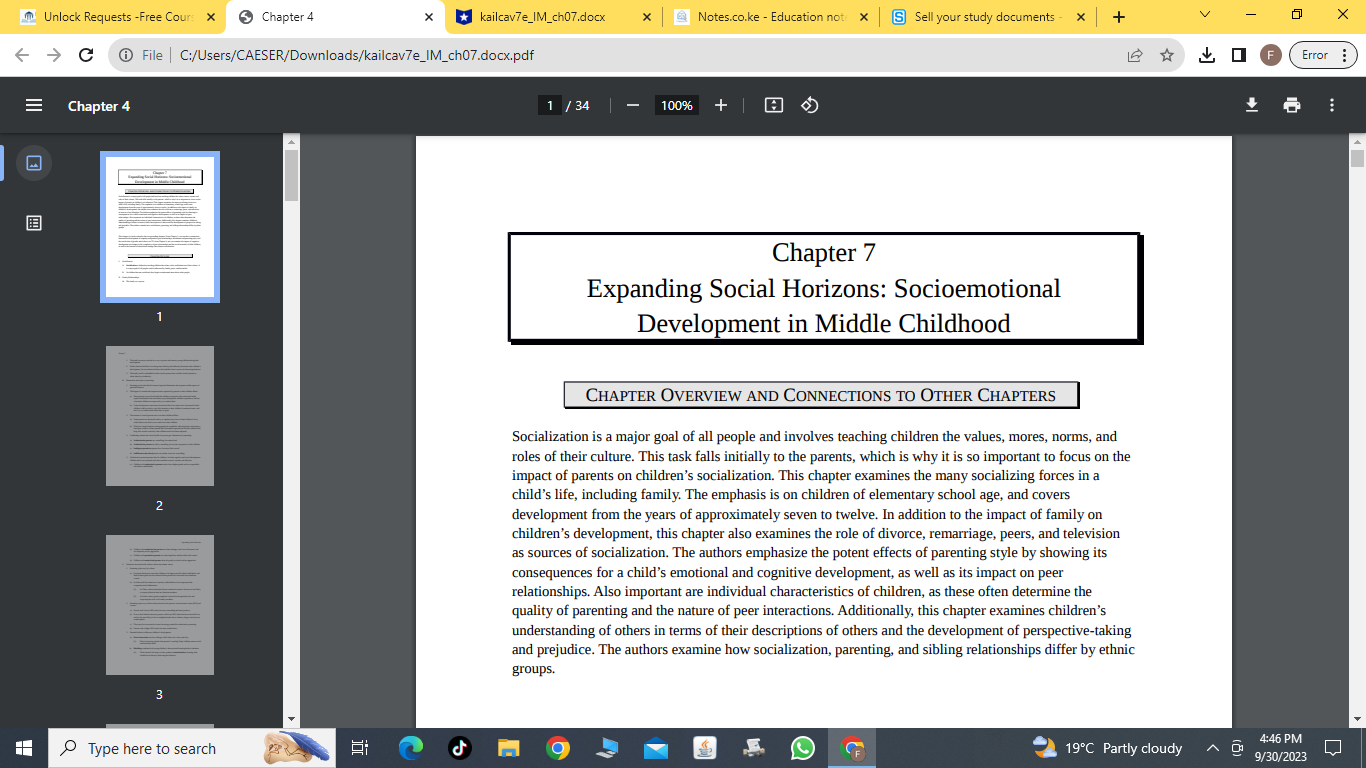
CHAPTER OVERVIEW AND CONNECTIONS TO OTHER CHAPTERS
Socialization is a major goal of all people and involves teaching children the values, mores, norms, and
roles of their culture. This task falls initially to the parents, which is why it is so important to focus on the
impact of parents on children’s socialization. This chapter examines the many socializing forces in a
child’s life, including family. The emphasis is on children of elementary school age, and covers
development from the years of approximately seven to twelve. In addition to the impact of family on
children’s development, this chapter also examines the role of divorce, remarriage, peers, and television
as sources of socialization. The authors emphasize the potent effects of parenting style by showing its
consequences for a child’s emotional and cognitive development, as well as its impact on peer
relationships. Also important are individual characteristics of children, as these often determine the
quality of parenting and the nature of peer interactions. Additionally, this chapter examines children’s
understanding of others in terms of their descriptions of others and the development of perspective-taking
and prejudice. The authors examine how socialization, parenting, and sibling relationships differ by ethnic
groups.
This chapter is closely related to the two preceding chapters. From Chapter 5, you can draw connections
between the development of empathy and positive peer relationships, attachment and parenting style, and
the social roles of gender and violence on TV; from Chapter 6, you can examine the impact of cognitive
development on changes in the complexity of peer relationships and the social networks of older children,
as well as the features of educational settings that enhance socialization.
Below is the document preview.

COMPUTER NETWORKS
A computer network is a connection of two or more computers using transmission media that can either be wired or wireless with a major purpose of sharing resources.
11 Pages
550 Views
0 Downloads
292.33 KB
INTRODUCTION TO DEVELOPMENT STUDIES AND ETHICS
Trending!
Development studies is an interdisciplinary branch of social science. It has grown in popularity as a subject of study since the early 1990s, and has been most widely taught and researched in the third world and in countries with a colonial history, such as the UK, where development studies originated.
8583 Views
1 Downloads
50.17 KB
STRESS MANAGEMENT
Trending!
In this lesson we will learn about stress, various types of stress, causes of stress, stress
hormones and the stress management techniques.
6 Pages
10022 Views
0 Downloads
151.84 KB
INTRODUCTION TO TOTAL QUALITY MANAGEMENT
Trending!
TQM is defined as both philosophy and a set of guiding principles that represent the foundation of continuously improving organisation. It is the application of quantitative methods and human resources to improve all the process within the organisation and exceed customer needs now and in the future.
8040 Views
2 Downloads
132.41 KB
ABA 307: Industrial Psychology Notes
Trending!
Behaviour Change at the Work Place through Motivation Motivation is defined as the process that initiates, guides and maintains goal-oriented behaviors. Motivation is what causes us to act, whether it is getting a glass of water to reduce thirst or reading a book to gain knowledge. It involves the biological, emotional, social and cognitive forces that activate behavior. In everyday usage, the term motivation is frequently used to describe why a person does something. For example, you might say that a student is so motivated to do well in a master’s program that she spends every night studying.
21 Pages
9505 Views
0 Downloads
244.16 KB
PHYSIOLOGY OF CARDIOVASCULAR SYSTEM
Trending!
Download the comprehensive notes on the PHYSIOLOGY OF CARDIOVASCULAR SYSTEM. The slides are ellaborate and precise!
9003 Views
0 Downloads
1.13 MB
HRIM 254: ANALYSIS AND INTERPRETATION OF HEALTH CARE DATA
Trending!
Healthcare data management is the process of storing, protecting, and analyzing data pulled from diverse sources. Managing the wealth of available healthcare data allows health systems to create holistic views of patients, personalize treatments, improve communication, and enhance health outcomes.
9348 Views
1 Downloads
1.18 MB
EEN 100: INTRODUCTION TO ENVIRONMENTAL EDUCATION
Trending!
Environmental education is one of the most effective tools used in solving environmental problems. Other tools include; environmental law, training of environmental manager, like environmentally sensitive community workers, engineers, economists, foresters, game wardens, and policy matters.
9825 Views
2 Downloads
1.95 MB
VIRUSES
Trending!
Viruses are complexes consisting of protein and an RNA or DNA genome.
8866 Views
0 Downloads
1.45 MB
STRUCTURED PROGRAMMING IN C
Trending!
C language was created by Dennis Ritchie at Bell Telephone Laboratories in 1972. It was designed to develop Unix operating systems. The C language is so named because post cedes B language developed by Ken Thompson in the same place (Bell Labs).
12 Pages
8112 Views
0 Downloads
997.36 KB