Expanding Social Horizons: Socioemotional Development in Middle Childhood
| Institution | Keiser University |
| Course | Pschology |
| Year | 4th Year |
| Semester | Unknown |
| Posted By | Faith Kagwi |
| File Type | |
| Pages | 34 Pages |
| File Size | 174.87 KB |
| Views | 6634 |
| Downloads | 0 |
| Price: |
Buy Now
 Buy via
whatsapp Buy via
whatsapp
|


Description
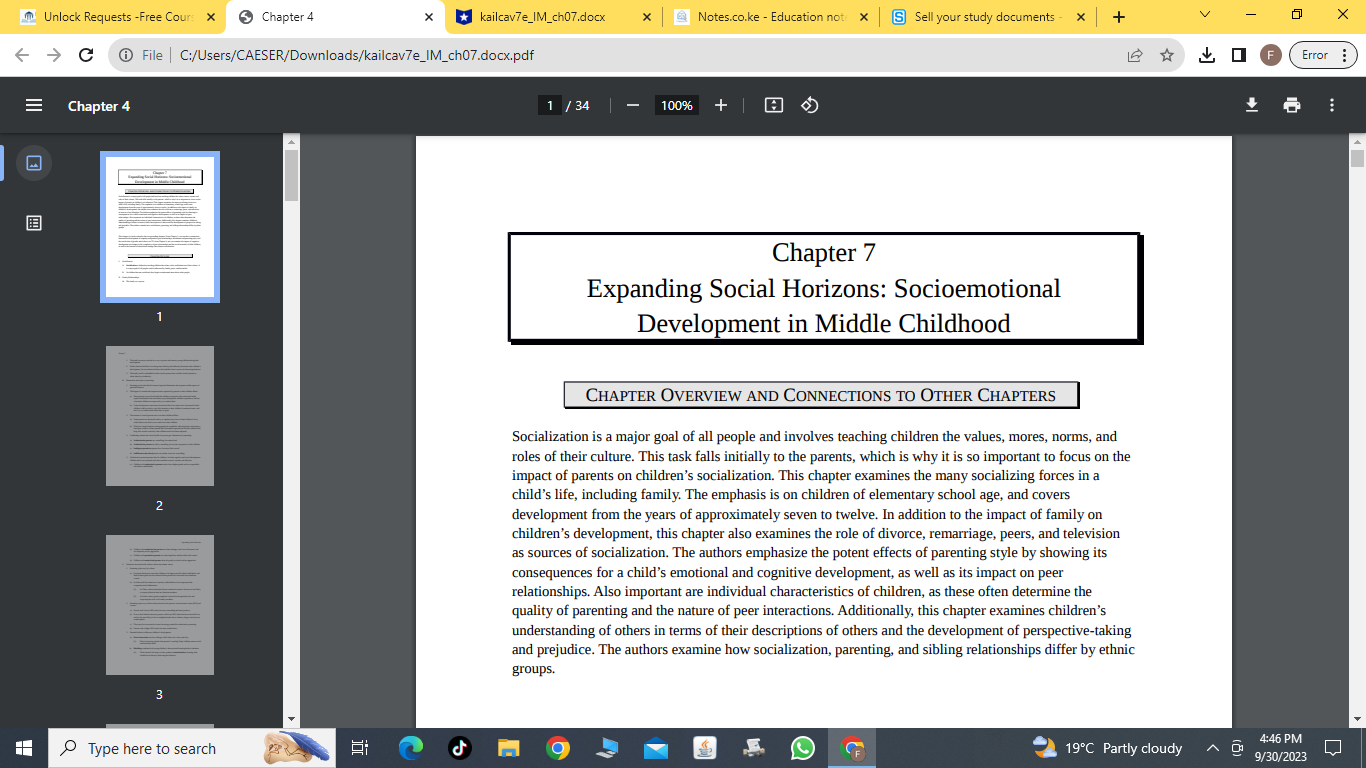
CHAPTER OVERVIEW AND CONNECTIONS TO OTHER CHAPTERS
Socialization is a major goal of all people and involves teaching children the values, mores, norms, and
roles of their culture. This task falls initially to the parents, which is why it is so important to focus on the
impact of parents on children’s socialization. This chapter examines the many socializing forces in a
child’s life, including family. The emphasis is on children of elementary school age, and covers
development from the years of approximately seven to twelve. In addition to the impact of family on
children’s development, this chapter also examines the role of divorce, remarriage, peers, and television
as sources of socialization. The authors emphasize the potent effects of parenting style by showing its
consequences for a child’s emotional and cognitive development, as well as its impact on peer
relationships. Also important are individual characteristics of children, as these often determine the
quality of parenting and the nature of peer interactions. Additionally, this chapter examines children’s
understanding of others in terms of their descriptions of others and the development of perspective-taking
and prejudice. The authors examine how socialization, parenting, and sibling relationships differ by ethnic
groups.
This chapter is closely related to the two preceding chapters. From Chapter 5, you can draw connections
between the development of empathy and positive peer relationships, attachment and parenting style, and
the social roles of gender and violence on TV; from Chapter 6, you can examine the impact of cognitive
development on changes in the complexity of peer relationships and the social networks of older children,
as well as the features of educational settings that enhance socialization.
Below is the document preview.

FUNDAMENTALS OF ICT NOTES
Trending!
ICT - Information Process Computers + Computer Technology Networks. Hardware - is tangible or physical parts of a computer e.g keyboards, mouses, screen, printer. Software - is intangible parts of a computer it refers to instructions that direct computer hardware on what to do.
60 Pages
11820 Views
4 Downloads
804.89 KB
INTEGRATED SCIENCE EXPLAINED NOTES
Trending!
Download a copy of INTEGRATED SCIENCE EXPLAINED. The notes are precise, complete and comprehensive. This will serve you well!
21 Pages
10769 Views
1 Downloads
435.98 KB
Business Studies Grade 7 Term 1 Notes
Trending!
Business refers to any activity that is carried out by an individual or an organization concerned with provision of goods and services with the aim of making profits
15 Pages
9890 Views
0 Downloads
306.62 KB
COST ACCOUNTING NOTES
Introduce students to aspects of cost and management accounting in the creation of
information for management decision making.
211 Pages
801 Views
0 Downloads
2.82 MB
HUMAN RESOURCE MANAGEMENT (HRM) NOTES
Trending!
This chapter introduces the students with the basic concepts of the human resource
management (HRM). HRM is the study of activities regarding people working in an organization.
115 Pages
8532 Views
1 Downloads
363.61 KB
INTERMEDIATE ACCOUNTING NOTES
The conceptual framework of accounting, also called the theoretical framework of
accounting is a coherent system of interrelated objectives and fundamentals that
can lead to consistent standards and that prescribes the nature, function and limits
of financial accounting and financial accounting statements.
97 Pages
1151 Views
0 Downloads
1.13 MB
INTERMEDIATE MICROECONOMIC NOTES
Trending!
Introduction: Meaning and purpose of microeconomic theory, Basic concepts and
mode of analysis, Traditional vs modern microeconomics, The Theory Of Consumer
Behaviour: Consumer Theory, The Budget Constraint, Consumer Preferences,
Utility: The Utility Function, Marginal Utility and Marginal Rate of Substitution,
Revealed Preference Theory, The Slutsky Equation, Production Theory,
Markets: Perfect Competition, Imperfect Competition, Game Theory: Elements of
Game theory, The Payoff matrix of a game, Nash Equilibrium, Secure Strategies,
General Equilibrium, Market Disequilibrium, Production, Distribution of Welfare
163 Pages
5976 Views
0 Downloads
1.03 MB
INTRODUCTION TO FINANCIAL MANAGEMENT NOTES
Trending!
Finance is the art and science of managing money. It is concerned with the processes,
institutions, markets and instruments involved in the generation and transfer
of money among individuals, businesses, and governments.
167 Pages
9248 Views
0 Downloads
624.76 KB
PRINCIPLES OF AUDITING NOTES
Trending!
The explanatory foreword to the ISA International Standards on Auditing describes
audit as the independent examination of an expression of an opinion on the financial
statements of an enterprise by an appointed auditor in pursuance of that appointment
and in compliance with any relevant statutory obligation.
242 Pages
6693 Views
0 Downloads
680.81 KB
PRINCIPLES OF RISK MANAGEMENT AND INSURANCE
Trending!
To introduce students to the concepts of risk management and insurance key elements in business
84 Pages
8126 Views
0 Downloads
1.11 MB