Expanding Social Horizons: Socioemotional Development in Middle Childhood
| Institution | Keiser University |
| Course | Pschology |
| Year | 4th Year |
| Semester | Unknown |
| Posted By | Faith Kagwi |
| File Type | |
| Pages | 34 Pages |
| File Size | 174.87 KB |
| Views | 6642 |
| Downloads | 0 |
| Price: |
Buy Now
 Buy via
whatsapp Buy via
whatsapp
|


Description
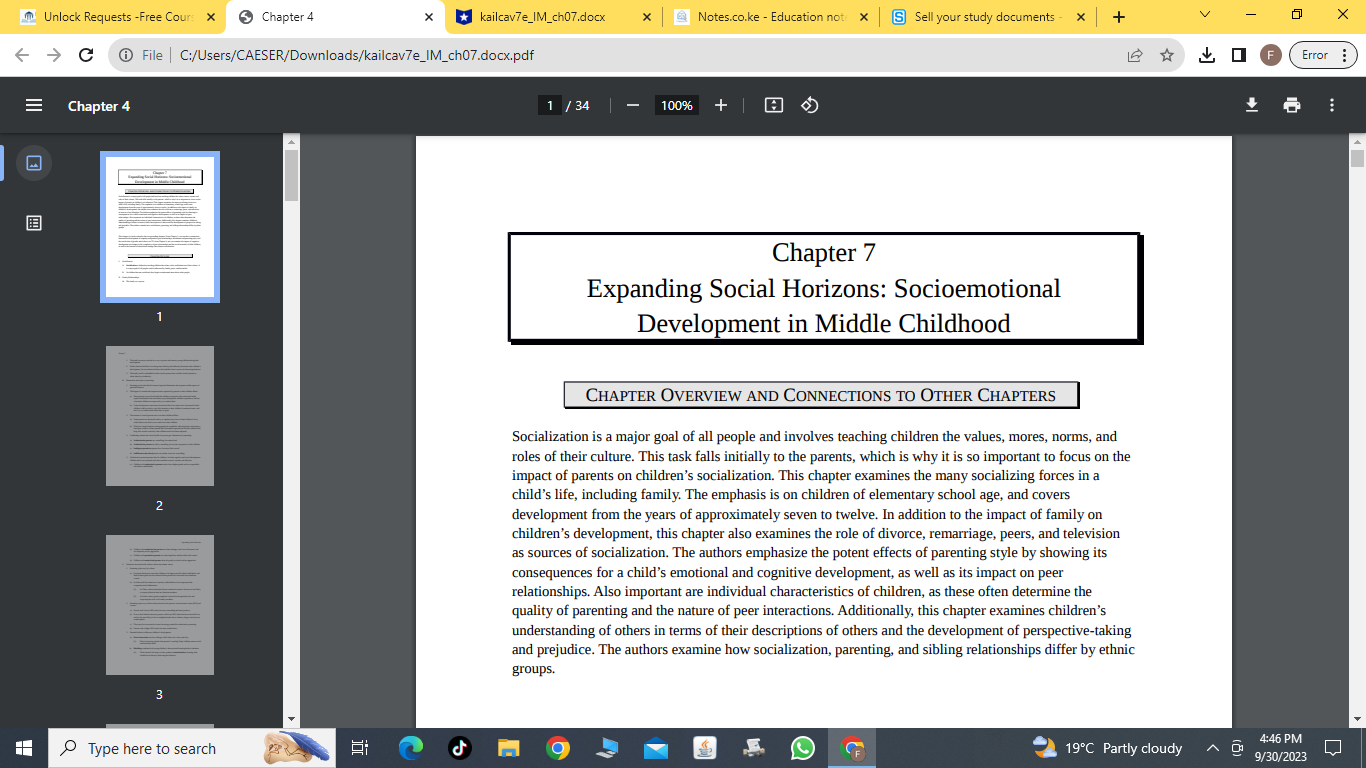
CHAPTER OVERVIEW AND CONNECTIONS TO OTHER CHAPTERS
Socialization is a major goal of all people and involves teaching children the values, mores, norms, and
roles of their culture. This task falls initially to the parents, which is why it is so important to focus on the
impact of parents on children’s socialization. This chapter examines the many socializing forces in a
child’s life, including family. The emphasis is on children of elementary school age, and covers
development from the years of approximately seven to twelve. In addition to the impact of family on
children’s development, this chapter also examines the role of divorce, remarriage, peers, and television
as sources of socialization. The authors emphasize the potent effects of parenting style by showing its
consequences for a child’s emotional and cognitive development, as well as its impact on peer
relationships. Also important are individual characteristics of children, as these often determine the
quality of parenting and the nature of peer interactions. Additionally, this chapter examines children’s
understanding of others in terms of their descriptions of others and the development of perspective-taking
and prejudice. The authors examine how socialization, parenting, and sibling relationships differ by ethnic
groups.
This chapter is closely related to the two preceding chapters. From Chapter 5, you can draw connections
between the development of empathy and positive peer relationships, attachment and parenting style, and
the social roles of gender and violence on TV; from Chapter 6, you can examine the impact of cognitive
development on changes in the complexity of peer relationships and the social networks of older children,
as well as the features of educational settings that enhance socialization.
Below is the document preview.

Power Electronics Notes
Trending!
Power Electronics involves combination of these areas. The function of PE is to process
and control the electrical energy by supplying voltage and current in a form that is
optimally suited to the load.
63 Pages
9168 Views
0 Downloads
9.16 MB
APPLIED BIOLOGY
The word biology is derived from the Greek words /bios/ meaning /life/ and /logos/ meaning /study/ and is defined as the science of life and living organisms. An organism is a living entity consisting of one cell e.g. bacteria, or several cells e.g. animals, plants and fungi.
70 Pages
308 Views
0 Downloads
1.84 MB
MICROBIOLOGY NOTES
Trending!
Capsule - Some species of bacteria have a third protective covering, a capsule made up of polysaccharides (complex carbohydrates). Capsules play a number of roles, but the most important are to keep the bacterium from drying out and to protect it from phagocytosis (engulfing) by larger microorganisms.
103 Pages
2462 Views
1 Downloads
2.16 MB
INTRODUCTION TO SYSTEMS ANALYSIS AND DESIGN THEORY NOTES
Trending!
A system is a set of an orderly grouping of interdependent components linked/put together according to a plan to achieve a specific objective. Examples include, computer system, music system etc.
105 Pages
7429 Views
0 Downloads
1.27 MB
HE/CU/TT/CC/03/6/A: COMMON DISEASES
This unit specifies the competencies required to demonstrate the knowledge of common diseases. It involves identifying the stages of disease development, demonstrating the knowledge of communicable diseases, non-communicable diseases and management of common diseases
14 Pages
1124 Views
4 Downloads
299.77 KB
Occupational health and safety
Trending!
This unit specifies the competencies required to lead the implementation of workplace’s safety and health program, procedures and policies/guidelines
25 Pages
4926 Views
1 Downloads
487.91 KB
HE/CU/TT/CC/04/6/A: PROVISION OF FIRST AID SERVICES
Trending!
This unit specifies the competencies required to provide first aid. It involves providing
cardio- pulmonary resuscitation; managing choking, burns, scalds, trauma, nose bleeding,
cuts, fractures, drowning, poisoning and snake bites. It also involves assisting patients with
existing conditions such as asthma, epilepsy and diabetes
32 Pages
8310 Views
1 Downloads
489.01 KB
ENVIRONMENTAL LITERACY
This unit specifies the competencies required to follow procedures for environmental hazard control, follow procedures for environmental pollution control, comply with workplace sustainable resource use, evaluate current practices in relation to resource usage, develop and adhere to environmental protection principles/strategies/guidelines.
65 Pages
507 Views
0 Downloads
934.71 KB
HE/CU/TT/CC/01/6/A: HUMAN ANATOMY AND PHYSIOLOGY
This unit specifies the competencies required to demonstrate the knowledge of human anatomy and physiology. It involves demonstrating the knowledge of organization of the human body, body fluids and their functions, body tissues; membranes and their functions, body cavities, human skeletal system, major muscles of the body and their functions, body joints, circulatory system, lymphatic system, endocrine system and its functions, nervous system and its function, digestive system and its function, urinary system and its function respiratory system and its function, special senses and their functions, reproductive system and its functions.
80 Pages
1663 Views
2 Downloads
2.69 MB
Community home based care Notes
Trending!
Community home based care is defined as any HIV and related care provided to people in their homes by formal or informal caregivers.
96 Pages
10217 Views
0 Downloads
5.45 MB