Expanding Social Horizons: Socioemotional Development in Middle Childhood
| Institution | Keiser University |
| Course | Pschology |
| Year | 4th Year |
| Semester | Unknown |
| Posted By | Faith Kagwi |
| File Type | |
| Pages | 34 Pages |
| File Size | 174.87 KB |
| Views | 6649 |
| Downloads | 0 |
| Price: |
Buy Now
 Buy via
whatsapp Buy via
whatsapp
|


Description
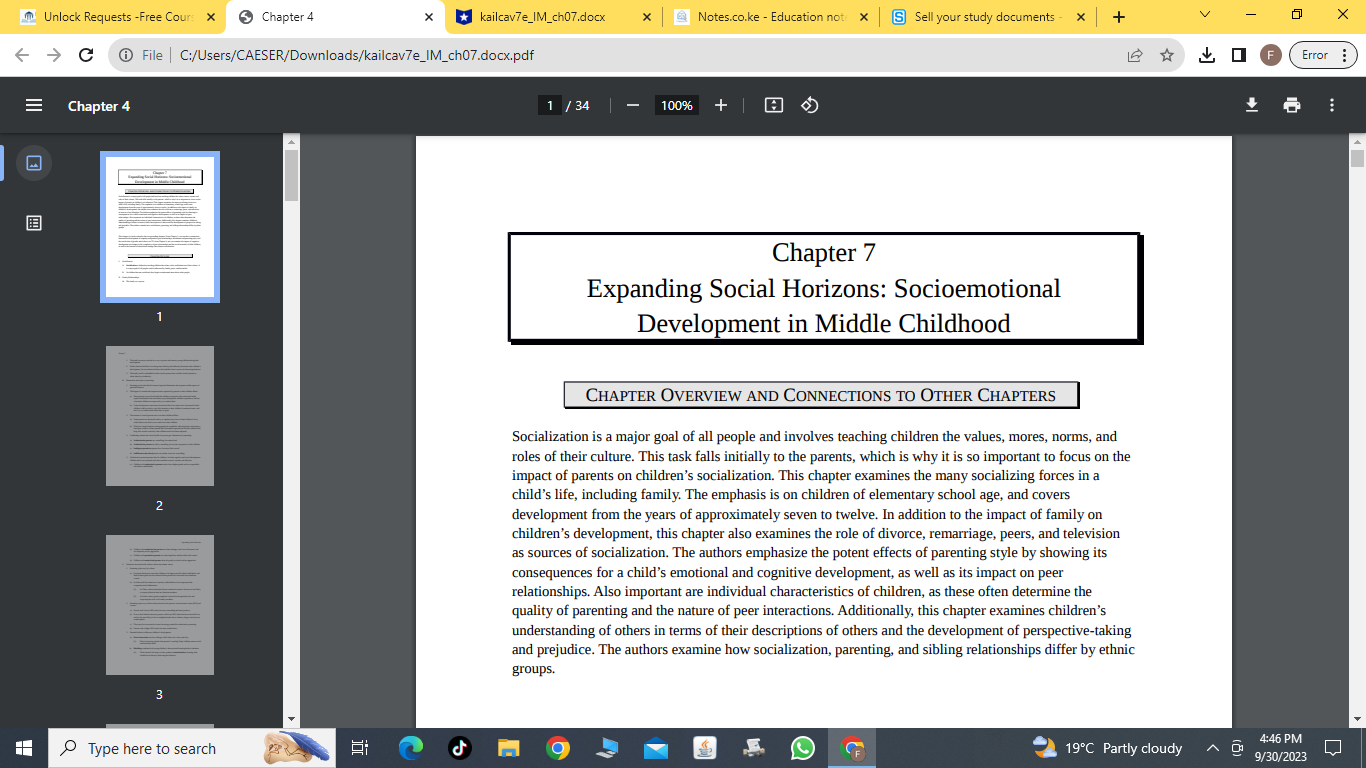
CHAPTER OVERVIEW AND CONNECTIONS TO OTHER CHAPTERS
Socialization is a major goal of all people and involves teaching children the values, mores, norms, and
roles of their culture. This task falls initially to the parents, which is why it is so important to focus on the
impact of parents on children’s socialization. This chapter examines the many socializing forces in a
child’s life, including family. The emphasis is on children of elementary school age, and covers
development from the years of approximately seven to twelve. In addition to the impact of family on
children’s development, this chapter also examines the role of divorce, remarriage, peers, and television
as sources of socialization. The authors emphasize the potent effects of parenting style by showing its
consequences for a child’s emotional and cognitive development, as well as its impact on peer
relationships. Also important are individual characteristics of children, as these often determine the
quality of parenting and the nature of peer interactions. Additionally, this chapter examines children’s
understanding of others in terms of their descriptions of others and the development of perspective-taking
and prejudice. The authors examine how socialization, parenting, and sibling relationships differ by ethnic
groups.
This chapter is closely related to the two preceding chapters. From Chapter 5, you can draw connections
between the development of empathy and positive peer relationships, attachment and parenting style, and
the social roles of gender and violence on TV; from Chapter 6, you can examine the impact of cognitive
development on changes in the complexity of peer relationships and the social networks of older children,
as well as the features of educational settings that enhance socialization.
Below is the document preview.

step by step to file Tax
Trending!
The purpose of this document is to help in filing KRA tax step by step
13 Pages
10275 Views
1 Downloads
938.24 KB
Wedding party invitation template
this is a wedding invitation template to be used to invite people to attend wedding ceremonies
690 Views
1 Downloads
4.45 MB
Wedding card template
This is a flowered wedding card with unique look.
607 Views
0 Downloads
397.06 KB
Wedding card template
This is a wedding invitation card template with quality design.
742 Views
0 Downloads
1.56 MB
Lesson 2 Computer Animation - Character Animation
Trending!
• Character Animation
• Posture representation
• Hierarchical structure of the body
Character animation is a specialized area of the animation process, which involves bringing animated characters to life. The role of a Character Animator
is analogous to that of a film or stage actor, and character animators are often
said to be "actors with a pencil" (or a mouse). Character animators breathe
life in their characters, creating the illusion of thought, emotion and personality. Character animation is often distinguished from creature animation, which
involves bringing photo-realistic animals and creatures to life.
No pages found
9042 Views
7 Downloads
1.14 MB
Lesson 3 Computer Animation - Skeletal Animation
Trending!
Skeletal animation is a technique in computer animation in which a character
is represented in two parts: a surface representation used to draw the character
(called skin or mesh) and a hierarchical set of interconnected bones (called
the skeleton or rig) used to animate (pose and keyframe) the mesh. While
this technique is often used to animate humans or more generally for organic
modeling, it only serves to make the animation process more intuitive and the
same technique can be used to control the deformation of any object — a door,
a spoon, a building, or a galaxy.
This technique is used in virtually all animation systems where simplified
user interfaces allows animators to control often complex algorithms and a huge
amount of geometry; most notably through inverse kinematics and other "goaloriented" techniques. In principle, however, the intention of the technique is never to imitate real anatomy or physical processes, but only to control the deformation of the mesh data.
No pages found
9076 Views
1 Downloads
134.92 KB
Lesson 4 Computer Animation - Joints
Trending!
A joint is a point at which parts of an artificial structure are joined. when
developing animated characters one needs to define the type of joints that will
be used to combine multiple segments of the character e.g hand to shoulder.
this is due to the fact that inorder to create a more realistic monevent of the
character or oblect the siolidity principle must be adhered to and the sence of
overlapping and irregular movements of the character must be avoided,
No pages found
8214 Views
0 Downloads
1.02 MB
Lesson 5 Computer Animation - Skinning
Trending!
Skinning is the process of attaching a renderable skin to an underlying articulated skeleton. There are several approaches to skinning with varying degrees
of realism and complexity. Our main focus will be on the smooth skinning
algorithm, which is both fast and reasonably effective, and has been used extensively in real time and pre-rendered animation. The smooth skinning algorithm
goes by many other names in the literature, such as blended skinning, multimatrix skinning, linear blend skinning, skeletal subspace deformation (SSD),
and sometimes just skinning.
This chapter will explain the smooth skinning algorithm in detail and provide
additional information about the offline creation and binding process. Binding
refers to the initial attachment of the skin to the underlying skeleton and assigning any necessary information to the vertices.
Smooth skinning, while fast and straightforward, does have its limitations,
and so alternative techniques are also briefly introduced and referenced, including a variety of deformation techniques and some more elaborate anatomically
based approaches that simulate muscle and skin deformations
No pages found
9413 Views
0 Downloads
223.91 KB
Lesson 6 Computer Animation - KeyFrame Animation
Trending!
Generalized coordinates
In analytical mechanics, specifically the study of the rigid body dynamics of
multibody systems, the term generalized coordinates refers to the parameters
that describe the configuration of the system relative to some reference configuration. Example is a vector to specify the posture of the body
q=(q1 ,q2 ,q3 ,q4 ,q5 , q6 , q7 ,... ,qn)
Usually, the first three numbers: location of the root the next three numbers:
orientation of root The rest: the joint angles of the body
No pages found
7139 Views
0 Downloads
122.79 KB
Lesson 7 Computer Animation - Facial Animation
Trending!
Facial Anination deals with the simulation of the different facial expresions a
character can make. Inorder to simulate conversation, visible emotional expressions(e.g Saddness, Happines), we need to understand the different mechanisims
and muscle structures that the face uses to accurately represent the emotion /
visemes. generally the facial expressions and visemes in animation relies on
three different appoaches:
• Muscle-based models
• Capture real human data
• Expression Cloning
No pages found
6884 Views
1 Downloads
2.36 MB