Expanding Social Horizons: Socioemotional Development in Middle Childhood
| Institution | Keiser University |
| Course | Pschology |
| Year | 4th Year |
| Semester | Unknown |
| Posted By | Faith Kagwi |
| File Type | |
| Pages | 34 Pages |
| File Size | 174.87 KB |
| Views | 6658 |
| Downloads | 0 |
| Price: |
Buy Now
 Buy via
whatsapp Buy via
whatsapp
|


Description
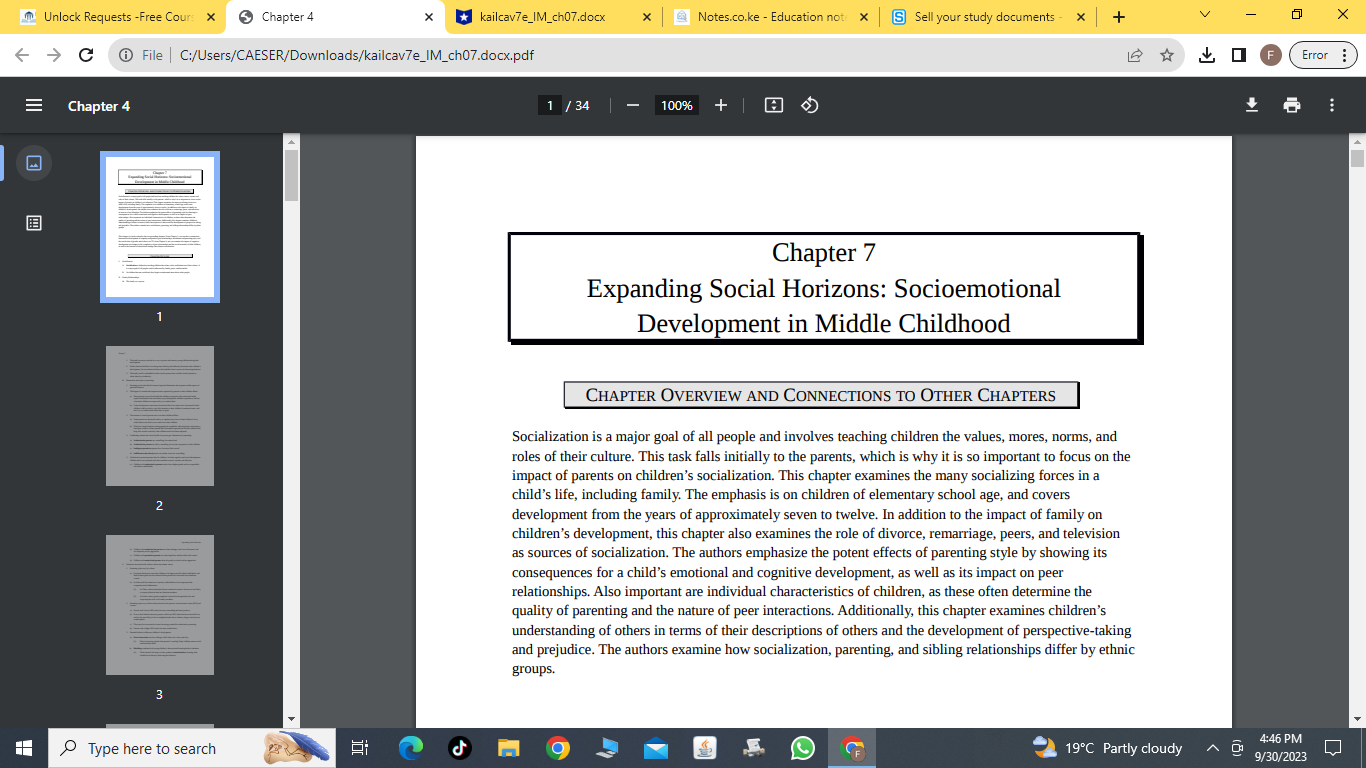
CHAPTER OVERVIEW AND CONNECTIONS TO OTHER CHAPTERS
Socialization is a major goal of all people and involves teaching children the values, mores, norms, and
roles of their culture. This task falls initially to the parents, which is why it is so important to focus on the
impact of parents on children’s socialization. This chapter examines the many socializing forces in a
child’s life, including family. The emphasis is on children of elementary school age, and covers
development from the years of approximately seven to twelve. In addition to the impact of family on
children’s development, this chapter also examines the role of divorce, remarriage, peers, and television
as sources of socialization. The authors emphasize the potent effects of parenting style by showing its
consequences for a child’s emotional and cognitive development, as well as its impact on peer
relationships. Also important are individual characteristics of children, as these often determine the
quality of parenting and the nature of peer interactions. Additionally, this chapter examines children’s
understanding of others in terms of their descriptions of others and the development of perspective-taking
and prejudice. The authors examine how socialization, parenting, and sibling relationships differ by ethnic
groups.
This chapter is closely related to the two preceding chapters. From Chapter 5, you can draw connections
between the development of empathy and positive peer relationships, attachment and parenting style, and
the social roles of gender and violence on TV; from Chapter 6, you can examine the impact of cognitive
development on changes in the complexity of peer relationships and the social networks of older children,
as well as the features of educational settings that enhance socialization.
Below is the document preview.

Entrepreneurship: Concept and Functions
Trending!
An entrepreneur is a person who starts an enterprise and converts a situation into opportunity. He/she searches for change and responds to it. A number of definitions have been given of an entrepreneur. The economists view him/her as the fourth factor of production, along with land labour and capital.
275 Pages
9127 Views
0 Downloads
4.22 MB
Introduction to Project Management
Project in general refers to a new endeavor with specific objective and varies so widely that it is very difficult to precisely define it. Some of the commonly quoted definitions are as follows. Project is a temporary endeavor undertaken to create a unique product or service or result.
72 Pages
1900 Views
0 Downloads
866.69 KB
MBM 2223: Community Development Notes
Trending!
Community development helps to build community capacity in order to address issues and take advantage of opportunities, find common ground and balance competing interests. It doesn’t just happen capacity building requires both a conscious and a conscientious effort to do something (or many things) to improve the community.
51 Pages
7154 Views
1 Downloads
447.49 KB
GEOREFERENCING AND DIGITIZATION
Trending!
The participants of this training should have knowledge on creating working folders for data storage, navigating through the working folders to get and store data working with Qgis tools and basic skills of navigating GIS data on Qgis.
19 Pages
9021 Views
0 Downloads
4.74 MB
MBM 3323: PROJECT PLANNING AND MANAGEMENT
Trending!
This course provides the basics for trainees by introducing essential project management concepts and methods. The trainees will learn how to identify project components, organize them effectively and control the project from the earliest steps of developing the project charter through the final steps of a project-documentation and execution.
25 Pages
9399 Views
0 Downloads
1.07 MB
BM 404: PROJECT MANAGEMENT
Trending!
Project Management is the dynamic process utilizing the appropriate resources of the
organization in a controlled and structured manner, employed to achieve a change clearly defined with specific objectives identified as strategic needs.
103 Pages
8241 Views
1 Downloads
601.29 KB
The Law of Contract Notes
Trending!
A contract is a legally binding agreement between two or more parties.
15 Pages
8776 Views
0 Downloads
442.35 KB
Oxygen Sag Analysis
Trending!
Oxygen sag or the oxygen sag curve refers to the reduction in dissolved oxygen plotted over a distance along a water body from a point at which sewage or other pollutants have been discharged. The phenomenon of oxygen sag is usually related to the release of organic pollutants or nutrient elements, which promote the growth of oxygen-consuming microorganisms.
6 Pages
9842 Views
0 Downloads
977.92 KB
QGIS TRAINING MANUAL
Trending!
(GIS) refers to a computer-based tool for mapping and analyzing geographic
phenomenon that exist, and events that occur on Earth. GIS technology integrates
common database operations such as query and statistical analysis with the unique
visualization and geographic analysis benefits offered by maps.
106 Pages
9750 Views
0 Downloads
3.35 MB
Specialized Treatment Processes
Trending!
It is in this course where the trainee should familiarise themselves with specialised treatment processes such as water softening, iron and manganese removal, colour odour and taste removal, fluoridation, defluoridation and desalination processes.
20 Pages
8450 Views
0 Downloads
508.8 KB