Expanding Social Horizons: Socioemotional Development in Middle Childhood
| Institution | Keiser University |
| Course | Pschology |
| Year | 4th Year |
| Semester | Unknown |
| Posted By | Faith Kagwi |
| File Type | |
| Pages | 34 Pages |
| File Size | 174.87 KB |
| Views | 6666 |
| Downloads | 0 |
| Price: |
Buy Now
 Buy via
whatsapp Buy via
whatsapp
|


Description
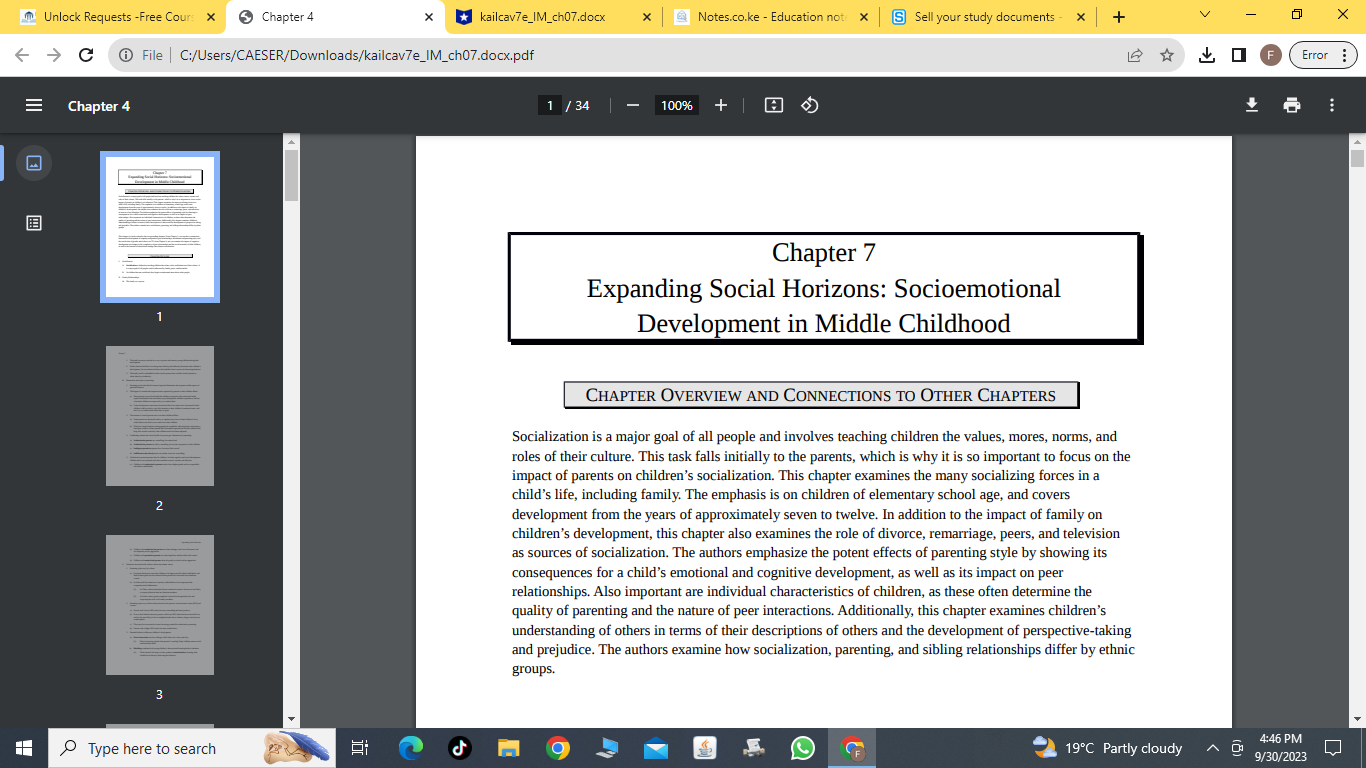
CHAPTER OVERVIEW AND CONNECTIONS TO OTHER CHAPTERS
Socialization is a major goal of all people and involves teaching children the values, mores, norms, and
roles of their culture. This task falls initially to the parents, which is why it is so important to focus on the
impact of parents on children’s socialization. This chapter examines the many socializing forces in a
child’s life, including family. The emphasis is on children of elementary school age, and covers
development from the years of approximately seven to twelve. In addition to the impact of family on
children’s development, this chapter also examines the role of divorce, remarriage, peers, and television
as sources of socialization. The authors emphasize the potent effects of parenting style by showing its
consequences for a child’s emotional and cognitive development, as well as its impact on peer
relationships. Also important are individual characteristics of children, as these often determine the
quality of parenting and the nature of peer interactions. Additionally, this chapter examines children’s
understanding of others in terms of their descriptions of others and the development of perspective-taking
and prejudice. The authors examine how socialization, parenting, and sibling relationships differ by ethnic
groups.
This chapter is closely related to the two preceding chapters. From Chapter 5, you can draw connections
between the development of empathy and positive peer relationships, attachment and parenting style, and
the social roles of gender and violence on TV; from Chapter 6, you can examine the impact of cognitive
development on changes in the complexity of peer relationships and the social networks of older children,
as well as the features of educational settings that enhance socialization.
Below is the document preview.

APP 201: POLITICAL THEORY
This is a second year, first semester course that focuses on political theories that political science is grounded. The module aims at exposing you to different concepts, theories and ideologies. It will help you understand the difference between political theory and political science, evaluate the theories used in political inquiry, comprehend the concepts state, power and authority and differentiate the different political ideologies.
36 Pages
335 Views
0 Downloads
1012.65 KB
APP 201: POLITICAL THEORY
This is a second year, first semester course that focuses on political theories that political science is grounded. The module aims at exposing you to different concepts, theories and ideologies. It will help you understand the difference between political theory and political science, evaluate the theories used in political inquiry, comprehend the concepts state, power and authority and differentiate the different political ideologies.
36 Pages
433 Views
0 Downloads
1012.65 KB
CILS 2101: COMMUNICATION AND INFORMATION LITERACY SKILLS
Communication refers to the conveying of ideas from the mind of one person to the
mind of another which takes place between two or more people, (Harding, 1985 ).
Simply put, it implies that when a person has some idea, they can easily transfer
this idea as it is, to another person’s mind or other people’s minds with no difficulty.
159 Pages
1729 Views
0 Downloads
2.24 MB
ECO 213: INTERMEDIATE MICROECONOMICS
Trending!
The purpose of intermediate microeconomic theory is to provide an adequate exposition of the basic concepts and techniques of microeconomic analysis. The consumer and producer theory and the theory of markets will be treated mathematically and diagrammatically. Further, pure aspects of general equilibrium theory and welfare economics will be covered.
59 Pages
8759 Views
0 Downloads
1.78 MB
GEO 222: SPATIAL ORGANIZATION
Trending!
Spatial organization refers to the arrangement of physical and human objects on the Earth's surface. In this course, we look at how the environment is arranged, how the environment affects man, how man adapts to the environment, how culture is developed and finally how man can conserve the environment.
38 Pages
7518 Views
0 Downloads
777.93 KB
LECTURE 5: MARKET STRUCTURES
Trending!
Market structure refers to the nature and degree of competition in the market for goods and services. The structures of market both for goods market and service (factor) market are determined by the nature of competition prevailing in a particular market.
13 Pages
6582 Views
1 Downloads
191.87 KB
GEO 221: PHYSICAL GEOGRAPHY
Trending!
The rocks that make up Earth’s mantle are mostly silicates a wide variety of compounds that share a silicon and oxygen structure. Common silicates found in the mantle include olivine, garnet, and pyroxene. The other major type of rock found in the mantle is magnesium oxide. Other mantle elements include iron, aluminum, calcium, sodium, and potassium.
49 Pages
5921 Views
0 Downloads
1.3 MB
THEORY OF DEMAND NOTES
Trending!
The purpose of the theory of demand is to determine the various factors that affect
demand of a commodity. That is, the establishment of the law of demand that states that the market demand is negatively related to the price.
53 Pages
6915 Views
0 Downloads
663.65 KB
ABA 404 TOPIC 1: NATURE AND SCOPE OF MANAGEMENT ACCOUNTING
Trending!
Accounting is the process of identifying measuring and communicating economic information to permit informed judgments and decisions by users of information.
It is therefore concerned with providing information that will help decision makers make good decisions.
6 Pages
8615 Views
0 Downloads
349.38 KB
ABA 404 TOPIC 2: DECISION MAKING THEORY
Trending!
Planning involves making choices between alternatives and is primarily a decision-making activity. The final two stages represent the control process, which is the process of measuring and correcting actual performance to ensure that the alternatives that are chosen and the plans for implementing them are carried out. Let us now consider each of the elements of the decision-making and control process.
10 Pages
6079 Views
0 Downloads
574.23 KB