Expanding Social Horizons: Socioemotional Development in Middle Childhood
| Institution | Keiser University |
| Course | Pschology |
| Year | 4th Year |
| Semester | Unknown |
| Posted By | Faith Kagwi |
| File Type | |
| Pages | 34 Pages |
| File Size | 174.87 KB |
| Views | 6700 |
| Downloads | 0 |
| Price: |
Buy Now
 Buy via
whatsapp Buy via
whatsapp
|


Description
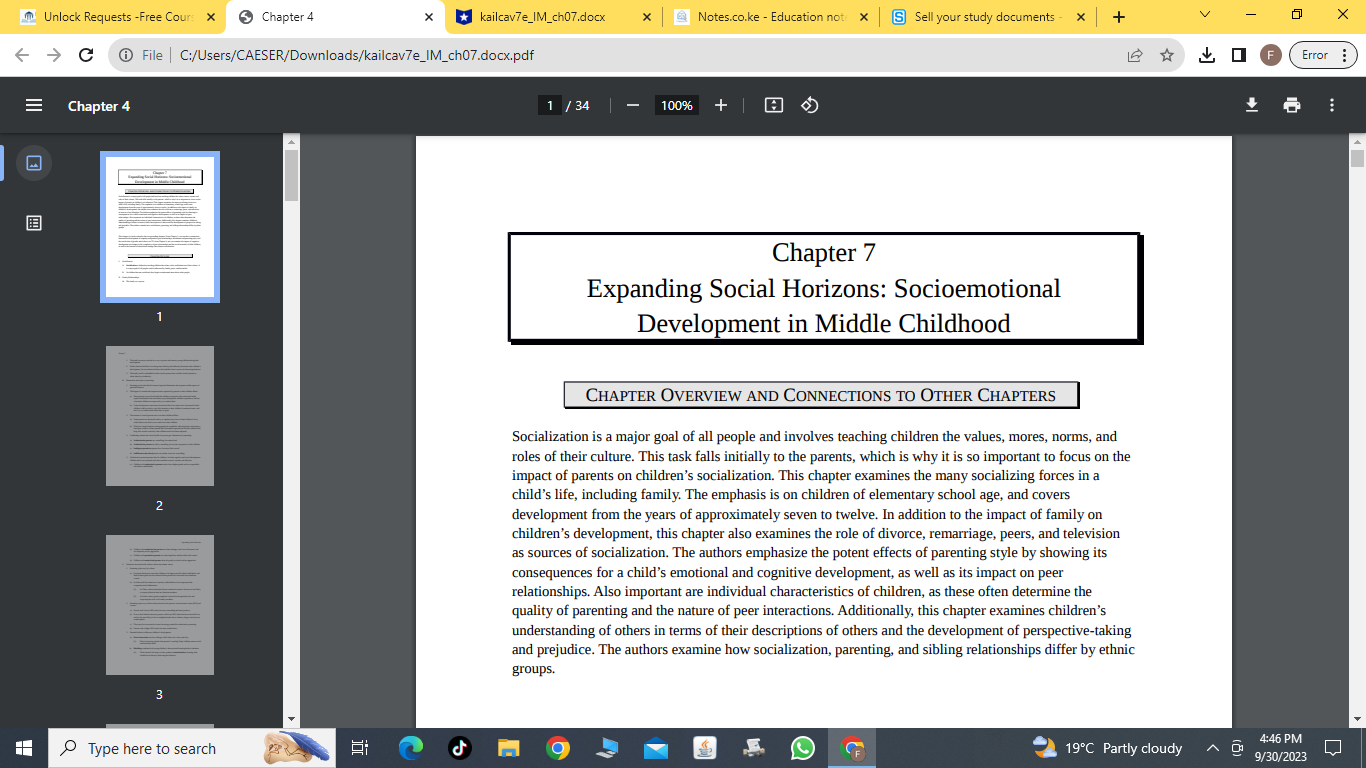
CHAPTER OVERVIEW AND CONNECTIONS TO OTHER CHAPTERS
Socialization is a major goal of all people and involves teaching children the values, mores, norms, and
roles of their culture. This task falls initially to the parents, which is why it is so important to focus on the
impact of parents on children’s socialization. This chapter examines the many socializing forces in a
child’s life, including family. The emphasis is on children of elementary school age, and covers
development from the years of approximately seven to twelve. In addition to the impact of family on
children’s development, this chapter also examines the role of divorce, remarriage, peers, and television
as sources of socialization. The authors emphasize the potent effects of parenting style by showing its
consequences for a child’s emotional and cognitive development, as well as its impact on peer
relationships. Also important are individual characteristics of children, as these often determine the
quality of parenting and the nature of peer interactions. Additionally, this chapter examines children’s
understanding of others in terms of their descriptions of others and the development of perspective-taking
and prejudice. The authors examine how socialization, parenting, and sibling relationships differ by ethnic
groups.
This chapter is closely related to the two preceding chapters. From Chapter 5, you can draw connections
between the development of empathy and positive peer relationships, attachment and parenting style, and
the social roles of gender and violence on TV; from Chapter 6, you can examine the impact of cognitive
development on changes in the complexity of peer relationships and the social networks of older children,
as well as the features of educational settings that enhance socialization.
Below is the document preview.

DIAGNOSTIC AND STATISTICAL MANUAL OF MENTAL DISORDERS
Trending!
Before each disorder name, ICD-9-CM codes are provided, followed by ICD-IO-CM codes in parentheses. Blank lines indicate that either the ICD-9-CM or the ICD-IO-CM code is not applicable. For some disorders, the code can be indicated only according to the subtype or
specifier.
970 Pages
7683 Views
0 Downloads
30.48 MB
ECT 202: INSTRUCTIONAL METHODS IN EDUCATION
Trending!
This module aims at giving you a good perspective of what teaching means and how to
effectively perform the teaching task. The module tackles each related topic in teacher
education in a systematic and logically sequenced order. Its focus is to make the teacher
effective in disseminating information, skills, values and attitudes to his learners.
13 Pages
8703 Views
0 Downloads
328.05 KB
ASC 103: SOCIAL STRUCTURE OF AFRICAN SOCIETIES
Trending!
The discipline of sociology is founded on a trinity of three main pillars: social structure,
social research methods and social theory.
You may like to think of the discipline of sociology as a traditional African stool that
stands on three legs: socialstructure, social research methods and social theory.
Having been introduced to the discipline of sociology last semester, this course
exposes you to the first pillar: social structure. As you go on with your courses in
sociology you will encounter the other two pillars: social research methods and social
theory
162 Pages
3309 Views
1 Downloads
4.7 MB
AGE 300: AIR PHOTO INTERPRATATION ANDFIELD COURSE
Trending!
The word photography was coined in 1839 from the Greek terms 'phos' for light and graphs meaning to write or draw or record. photography is therefore nothing more than graphic recording of light energy of different intensities. the scope of photography is now understood to include all processes that are used to record the action of radiant energy on different forms of matter.
112 Pages
6875 Views
0 Downloads
3.57 MB
ASC 100: INTRODUCTION TO SOCIOLOGY
Trending!
This is a
very exciting course which many social science scholars have termed as the Queen Mother of
all social sciences. Many people not schooled in sociology liken it to socialization which is
incorrect. Socialization is a small part of sociology and shall be covered in due course. In this
course all sociological concepts will be introduced to you. This is an interactive instructional
module that uses both action and collaborative learning styles that provide you with diverse
online learning experiences and effective learning processes. The key purpose of this module
is to expose you basic sociological concepts and knowledge enough to illuminate your interest in social sciences and particularly sociology. The intention is to equip you with the
necessary intellectual infrastructure to analyze societal structures and processes with the aim of creating and furthering positive reform
103 Pages
4301 Views
0 Downloads
3.23 MB
UCI 204: Relational database management systems
Trending!
It contains all the notes related to database and database management systems.
10086 Views
1 Downloads
1.28 MB
LESSON 8: MUTUALLY EXCLUSIVE AND EXHAUSTIVE EVENTS; AND PROBABILITY
Trending!
In this lesson we will discuss mutually exclusive and exhaustive events, and also
probability.
8 Pages
8928 Views
0 Downloads
132.5 KB
LESSON 5: MOMENTS
Trending!
Moments are popularly used to describe the characteristics of a distribution and are measured about a point.
9 Pages
6423 Views
0 Downloads
198.8 KB
LESSON 4: MEASURES OF DISPERSION
Trending!
The measures of central tendency are not sufficient measures to reveal the shape of the distribution of data set. The measures that show the spread of a data set are called the measures of dispersion. The main measures of dispersion are range, inter quartile range, standard deviation, variance and coefficient of variation. In this lesson we will discuss these measures of dispersion.
9 Pages
7551 Views
0 Downloads
210.71 KB
LESSON 1: DEFINITION OF STATISTICS, DATA COLLECTION AND DATA PRESENTATION TECHNIQUES
Trending!
Statistics is the science of data. This involves collecting, classifying, summarizing,
organizing, analyzing, and interpreting numerical information.
7 Pages
9977 Views
0 Downloads
152.45 KB