Expanding Social Horizons: Socioemotional Development in Middle Childhood
| Institution | Keiser University |
| Course | Pschology |
| Year | 4th Year |
| Semester | Unknown |
| Posted By | Faith Kagwi |
| File Type | |
| Pages | 34 Pages |
| File Size | 174.87 KB |
| Views | 6714 |
| Downloads | 0 |
| Price: |
Buy Now
 Buy via
whatsapp Buy via
whatsapp
|


Description
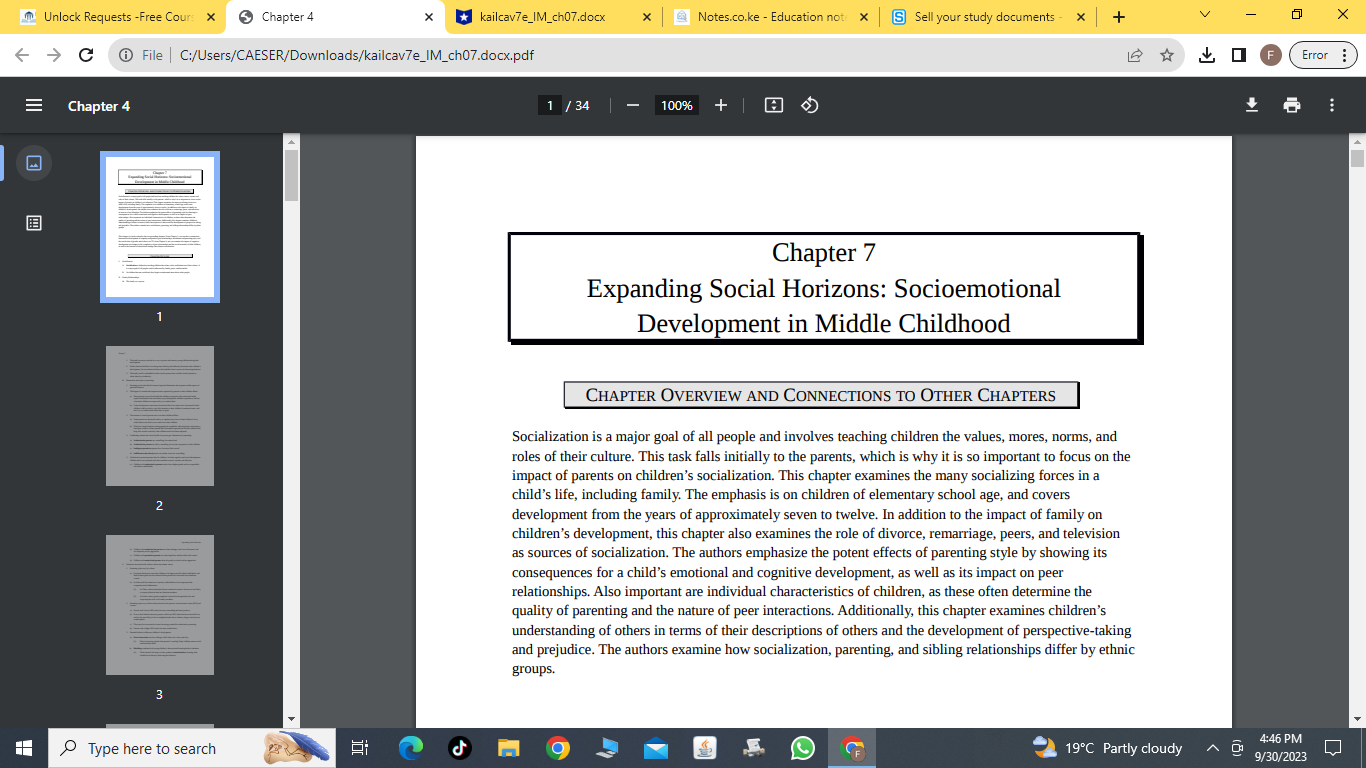
CHAPTER OVERVIEW AND CONNECTIONS TO OTHER CHAPTERS
Socialization is a major goal of all people and involves teaching children the values, mores, norms, and
roles of their culture. This task falls initially to the parents, which is why it is so important to focus on the
impact of parents on children’s socialization. This chapter examines the many socializing forces in a
child’s life, including family. The emphasis is on children of elementary school age, and covers
development from the years of approximately seven to twelve. In addition to the impact of family on
children’s development, this chapter also examines the role of divorce, remarriage, peers, and television
as sources of socialization. The authors emphasize the potent effects of parenting style by showing its
consequences for a child’s emotional and cognitive development, as well as its impact on peer
relationships. Also important are individual characteristics of children, as these often determine the
quality of parenting and the nature of peer interactions. Additionally, this chapter examines children’s
understanding of others in terms of their descriptions of others and the development of perspective-taking
and prejudice. The authors examine how socialization, parenting, and sibling relationships differ by ethnic
groups.
This chapter is closely related to the two preceding chapters. From Chapter 5, you can draw connections
between the development of empathy and positive peer relationships, attachment and parenting style, and
the social roles of gender and violence on TV; from Chapter 6, you can examine the impact of cognitive
development on changes in the complexity of peer relationships and the social networks of older children,
as well as the features of educational settings that enhance socialization.
Below is the document preview.

GENERAL STUDIES FOR THE ARTISAN
Trending!
The basis of any family is the couple i.e. a man and a woman who are united by marital bond or by marriage. Marriage is the marital union of man and woman by virtue of living together in undivided partnership.
36 Pages
8760 Views
10 Downloads
546.25 KB
INTRODUCTION TO COMMUNICATION
communication is the giving, receiving, or exchange of information, opinions or ideas by writing, speech or visual means or a combination of the three so that the material communicated is completely understood by everyone concerned.
68 Pages
463 Views
0 Downloads
1.04 MB
Public Relations
Public relations describes the various methods a company uses to disseminate messages about its products, services, or overall image to its customers, employees,
stockholders, suppliers, or other interested members of the community. The point of
public relations is to make the public think favorably about the company and its
offerings. Commonly used tools of public relations include news releases, press
conferences, speaking engagements, and community service programs.
31 Pages
585 Views
0 Downloads
1.13 MB
ACCOMMODATION OPERATIONS MANAGEMENT II
Trending!
This course unit is intended to equip the trainee with knowledge skills and attitude to enable him/her work efficiently in catering and accommodation establishment.
22 Pages
10439 Views
0 Downloads
283.62 KB
HOUSEKEEPING
Housekeeping is defined as the provision of a clean comfortable and safe environment. It can also be defined as that section in a hotel, hospital or hostel that is involved with ensuring high standards of hygiene.
168 Pages
620 Views
1 Downloads
1.48 MB
EMPLOYEES’ RECORDS
Trending!
Personnel records are documents and files relating to the human resources of an
organization and includes or contains information on manpower planning, recruitment and selection, training, compensation, appraisal etc.
9 Pages
8262 Views
0 Downloads
461.21 KB
FRONT OFFICE OPERATIONS KNEC NOTES
Trending!
Front office: Marketing, sales, and service departments that come in direct contact with the customers, and liaise with the back-office (administrative) departments to maintain a two way flow of information.
19 Pages
12671 Views
7 Downloads
313.45 KB
BUSINESS PLAN FORMAT
Trending!
You are expected to write the business plan in the order in which it is presented to you. Do not interchange chapters or rearrange the sub-topics within chapters.
14 Pages
10565 Views
0 Downloads
791.98 KB
APS 301: HUMAN LEARNING
Trending!
So, a baby beginning to walk, a guy taking guitar lessons so he play well enough to impress
girls, a single mom taking real estate classes to get her real estate license and switch careers, a
kid figuring out how to advance to the next level on a video game without resorting to cheat
codes, a grandfather regaining lost function in a hand after a stroke, all of these reflect types of learning. These types of learning aren't all the same, don't all use the same psychological
processes or require the same parts of the brain, but they're still learning according to our
definition.
94 Pages
7394 Views
0 Downloads
1.02 MB
APS 321: ENVIRONMENTAL PSYCHOLOGY
Trending!
Environmental psychology is an interdisciplinary field focused on the interplay between human’s actions or behaviors and their surroundings. The field defines the term environment broadly, encompassing natural environments, social settings, built environments, learning environments and informational environment
30 Pages
2142 Views
0 Downloads
1.21 MB