Expanding Social Horizons: Socioemotional Development in Middle Childhood
| Institution | Keiser University |
| Course | Pschology |
| Year | 4th Year |
| Semester | Unknown |
| Posted By | Faith Kagwi |
| File Type | |
| Pages | 34 Pages |
| File Size | 174.87 KB |
| Views | 6719 |
| Downloads | 0 |
| Price: |
Buy Now
 Buy via
whatsapp Buy via
whatsapp
|


Description
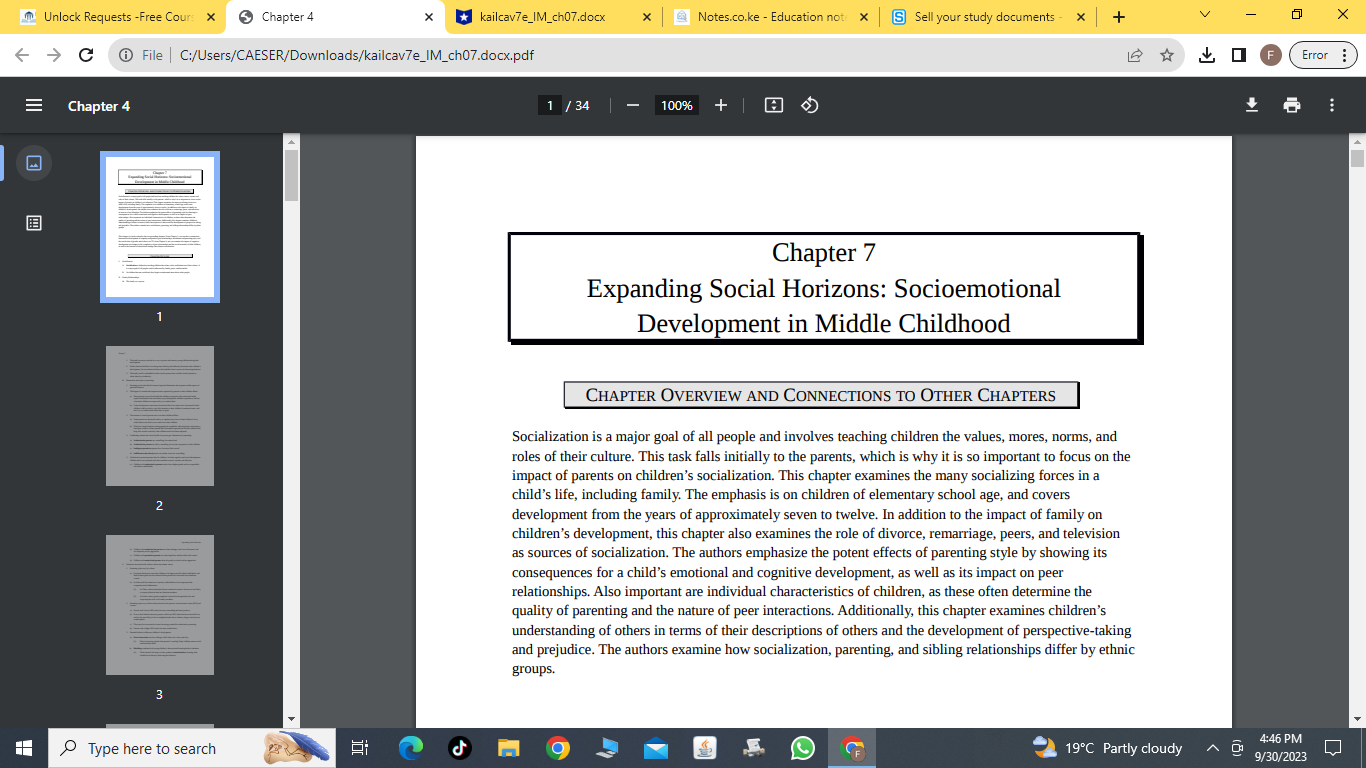
CHAPTER OVERVIEW AND CONNECTIONS TO OTHER CHAPTERS
Socialization is a major goal of all people and involves teaching children the values, mores, norms, and
roles of their culture. This task falls initially to the parents, which is why it is so important to focus on the
impact of parents on children’s socialization. This chapter examines the many socializing forces in a
child’s life, including family. The emphasis is on children of elementary school age, and covers
development from the years of approximately seven to twelve. In addition to the impact of family on
children’s development, this chapter also examines the role of divorce, remarriage, peers, and television
as sources of socialization. The authors emphasize the potent effects of parenting style by showing its
consequences for a child’s emotional and cognitive development, as well as its impact on peer
relationships. Also important are individual characteristics of children, as these often determine the
quality of parenting and the nature of peer interactions. Additionally, this chapter examines children’s
understanding of others in terms of their descriptions of others and the development of perspective-taking
and prejudice. The authors examine how socialization, parenting, and sibling relationships differ by ethnic
groups.
This chapter is closely related to the two preceding chapters. From Chapter 5, you can draw connections
between the development of empathy and positive peer relationships, attachment and parenting style, and
the social roles of gender and violence on TV; from Chapter 6, you can examine the impact of cognitive
development on changes in the complexity of peer relationships and the social networks of older children,
as well as the features of educational settings that enhance socialization.
Below is the document preview.

DDS 101: INTRODUCTION TO DEVELOPEMENT STUDIES
Trending!
Examines the patterns, practices, policies and theories associated with inequalities in world development. The discipline pays particular attention to the relationships between “developed” and “developing” societies.
90 Pages
7816 Views
1 Downloads
1.07 MB
UCI 202: COMPUTER BASED INFROMATION SYSTEM
Trending!
This course presents the fundamental methodology and process for the analysis and design of computer based information system.
59 Pages
8898 Views
0 Downloads
707.18 KB
System Analysis and Design
System is an orderly grouping of interrelated and interdependent components linked together according to a plan to achieve a specific common goal.
32 Pages
365 Views
0 Downloads
327.91 KB
COMPUTER NETWORKS
A computer network, is a collection of computers and other hardware components interconnected by communication channels that allow sharing of resources and information.
14 Pages
502 Views
0 Downloads
904.58 KB
WRITING FOR BROADCAST MEDIA
Trending!
Broadcasting is the passing on or the transmission of messages from a single source, the station, to a heterogeneous audience, spread in different places but found within the range on the Medium of broadcast.
22 Pages
8154 Views
3 Downloads
800.04 KB
Classification of Bacteria
Trending!
In the past they were viewed as an
unusual group of bacteria and named
archaebacteria but since the Archaea
have an independent evolutionary
history and show many differences in
their biochemistry from other forms
of life. They are now classified as a separate
domaIN
34 Pages
7092 Views
0 Downloads
2.87 MB
Introduction to economics
The word economics comes from the Greek word iokonomia where oikos means house and nomos means managing. Adam Smith defines economics as a science that studies the nature and cause of national wealth. Alfred Marshall defines economics as the study of mankind in the ordinary business of life. Lionel Robbins defines economics as science which studies human behaviour as a relationship between ends and scarce means which have alternative uses.
94 Pages
1469 Views
1 Downloads
1.59 MB
Introduction to general Microbiology
Trending!
Microbiology - The science that studies very small living
things Usually requires a magnification tool – the microscope
Some organisms are large though – Helminths – worms
Sub groups of Microbes we will study
57 Pages
7763 Views
2 Downloads
1.93 MB
BIOCHEMISTRY OF MUSCULAR TISSUE
Trending!
Sarcomere
• Is the smallest contractile unit in the myofibril.
• Is the region between 2 neighbouring Z LINES
• is composed of long, fibrous proteins as filaments that slide past
each other when a muscle contracts or relaxes.
• When the myofibril is examined by electron microscopy,
alternating dark and light bands can be observed.
37 Pages
9149 Views
0 Downloads
1.13 MB
OPERATING SYSTEMS
Is a core set of programs that control and supervise the hardware of a computer and provide services to other system software, application software, programmers and users of a computer. It acts as an intermediary between users of computer hardware.
34 Pages
366 Views
0 Downloads
1.02 MB