Expanding Social Horizons: Socioemotional Development in Middle Childhood
| Institution | Keiser University |
| Course | Pschology |
| Year | 4th Year |
| Semester | Unknown |
| Posted By | Faith Kagwi |
| File Type | |
| Pages | 34 Pages |
| File Size | 174.87 KB |
| Views | 6733 |
| Downloads | 0 |
| Price: |
Buy Now
 Buy via
whatsapp Buy via
whatsapp
|


Description
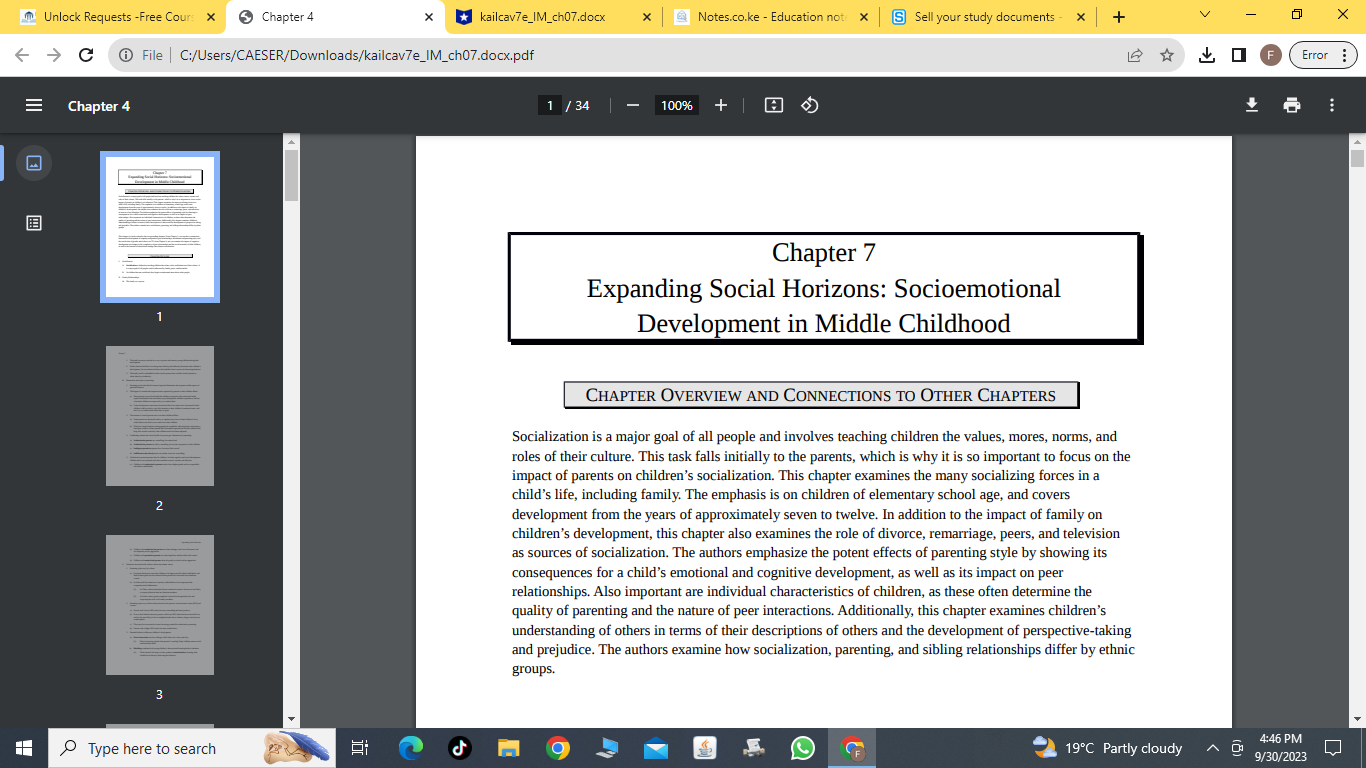
CHAPTER OVERVIEW AND CONNECTIONS TO OTHER CHAPTERS
Socialization is a major goal of all people and involves teaching children the values, mores, norms, and
roles of their culture. This task falls initially to the parents, which is why it is so important to focus on the
impact of parents on children’s socialization. This chapter examines the many socializing forces in a
child’s life, including family. The emphasis is on children of elementary school age, and covers
development from the years of approximately seven to twelve. In addition to the impact of family on
children’s development, this chapter also examines the role of divorce, remarriage, peers, and television
as sources of socialization. The authors emphasize the potent effects of parenting style by showing its
consequences for a child’s emotional and cognitive development, as well as its impact on peer
relationships. Also important are individual characteristics of children, as these often determine the
quality of parenting and the nature of peer interactions. Additionally, this chapter examines children’s
understanding of others in terms of their descriptions of others and the development of perspective-taking
and prejudice. The authors examine how socialization, parenting, and sibling relationships differ by ethnic
groups.
This chapter is closely related to the two preceding chapters. From Chapter 5, you can draw connections
between the development of empathy and positive peer relationships, attachment and parenting style, and
the social roles of gender and violence on TV; from Chapter 6, you can examine the impact of cognitive
development on changes in the complexity of peer relationships and the social networks of older children,
as well as the features of educational settings that enhance socialization.
Below is the document preview.

ESM 104: QUANTITATIVE SKILLS II
Trending!
Record keeping: Ledger, income statement, balance sheet, assets and liabilities, analysis of
simple financial statements; Interest: simple and compound interests, calculation of
discounts and commissions, depreciation, future value of an investment (FV), annuities;
Budgeting: personal and simple budgets, financial projections, simple investment analysis,
cost of capital, working capital expenditure, balance of payments, balance of trade, Gross
national product (GNP), Gross domestic product (GDP); Index numbers; meaning of index number, price relative index, types of index numbers, calculation of index numbers, uses of index numbers; Taxation: purpose, types of taxes, calculation of personal income tax,. Value added tax (VAT), Stock exchange: shares, bond, stock market, share valuation.
55 Pages
9523 Views
9 Downloads
682.79 KB
BAF 4103: Principles of Auditing
Trending!
Auditing is the independent examination of financial information of any entity, whether profit oriented or not, and irrespective of its size or legal form, when such an examination is conducted with a view to expressing an opinion thereon.
95 Pages
8706 Views
0 Downloads
1.27 MB
COMMERCE
Trending!
Commerce is study related to distribution of products from the producer (point of production) to the consumer (point of consumption).
42 Pages
2182 Views
0 Downloads
554.17 KB
BBM2102: INTRODUCTION TO PURCHASING AND SUPPLIES MANAGEMENT
Trending!
The purpose of this course is to introduce students to purchasing and supply management concepts and techniques necessary to perform the purchasing function of an organization.
98 Pages
9164 Views
1 Downloads
1.22 MB
INTERNATIONAL PROCUREMENT
Trending!
The International Marketing Entry Evaluation Process is a five stage process, and its purpose is to gauge which international market or markets offer the best opportunities for our products or services to succeed.
8386 Views
0 Downloads
722.8 KB
SOCIAL POLICY AND ADMINISTRATION
Social policy is an activity that tries to formulate, implement a solution to solve
social problem. The propose of teaching their subject is to equip trainees with
knowledge, skills and attitude to enable them understand know how social
policies are made and administered for one achievement of goal, it also help to
examine organization structure and involve themselves in implementing policy
into programme and access their effectiveness.
21 Pages
1885 Views
2 Downloads
160.22 KB
HOSPITALITY AND TOURISM LAW
Trending!
While the law is indeed complex, certain basic principles and procedures can be established that will minimize a manager’s chances of encountering legal difficulty.
Law affects every aspect of our lives. Law governs our conduct form the cradle to the grave. In fact, the influence of law extends form even before our birth and after our death.
107 Pages
7390 Views
2 Downloads
1.17 MB
CLC 111: Principles and Practice of Communication
Trending!
This course explains the meaning of organizational communication and show its importance in the success of organizations. we also identify and discuss the various types of communications in organizations as well as communication problems in organizations
41 Pages
10613 Views
0 Downloads
11.58 MB
LINEAR ALGEBRA
Trending!
This text is designed to teach the concepts and techniques of basic linear algebra
as a rigorous mathematical subject. Besides computational proficiency, there is an
emphasis on understanding definitions and theorems, as well as reading, understanding and creating proofs. A strictly logical organization, complete and exceedingly
detailed proofs of every theorem, advice on techniques for reading and writing proofs, and a selection of challenging theoretical exercises will slowly provide the novice with the tools and confidence to be able to study other mathematical topics in a
rigorous fashion.
No pages found
2283 Views
0 Downloads
2.34 MB
CPY 101: INTRODUCTION TO PSYCHOLOGY
Trending!
In this lecture the focus will be to learn about the evolution of psychology from a
philosophical discipline to a scientific one. We will find out and learn about different
schools of psychology and the modern perspectives of psychology – different approaches
that modern psychologists use to explain human nature. Psychology has evolved into a
discipline that can be treated from both basic and applied perspective. As a scientific discipline we will learn about modern research methodologies that scientific psychologists use to study human and animal behaviour. The significance of ethical issues will also be
addressed.
110 Pages
8900 Views
6 Downloads
2.53 MB