Expanding Social Horizons: Socioemotional Development in Middle Childhood
| Institution | Keiser University |
| Course | Pschology |
| Year | 4th Year |
| Semester | Unknown |
| Posted By | Faith Kagwi |
| File Type | |
| Pages | 34 Pages |
| File Size | 174.87 KB |
| Views | 6741 |
| Downloads | 0 |
| Price: |
Buy Now
 Buy via
whatsapp Buy via
whatsapp
|


Description
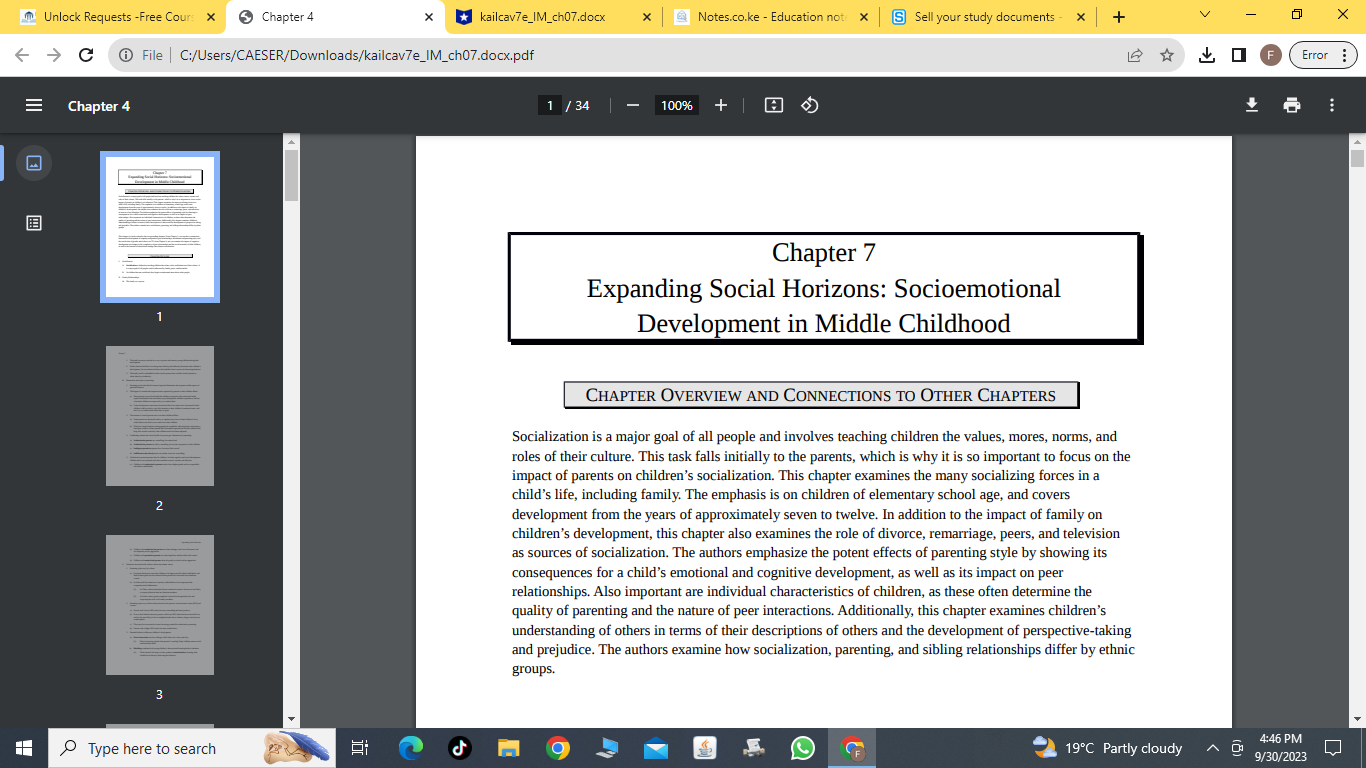
CHAPTER OVERVIEW AND CONNECTIONS TO OTHER CHAPTERS
Socialization is a major goal of all people and involves teaching children the values, mores, norms, and
roles of their culture. This task falls initially to the parents, which is why it is so important to focus on the
impact of parents on children’s socialization. This chapter examines the many socializing forces in a
child’s life, including family. The emphasis is on children of elementary school age, and covers
development from the years of approximately seven to twelve. In addition to the impact of family on
children’s development, this chapter also examines the role of divorce, remarriage, peers, and television
as sources of socialization. The authors emphasize the potent effects of parenting style by showing its
consequences for a child’s emotional and cognitive development, as well as its impact on peer
relationships. Also important are individual characteristics of children, as these often determine the
quality of parenting and the nature of peer interactions. Additionally, this chapter examines children’s
understanding of others in terms of their descriptions of others and the development of perspective-taking
and prejudice. The authors examine how socialization, parenting, and sibling relationships differ by ethnic
groups.
This chapter is closely related to the two preceding chapters. From Chapter 5, you can draw connections
between the development of empathy and positive peer relationships, attachment and parenting style, and
the social roles of gender and violence on TV; from Chapter 6, you can examine the impact of cognitive
development on changes in the complexity of peer relationships and the social networks of older children,
as well as the features of educational settings that enhance socialization.
Below is the document preview.

INTRODUCTION TO SOCIOLOGY
Sociology In other words it is the study of mans behavior in groups or the interactions among human beings, of social relationships and the processes by which human group activity takes place.
9 Pages
1895 Views
0 Downloads
255.72 KB
SOCIALIZATION
Trending!
Through interaction with others, a person gains an identity, develops values and
inspirations and under favorable conditions become able to make full use of his potentials.
32 Pages
7493 Views
0 Downloads
371.51 KB
STONES
Trending!
A building stone may be defined as a sound rock that can be safely used in some situation in the construction as a massive dressed or undressed unit. Stones are derived from the rocks which are naturally occurred as the portion of earth’s crus
17 Pages
7491 Views
0 Downloads
706.8 KB
TIMBER
Timber is a type of wood which has been processed into beams and planks and thus they can be used for building purposes. Finished timber is supplied in standard sizes for the industry.
Timber is used for building houses and making furniture.
26 Pages
1843 Views
0 Downloads
879.83 KB
INTRODUCTION TO COMMUNITY HEALTH
The aim of community health is to generate organized community effort to address public health problems and needs. In order to help the community prevent disease and improve their health, we need to understand how it organises itself as individuals, families and within the larger community.
92 Pages
1676 Views
0 Downloads
1.37 MB
STEEL
Trending!
Steel is one of the most commonly used materials in civil engineering due to its high strength, durability and relatively low cost. It is an alloy of iron and a number of other elements including carbon. Manufacturers produce different types of steel by varying the type and quantity of alloy components, as well as the production process and the manner in which they are worked.
16 Pages
7060 Views
0 Downloads
261.83 KB
PEOPLE WITH SPECIAL NEEDS IN THE COMMUNITY
Trending!
A child in need is one who has been abandoned, orphaned, or one whose parents are incapable of looking after them properly. Such a child needs the best possible alternative arrangements for their care in the absence of the parents.
54 Pages
6684 Views
0 Downloads
1.15 MB
GLASS
Glass, an inorganic solid material that is usually transparent or translucent as well as hard, brittle, and impervious to the natural elements Glass is used in the building industry as insulation material, structural component, external glazing material, cladding material; it is used to make delicate looking fenestrations on facades as well as conventional windows. It is also used as solar power glass and switchable glass projection screens
11 Pages
937 Views
0 Downloads
491.11 KB
COMMUNITY DIAGNOSIS
Community diagnosis is a process through which health workers and community members identify community’s priority health problem, and together make plan of action and implement them.
123 Pages
505 Views
2 Downloads
4.32 MB
Family planning and contraception
Trending!
By the end of this session the trainees will be able to effectively discuss methods of
family planning.
263 Pages
8203 Views
0 Downloads
1.66 MB