EET 301: MACROECONOMIC THEORY III
| Institution | KENYATTA UNIVERSITY |
| Course | ECONOMIC THEORY |
| Year | 1st Year |
| Semester | Unknown |
| Posted By | Brian Mike |
| File Type | |
| Pages | 115 Pages |
| File Size | 1.05 MB |
| Views | 7845 |
| Downloads | 0 |
| Price: |
Buy Now
 Buy via
whatsapp Buy via
whatsapp
|


Description
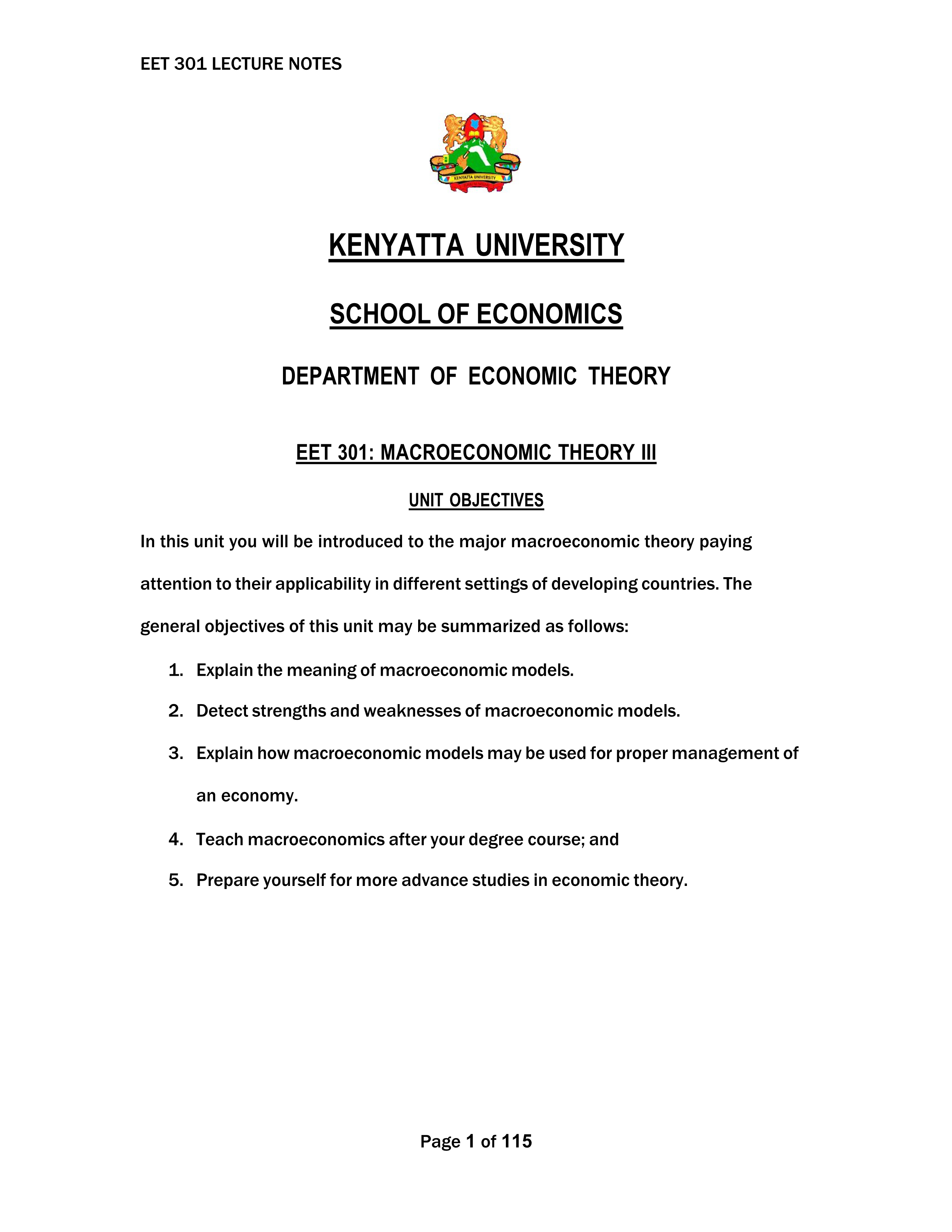
In this unit you will be introduced to the major macroeconomic theory paying
attention to their applicability in different settings of developing countries. The
general objectives of this unit may be summarized as follows: Explain the meaning of macroeconomic models. Detect strengths and weaknesses of macroeconomic models. Explain how macroeconomic models may be used for proper management of
an economy. Teach macroeconomics after your degree course; and Prepare yourself for more advance studies in economic theory.
Below is the document preview.

LESSON 2: MEASURES OF CENTRAL TENDENCY
Trending!
One of main objectives of statistical analysis is to obtain one single value that describes the characteristic of the entire mass of unwieldy data. Such a value is called the central value or average value. In this lesson we will consider some of central values which are commonly used.
8 Pages
7835 Views
0 Downloads
213.46 KB
LESSON 3: MEASURES OF CENTRAL TENDENCY cont..
Trending!
In this lesson we will discuss the other measures of location or measures of central tendency namely, geometric mean, harmonic mean, median and mode of given data.
10 Pages
8709 Views
0 Downloads
246.31 KB
THEORIES OF LANGUAGE ACQUISITION
Trending!
Over the last fifty years, several theories have been put forward to explain the process by which children learn to understand and speak a language. They can be summarised as follows:
4 Pages
9606 Views
0 Downloads
44.66 KB
SZL 105: LABORATORY METHODS AND TECHNIQUES IN ZOOLOGY
Trending!
A laboratory is a closed or isolated environment where scientific experiments and procedures are carried out. Laboratory studies are applied in all areas of science namely. Physics, chemistry,biology, agriculture, health, environment, geology, mining among others.
31 Pages
9975 Views
11 Downloads
681.05 KB
SST 305: Theory of Estimation Notes
Trending!
The objective of statistics is to make an inference about a population based on information contained in a sample. Most statistical inference procedures involve either estimation or hypothesis testing. This course looks at estimation.
41 Pages
7780 Views
7 Downloads
3.41 MB
SMA 335: Ordinary Differential Equation 1
Trending!
The subject of differential equations constitutes a very important and useful branch of
modern m mathematics. In this lesson we sh all consider some definition of ordinary
differential equations.
156 Pages
9217 Views
2 Downloads
2.32 MB
LESSON 7: REGRESSION AND CORRELATION ANALYSIS
Trending!
In this lesson we will discuss regression and correlation. Correlation analysis deals with the association between two or more variables; while regression analysis attempts to establish the nature of the relationship between variables.
11 Pages
7432 Views
1 Downloads
271.03 KB
LESSON 6: SKEWNESS AND KURTOSIS
Trending!
Skewness refers to lack of symmetry. A skewed distribution is a frequency distribution that is asymmetric (not symmetric). When the longer tail of a distribution extends to the right, it is said to be skewed to the right and when the longer tail of a distribution extends to the left, it said to be skewed to the left.
9 Pages
7738 Views
0 Downloads
257.5 KB
TISSUES
Cells are the body's smallest functional units they are grouped together to form tissues, each of which has specialized functions eg blood, muscles
105 Pages
1760 Views
0 Downloads
9.63 MB
DIFFERENTIAL EQUATIONS OF THE FIRST ORDER
Trending!
The order of a differential equation is that of the highest derivative occurring in it; the degree of a differential equation is that to which the derivative of the highest order is raised when the equation is expressed in a rational integral form.
43 Pages
6988 Views
0 Downloads
1 MB